
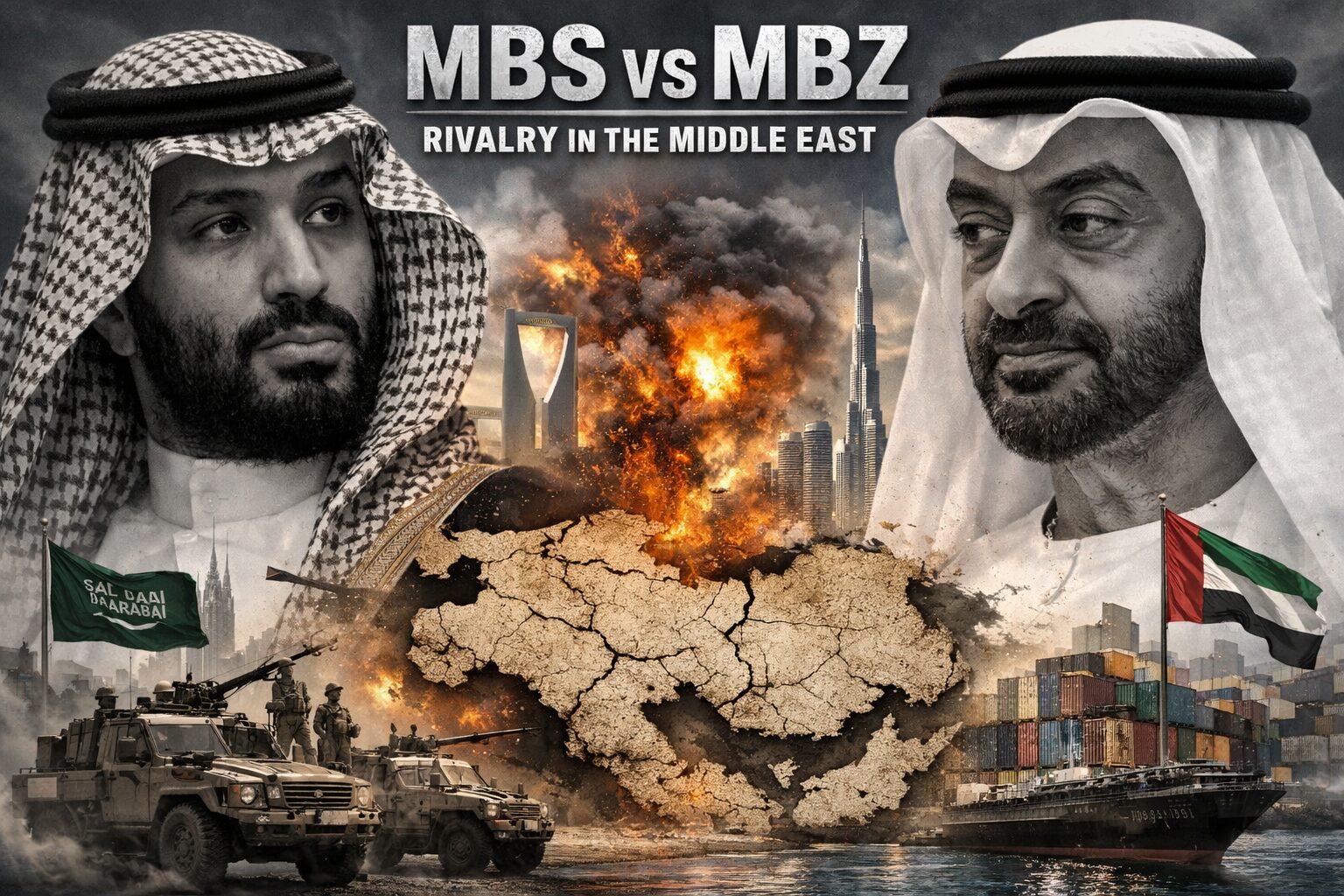
The relationship between Mohammed bin Salman and Mohammed bin Zayed has quietly but decisively entered a new phase marked by real lasting tension rather than tactical disagreement. What is unfolding between Riyadh and Abu Dhabi is no longer a matter of personal style or economic competition alone but a muted confrontation between two visions of regional leadership. This rivalry is fueled by constant comparison, by a widening gap in international recognition, and by a form of strategic jealousy rooted in the fact that the United Arab Emirates have succeeded without noise or spectacle in occupying spaces of influence that Saudi Arabia has long regarded as part of its natural sphere.
For decades the Gulf’s implicit hierarchy appeared stable. Saudi Arabia embodied central power through demography, energy rents and religious authority. The UAE was seen as an efficient, innovative partner useful to regional modernization but structurally secondary. That tacit order began to crack when the Emirates moved beyond the role of commercial hub to become a global strategic actor capable of shaping security, diplomatic, and ideological files far beyond their size. From that point on comparison became uncomfortable for Riyadh.
Mohammed bin Salman’s ascent was defined by acceleration. By rapidly concentrating political security and economic levers he broke with the Kingdom’s traditional collegial governance. This approach delivered immediate control and decisiveness, but it also produced extreme personalization of power and permanent international exposure. Mohammed bin Zayed by contrast built authority over time. His influence emerged through the methodical management of post Arab Spring shocks early neutralization of Islamist movements and the construction of institutions capable of absorbing crises without exposing the apex of the state. This initial divergence created a durable gap in strategic maturity.
Governance styles widened that gap. In Saudi Arabia rapid centralization came with visible coercion mass arrests high profile economic purges and personalized anticorruption campaigns. These measures reinforced immediate authority but weakened internal regulation and entrenched reliance on coercion. In the UAE political control rests more on institutional legal and administrative mechanisms paired with preventive surveillance and discreet balance management. This architecture limits crises compartmentalizes risk and prevents the state from becoming hostage to one man’s decisions.
Human rights have played a decisive role in international perceptions of this divergence. Under Mohammed bin Salman increased use of the death penalty including in political and security related cases mass executions and the imprisonment of activists and dissidents have generated sustained criticism. These practices impose lasting diplomatic costs undermine reform narratives and create structural distrust among Western partners. In the UAE while the system remains authoritarian control is more regulated and less demonstrative. Authorities prioritize prevention administrative neutralization and targeted surveillance without turning capital punishment into a political instrument. This difference reinforces Abu Dhabi’s image as predictable and manageable.
The murder of Jamal Khashoggi marked a point of no return. It crystallized doubts about decision making at the Saudi apex and placed Mohammed bin Salman under constant international scrutiny. Since then Saudi Arabia remains indispensable but every major initiative is filtered through that rupture. Mohammed bin Zayed by enforcing strict discipline in communication delegation and decision making avoided such reputational shocks. In a world where credibility conditions long term partnerships this restraint became a decisive strategic advantage.
Frustration in Riyadh deepened as Vision 2030 sought to reposition Saudi Arabia as the Arab world’s economic cultural and political center while investors diplomats and policymakers continued to see Dubai and Abu Dhabi as more predictable operationally reliable environments. This recognition gap more than material differences fueled growing strategic jealousy. Saudi Arabia takes major political risks and spends heavily yet the Emirates capture disproportionate dividends in image influence and centrality.
Saudi decisions targeting the Emirati model must be read through this lens. Mandating multinational headquarters to relocate to Riyadh is not merely domestic development policy it is an explicit attempt to erode the Emirates’ comparative advantage now viewed as a direct competitor siphoning prestige and flows Riyadh believes should naturally accrue to it. Psychologically this marks a break Abu Dhabi is no longer just an ally but a pole to be contained.
Rivalry now crystallizes across concrete arenas. Economically through competition for regional headquarters financial hubs logistics and capital. Diplomatically in relations with Washington Europe and major Asian powers where the UAE is often perceived as more predictable and disciplined. Ideologically in the fight against political Islam Mohammed bin Zayed has imposed a clear doctrinal and consistent stance against the Muslim Brotherhood across state institutions. Saudi Arabia despite official hostility has adopted a more fluctuating approach accepting tactical alliances when expedient most visibly in Yemen with actors linked to Islah.
Yemen is the clearest revealer. Officially allied Riyadh and Abu Dhabi pursued different objectives. Saudi Arabia prioritized preserving formal state unity and securing its southern border. The UAE focused on controlling strategic points ports maritime routes coastal zones by backing local forces able to guarantee stability particularly in the South. The Southern Transitional Council supported by Abu Dhabi became unavoidable on the ground. For Riyadh the rise of autonomous Emirati backed actors challenged its leadership. Attacks direct or indirect on southern forces can thus be read as political signals as much as military actions meant to reaffirm that final authority cannot bypass Saudi Arabia.
Beyond Yemen the UAE’s global expansion is deeply unsettling for Riyadh. Abu Dhabi now operates politically economically and security wise across the main arteries of strategic globalization ports and logistics in East Africa the Horn the Red Sea and the Mediterranean massive investments in Europe’s energy infrastructure finance and technology sectors defense partnerships and intelligence cooperation with Western and Asian powers and an active humanitarian diplomacy enabling entry into fragile zones where others are rejected. This omnipresence produces a new reality the Emirates are consulted sometimes before Riyadh on files Saudi Arabia considers naturally its own.
This generates profound strategic irritation. From Riyadh’s perspective the UAE enjoys disproportionate influence relative to its size benefiting from regional momentum while avoiding the heaviest political and reputational costs. From Abu Dhabi’s view Saudi activism can appear disorderly risky and destabilizing. This divergence erodes trust and hardens competition.
Today relations remain functional but conditional competitive and under constant watch. Cooperation persists but it is hedged and offset by parallel strategies. Open rupture is unlikely shared interests remain strong but rapid normalization is equally improbable. As long as the UAE continues to expand its global footprint with silent efficiency and Saudi Arabia seeks to reclaim what it views as natural leadership rivalry will remain structural.
What is at stake goes beyond two men. It is a contest over defining regional leadership in the post oil era. Saudi Arabia advances through speed centralization and display the UAE through anticipation networks and cost control. In this mismatch lies the core of today’s tension. And as long as recognition and results diverge the Middle East’s silent recomposition will continue starting at the heart of the Gulf.
Leave a Reply