Author: chiefeditor

  • Full-scale Russian invasion of Ukraine has sown ‘psychological terror’, warns top aid coordinator

    Briefing from Ukrainian capital Kyiv after another night of “air sirens and more loud explosions”, Mr. Schmale noted that the crisis began in 2014, with Russia’s illegal annexation of Crimea. “So, all children that were born since – all children up to the age of 11 – have never experienced their country at peace,” he said.

    According to the UN aid coordination office, OCHA, 2024 saw a 30 per cent increase in civilian casualties compared to 2023. “The humanitarian situation is worsening, especially in frontline areas,” it said in an update, highlighting that a full 36 per cent of Ukraine’s population – 12.7 million people – needs humanitarian aid this year.

    “There are very strong pushes by the armed forces of the Russian Federation along the front line and evacuations are ongoing,” Mr. Schmale explained. “We are supporting people with essential goods, including cash assistance, as they are on the move to transit centres, collective sites and wherever they end up being.”

    Speaking from Zaporizhzhia in southeast Ukraine, Toby Fricker from the UN Children’s Fund (UNICEF) said that more than 2,520 children have been killed or injured since the start of the full-scale Russian invasion.

    “The real number is likely far higher and it’s getting worse”, said Mr. Fricker, chief of communication in Ukraine. “There was a more than 50 per cent increase in child casualties in 2024 compared to 2023 and what we see is no place is safe: schools, maternity wards, children’s hospitals, all have been affected by attacks.”

    Behind battle lines

    Underscoring the essential role played by women in Ukraine “beyond the battlefield”, UN Women Geneva Director Sofia Calltorp explained that “there is another story unfolding, and that is the story of all those women and girls who are bearing the brunt of this war.”

    In 2024, the number of people killed and injured in Ukraine increased by 30 per cent, Ms. Calltorp noted. “Of them, 800 women lost their lives and more than 3,700 women were injured last year in Ukraine. We also know that the vast majority of Ukrainian refugees and displaced persons are women, and 6.7 million women are in need of lifesaving humanitarian assistance.”

    Funding crisis

    Responding to questions about the impact of the US funding freeze on humanitarian work, Ukraine Humanitarian Coordinator Mr. Schmale expressed “hope that US funding will become part of the equation. Last year, it made up 30 per cent of what we spent on the humanitarian side, 10 per cent on the development side.”

    The UN’s top aid official in Ukraine added: “We are of course worried about the funding freezes; as we all know, it’s not the end of the day yet, there are a lot of discussions going on. We have some of our partners, including within the UN, that have received some exemptions from the general freeze of funding, but so far, no money has been flowing as a result of those exemptions.”

    In addition to repeated attacks on energy infrastructure across Ukraine, other public facilities have also been targeted, with 780 health centres and more than 1,600 schools damaged or destroyed, according to the UN World Health Organization (WHO).

    “In Odessa this week we saw a health clinic providing care for 40,000 children and a kindergarten serving 250 of the youngest children were severely damaged in an attack,” said Dr Jarno Harbicht, WHO Country Representative for Ukraine. “When a children’s hospital is hit, a school shelled or electric grid destroyed, children suffer even when they survive.”

    Haunted by drones

    The mental stress faced by millions of Ukrainians because of the war is real and debilitating, the WHO official continued: “Imagine a young mother in Kharkiv region in Ukraine, her days interrupted by air raid sirens and her nights haunted by drones. Each day is a struggle balancing her children’s safety with their anxiety that has become her constant companion.”

    The UN Human Rights Monitoring Mission (HRMMU) has confirmed the killing of more than 12,654 civilian men, women, girls, and boys since the full-scale Russian invasion on 24 February 2022, with nearly 30,000 injured. Eighty-four per cent of the casualties happened in territory controlled by the Ukrainian government and 16 per cent in territory occupied by Russia.

    “Three years of full-scale conflict in Ukraine have wrought persistent and escalating human rights violations and breaches of international humanitarian law,” said Danielle Bell, Chief of HRMMU. “As the civilian toll grows heavier, the human rights of all those affected must remain at the forefront of  any negotiations for sustainable peace.”

    Rising toll

    The UN Human Rights Monitoring Mission (HRMMU) has confirmed the killing of more than 12,654 civilian men, women, girls, and boys since the full-scale Russian invasion on 24 February 2022, with nearly 30,000 injured. Eighty-four per cent of the casualties happened in territory controlled by the Ukrainian government and 16 per cent in territory occupied by Russia.

    “Three years of full-scale conflict in Ukraine have wrought persistent and escalating human rights violations and breaches of international humanitarian law,” said Danielle Bell, Chief of HRMMU. “As the civilian toll grows heavier, the human rights of all those affected must remain at the forefront of  any negotiations for sustainable peace.”

    Source link

  • Media advisory – Agriculture and Fisheries Council of 24 February 2025

    Main agenda items, approximate timing, public sessions and press opportunities.

    Source link

  • The European Union working towards litter-free coastal communities

    The growing amount of litter reaching our oceans is one of the most significant forms of marine pollution, posing threats to both marine ecosystems and human health.

    As litter enters the marine environment from land and rivers, and gets to the sea basins of different countries, it turns into a transboundary issue. Therefore, to be addressed effectively, it requires a transnational action involving policy makers and local authorities, researchers, the industry, Non-Governmental Organisations, and civil society.

    Being aware of the challenges of marine litter, in the last 15 years several EU funding programmes have addressed marine litter under different perspectives. The outcome is a wide range of EU research projects and associated results.

    This important legacy has led to new knowledge and guidance in the form of scientific publications and technical reports, online information products, interfaces and apps for data management, monitoring and modelling tools, protocols and technologies, case studies and awareness materials.

    EU projects joining forces on marine litter

    The Task Force on Healthy ocean and resilient coasts (Pillar IV) of the Atlantic Action Plan of the European Commission, and the Interreg Atlantic Area project Free LitterAT have launched a collaborative framework to address this issue.

    The objective is to engage key EU projects that had delivered or plan to deliver tangible outcomes to help coastal communities and stakeholders to prevent and/or reduce marine litter for litter-free coastal communities. 

    The full list of projects that joined the initiative can be found at the end of the news.

    Marine litter-free toolkit 

    As a first product of this collaborative initiative, they developed a Free Litter Toolkit  to facilitate the access to key projects and associated resources, while also fostering networking and result clustering activities.

    The toolkit includes references to selected projects and associated resources that are expected to become solutions to achieve litter-free coastal communities. 

    To produce the toolkit, European project repositories, databases and related literature were consulted. Selected projects were also approached to join the initiative and to support the identification of their results.   

    The resources selected cover tangible results such as guidelines and methodologies, good practices, manuals, procedures, prototype technology, lifecycle studies, ready-to-work tools and technologies, software, apps, training and communication materials. It also includes scientific publications in the following thematic areas: 

    • Waste management and recycling
    • Prevention of litter entrance from sources (e.g. rivers)
    • Applicable detection, monitoring and modelling approaches
    • Marine litter removal and collection (abandoned, lost or other discarded fishing gear, Fishing for Litter schemes, coast and beach clean-up)
    • Awareness raising

    The Toolkit does not assume to be comprehensive in terms of capturing the huge universe of projects dealing with marine litter. However, it showcases a significant sample of key projects that can contribute to litter-free coastal communities with their outcomes.

    Although the action is promoted in the framework of the Atlantic Action Plan, the scope of the collaboration is not limited to this geographical area. It has the vocation to be applicable to other sea basins too. 

    Free Litter Toolkit 

    Future actions 

    A wide dissemination plan for the toolkit will be implemented with the involvement of the participating EU projects and the support of the Atlantic Action Plan Pillar IV taskforce. The key goal is to reach as many potential end users involved in promoting litter free communities as possible. 

    The organisation of joint actions (workshops, pilot actions, training activities), and the possibility of clustering the results of the projects will be explored. 

    Background – PILLAR IV of the Atlantic Action Plan

    The Atlantic Maritime Strategy, adopted by the European Commission in 2011, was created in response to calls from stakeholders for a more ambitious, open and effective cooperation in the Atlantic Ocean Area. The first Atlantic Action Plan (2013-2020) was updated by the Action Plan 2.0, released in 2020, and aims to unlock the potential of the blue economy in the Atlantic Area while preserving marine ecosystems and contributing to climate change adaptation and mitigation.

    The implementation of the Atlantic Action Plan is supported by the Sea Basins Assistance Mechanism funded under the European Maritime, Fisheries and Aquaculture Fund.

    The Action Plan has the ambition to achieve seven goals under the four thematic pillars listed below through concrete actions mobilising all relevant Atlantic stakeholders. 

    • Pillar I: Ports as gateways and hubs for the blue economy 
    • Pillar II: Blue skills of the future and ocean literacy
    • Pillar III: Marine renewable energy 
    • Pillar IV: Healthy ocean and resilient coasts

    These pillars are interconnected and trans-regional by nature. They address key challenges and aim to foster sustainable blue growth and contribute to greater territorial cooperation in the EU Atlantic area. In practical terms, each Pillar is supported by a task force of representatives of the four Atlantic countries. Each taskforce is chaired by a Pillar Coordinator with every country being responsible for one pillar and nominating its coordinator. 

    The Pillar IV addresses the context of vulnerability of the European Atlantic Ocean and its coastal areas, which are exposed to several human activities.

    The Pillar focuses on two specific goals (fig I): Goal 6 “Stronger coastal resilience” and Goal 7 “The fight against marine pollution”, the latter one including a set of concrete actions, most of them addressed to tackle marine litter.

    Further information can be found in the Pillar IV infographic.
     

    Projects involved in the toolkit

    AQUA-LIT ‘Preventing measures for averting the discarding of litter in the marine environment from the aquaculture industry’

    https://aqua-lit.eu/

    CAPonLITTER‘Capitalising good coastal practices and improving policies to prevent marine litter’

    https://www.interregeurope.eu/caponlitter

    CIRCNETS ‘Blue Circular Nets’

    https://www.interreg-npa.eu/projects/circnets/home

    CleanAtlantic ‘Tackling Marine Litter in the Atlantic Area’

    http://www.cleanatlantic.eu

    CRoCuS ‘Cleaner Rivers – Cleaner Seas’

    http://earthforever.org/en/p22.html

    EUROqCHARM‘EUROpean quality Controlled Harmonization Assuring Reproducible Monitoring and assessment of plastic pollution’

    https://www.euroqcharm.eu/en/

    Free LitterAT ‘Advancing towards litter-free Atlantic coastal communities by preventing and reducing macro and micro litter’

    http://www.freelitterat.eu

    GoJelly ‘GoJelly – A gelatinous solution to plastic pollution’

    https://gojelly.eu/

    INdIGO ‘Innovative fishing Gear for Ocean’

    https://indigo-interregproject.eu/

    INSPIRE ‘Innovative Solutions for Plastic Free European Rivers’

    https://inspire-europe.org/

    INTEMARES Artes Perdidos ‘INTEMARES – Lost Fishing Gear’

    www.artesperdidos.es

    INTEMARES Caladeros Limpios ‘INTEMARES – Clean Fishing Grounds’

    https://www.miteco.gob.es/eu/costas/temas/proteccion-medio-marino/basuras-marinas/basura-acciones.html

    LIFE LEMA ‘Intelligent marine litter removal and management for local authorities’

    https://www.azti.es/proyectos/life-lema/

    MAELSTROM ‘Smart technology for Marine Litter Sustainable Removal and Management’

    https://www.maelstrom-h2020.eu/

    MARELITT Baltic ‘Reducing the impact of marine litter in the form of Derelict Fishing Gear (DFG) on the Baltic Sea environment’

    https://www.marelittbaltic.eu/

    Mo.Ri.net ‘Monitoring, census, removal and recycling of ghost nets: fishermen as key players in the safeguard of the sea’

    https://www.isprambiente.gov.it/en/projects/sea/mo-ri-net-project

    NETTAG ‘NetTag – Preventing marine litter from fisheries’

    https://nettag.ciimar.up.pt/

    NETTAG+ ‘Preventing, avoiding and mitigating environmental impacts of fishing gears and associated marine litter’

    https://nettagplus.eu/

    Oceanwise ‘Wise reduction of EPS marine litter in the North-East Atlantic Ocean’

    https://www.oceanwise-project.eu/

    Plastic Pirates ‘Upscaling the Plastic Pirates citizen science initiative across Europe’

    https://www.plastic-pirates.eu/en

    REMEDIESCo-creating strong uptake of REMEDIES for the future of our oceans through deploying plastic litter valorisation and prevention pathways’

    https://remedies-for-ocean.eu/

    SEACLEAR ‘SEarch, identificAtion and Collection of marine Litter with Autonomous Robots’

    https://seaclear-project.eu/

    SEACLEAR 2.0 Scalable full-cycle marine litter remediation in the Mediterranean: Robotic and Participatory solutions’

    https://www.seaclear2.eu/

    SEARCULAR ‘Circular solutions for fishing gears’

    https://searcular.eu/

    TREASURE ‘Targeting the reduction of plastic outflow into the Sorth sea’

    https://www.interregnorthsea.eu/treasure

    Source link

  • UN chief condemns ‘abhorrent and appalling’ treatment of hostages’ remains by Hamas

    Hamas militants said the bodies of the four people who were returned to Tel Aviv on Thursday morning were those of a mother and two children from the Bibas family, along with 84-year-old peace activist Oded Lifshitz.

    It is the first time that Hamas – which has controlled the Gaza Strip since 2006 – has returned the bodies of hostages seized during the terror attacks it launched on 7 October 2023, since the ceasefire with Israel came into effect last month.

    Addressing correspondents at the daily briefing in New York, UN Spokesperson Stéphane Dujarric said that under international law, any handover of a dead person’s remains “must comply with the prohibition of cruel, inhuman or degrading treatment, ensuring respect for the dignity of the deceased – and their families.”

    I can tell you that the Secretary-General condemns the parading of bodies and displaying of the coffins of the deceased hostages in the manner seen this morning, which is abhorrent and appalling,” said Mr. Dujarric.

    Ceasefire must continue

    The Secretary-General also reiterated his appeal to all combatants who are party to the fragile ceasefire process to stand by their commitments and continue the full implementation of the deal.

    Six hostages are due to be freed on Saturday.

    Hamas claimed in November 2023 that Shiri Bibas and her two sons had been killed during an Israeli airstrike but provided no evidence. Israelis gathered in Hostages Square in Tel Aviv on Thursday observed a minute’s silence following news of the handover.

    “The hearts of an entire nation lie in tatters,” said Israel’s President Isaac Herzog.

    Respect for the dead

    The UN chief urged the parties to the conflict “to respect the remains of the dead and to return them to their relatives, consistent with applicable obligations under international humanitarian law and human rights law.”

    The UN has long called for the release of all hostages, a permanent ceasefire and irreversible progress towards a two-State solution, Mr. Dujarric reminded.

    Aid for civilians in Gaza continues to scale-up

    The Humanitarian Coordinator for the Occupied Palestinian Territory, Muhannad Hadi, together with the head of UN migration agency IOM, Amy Pope, heard pleas for urgent shelter and support during a visit to southern areas of Gaza on Thursday.

    Mr. Hadi and Ms. Pope also met with humanitarian partners, staff and heads of UN agencies to discuss the ongoing response.

    Humanitarian assistance in Gaza continues to scale up, said Mr. Dujarric, with nearly all those in need now reached with food parcels, including rations for one month for most families.

    Polio vaccinations

    Meanwhile, preparations continue for the third round of polio vaccinations across Gaza, due to resume on Saturday.  

    The World Health Organization (WHO) and children’s agency UNICEF have warned the current environment in Gaza “creates ideal conditions for further spread of the poliovirus, as transmission can happen in overcrowded shelters and when water, sanitation and hygiene infrastructure is damaged.”

    The UN reproductive health agency, UNFPA, reports that nearly 2,400 postpartum kits have been distributed to all hospitals that provide maternity services over the past two weeks, Mr. Dujarric added. 

    Source link

  • “Harry Potter and the Philosopher’s Stone” – The Birth of a Literary Phenomenon – Magic, Friendship, and Destiny

    With the publication of “Harry Potter and the Philosopher’s Stone”, you are invited into a world where magic, friendship, and destiny intertwine, captivating readers of all ages. This groundbreaking novel introduces you to a young boy who discovers his true identity and the enchanting realm of Hogwarts, setting the stage for an extraordinary adventure. As you probe into the pages, you will uncover the numerous themes that resonate deeply, reflecting on the power of friendship and the importance of courage in the face of adversity.

    The Magical World of Harry Potter

    The Setting and Its Significance

    Against the backdrop of a hidden magical society, J.K. Rowling intricately crafts a world that sparks your imagination and invites you to escape reality. The dual setting of the mundane world and the enchanting Hogwarts School of Witchcraft and Wizardry highlights a significant juxtaposition between the ordinary and the extraordinary. Your journey through the story reveals how characters like Harry, Hermione, and Ron traverse these realms, demonstrating that magic is often concealed within the familiar. Through places like Diagon Alley and the Forbidden Forest, Rowling sets the stage for a myriad of experiences that challenge your understanding of possibility and reality.

    This careful construction of settings plays a vital role in building the overall narrative, allowing you to relate to the characters while simultaneously being drawn into their fantastical world. Hogwarts, with its enchanting architecture and hidden corridors, symbolizes a place of growth, learning, and friendship. Each location serves as not just a backdrop, but a character in its own right, facilitating personal evolution and connection in ways that resonate deeply with your own life experiences.

    The Role of Magic in the Narrative

    Magical elements in the Harry Potter series are not only vital for entertainment but serve as a powerful vehicle for themes of friendship, courage, and the struggle between good and evil. You will find that magic is the lens through which characters confront their fears and limitations, allowing for profound moments of triumph. The spells, creatures, and artifacts encountered provide a sense of wonder and complexity, enriching the narrative and making it all the more relatable.

    Even within the magical framework, the characters face significant challenges and moral dilemmas that force you to reflect on your own choices. The dangers of dark magic, epitomized by Voldemort, serve to create tension and urgency, while the friendships formed at Hogwarts illustrate the importance of support and trust. As you probe further into the story, the magic not only entertains but also teaches vital lessons about resilience, empathy, and the power of your own heart when facing adversity.

    The Power of Friendship

    Forming Bonds at Hogwarts

    Assuming you step into the enchanting world of Hogwarts, the importance of friendship becomes painfully evident. The school serves as a melting pot where students from various backgrounds come together, forge bonds, and help each other navigate the trials of growing up. You witness alliances born from shared experiences, whether it’s tackling a difficult potion in Professor Snape’s class or facing a formidable foe during a Quidditch match. Every moment spent with your newfound friends deepens these connections, fostering a sense of belonging that is integral to your journey.

    Any true fan of the series knows that the trio of Harry, Ron, and Hermione represent the epitome of camaraderie. As you journey alongside them, you find that their distinct personalities complement each other perfectly. Harry’s innate bravery, Ron’s loyalty, and Hermione’s intellect create a powerful synergy that not only aids in overcoming challenges but also enriches your understanding of friendship’s dynamic role in one’s life. Their bond exemplifies how friendship can lead to personal growth and resilience, making it a vital aspect of your own magical experience.

    The Impact of Friendship on Character Development

    The journey through “Harry Potter and the Philosopher’s Stone” beautifully illustrates how the power of friendship can shape characters in profound ways. As you observe the evolution of Harry, Ron, and Hermione, you realize that their experiences together not only enhance their individual strengths but also help them confront their weaknesses. Through various challenges, the steps they take together lay the foundation for their growth into courageous individuals, capable of facing even the darkest of obstacles.

    This bond is not merely a backdrop to the story; it is a dynamic force that propels their character development. Through shared trials, you see how they inspire and uplift each other, such as when they encourage Harry to embrace his identity as a wizard rather than view it as a burden. The friendships foster a safe space for them to reveal vulnerabilities and learn valuable lessons about loyalty and sacrifice. Consequently, you understand that it is through these moments of connection that they mature, paving the way for the heroes they will become in later installments.

    Themes of Destiny and Choice

    Clearly, the interaction between destiny and choice is a central theme in “Harry Potter and the Philosopher’s Stone.” The characters are faced with decisions that significantly shape their paths, illustrating the idea that while certain events may feel predetermined, your choices ultimately determine the course of your life. You’re prompted to consider the tension between what you think is fated and the power of your decisions, a dichotomy that resonates not only within the narrative but also with your own experiences.

    The Prophecy and Its Implications

    On the surface, the prophecy that ties Harry to Voldemort suggests a predestined path laden with expectations. However, the implications of this prophecy extend far beyond the surface, urging you to contemplate how prophecy shapes identity and action. This element of the story raises questions about the extent to which you can escape or fulfill a predicted fate. Harry’s journey begins with the knowledge of this prophecy, and it becomes a powerful motivator for his growth as a character and for the choices he ultimately makes.

    The Balance Between Fate and Free Will

    Any exploration of the balance between fate and free will in the book reveals the nuances of the characters’ experiences. You’re likely to notice how Harry’s journey is filled with moments where he confronts the tension between a preordained destiny and his desire for autonomy. The characters grapple with the notion of whether their actions are merely fulfilling a prophecy or if they retain the freedom to shape their own outcomes. This struggle not only enhances the complexity of the characters but also invites you to reflect on your own life—how your choices interplay with the circumstances you find yourself in.

    Destiny within the narrative serves as a significant force, particularly in the life of Harry Potter. However, the story emphasizes that while fate may provide a framework, it’s your choices and the relationships you form that dictate your legacy. Through Harry’s decisions, you see the potential for transformation and the ability to defy expectations, showcasing the fundamental optimism present in the narrative that your choices hold power over your destiny. This theme highlights that being aware of your fate doesn’t preclude you from exercising your agency; instead, it can inspire you to forge your own path.

    The Cultural Impact of the Philosopher’s Stone

    Now that we’ve explored the intricacies of J.K. Rowling’s debut novel, it’s important to consider the broader implications it has had on culture and society. The release of “Harry Potter and the Philosopher’s Stone” in 1997 marked the beginning of a literary phenomenon that transcended generations and geographical boundaries. You might be fascinated to know that this book didn’t just enchant readers with its imaginative portrayal of magic but also sparked a renewed interest in reading among children and adults alike. With its engaging narrative and relatable characters, it transformed the landscape of literature, paving the way for a whole new genre of fantasy aimed at young readers.

    Reception and Popularity

    After its release, the reception of “The Philosopher’s Stone” was overwhelmingly positive, receiving acclaim from both critics and readers. It quickly became a bestseller, captivating audiences with its enchanting story of bravery, friendship, and the battle between good and evil. You might be intrigued to learn that the book has been translated into over 80 languages and sold more than 120 million copies worldwide, making it one of the best-selling books in history. This widespread success indicates how Rowling’s unique ability to evoke a sense of wonder resonated with people from various backgrounds, uniting them through a shared love for the captivating world of Hogwarts.

    Influence on Contemporary Literature

    Popularity aside, the impact of “The Philosopher’s Stone” extends beyond its commercial success. It has significantly influenced contemporary literature, ushering in a new era of fantasy novels tailored for young adults and children. You should know that many authors credit Rowling’s work with inspiring their own stories, leading to a surge in the popularity of magical realism and adventure tales. This shift enables new generations of writers to explore similar themes of friendship, bravery, and the quest for identity, echoing the profound messages embedded in Harry’s journey.

    And as you explore the world of contemporary literature, you will find that the ripple effects of “The Philosopher’s Stone” are evident in numerous bestsellers that followed its publication. Novels frequently feature young protagonists commenceing on extraordinary adventures, echoing Harry’s experiences within the magical world. This influence serves as a testament to the power of storytelling and the lasting connections it can forge between readers and the characters they come to love. Thus, as you investigate into various literary works, you can appreciate how Rowling’s creation has redefined narrative styles and inspired a legacy of imaginative exploration.

    The Characters That Define the Story

    Unlike many fantasy novels that rely heavily on tropes and archetypes, “Harry Potter and the Philosopher’s Stone” introduces you to a richly layered cast of characters that resonate deeply with readers. The diversity in personalities and backgrounds creates a vibrant world, allowing you to engage with multiple perspectives throughout Harry’s journey. The characters are not merely supporting figures; they play indispensable roles that shape the narrative, illustrating themes of magic, friendship, and destiny that persist throughout the series.

    Harry Potter: The Reluctant Hero

    To understand the essence of Harry Potter, you must examine his role as a reluctant hero. Unlike traditional heroes who seek adventure, Harry often finds himself thrust into challenging situations against his will, such as standing up to bullies like Draco Malfoy or confronting powerful enemies. This authenticity resonates with you, as you can relate to the complexities of entering a world where greatness is expected yet feels overwhelming. His character embodies the struggle between destiny and choice, reminding you that even the most unlikely individuals can become leaders.

    Supporting Characters: Friends and Foes

    After delving into Harry’s character, it’s imperative to explore the supporting cast that enriches the narrative. You will discover that characters such as Hermione Granger and Ron Weasley offer not just companionship but also serve as mirrors reflecting Harry’s growth. They each bring unique strengths and vulnerabilities that contribute to the balance of the story. Meanwhile, antagonists like Voldemort and his followers present not only danger but also imperative challenges that help Harry and his friends mature and develop their own identities.

    Consequently, the dynamics of friendship and rivalry in “Harry Potter and the Philosopher’s Stone” are imperative for illustrating themes of loyalty and bravery. Characters like Hermione, known for her intellect and resourcefulness, and Ron, who provides emotional support and a sense of humor, highlight the importance of collaboration and loyalty. On the other side of the spectrum, the threat of Voldemort emphasizes the fight against darkness, teaching you valuable lessons about overcoming fears and standing against evil. These relationships not only define the characters but also ensure that you remain invested in their journeys, creating an unforgettable literary experience.

    Adaptations and Legacy

    Your journey through the world of Harry Potter extends far beyond the pages of the book. The magical essence of “Harry Potter and the Philosopher’s Stone” was masterfully captured in its film adaptation, bringing beloved characters and enchanting locations to life. Above all, the film’s release in 2001 marked a significant cultural moment; it introduced readers of all ages to the wizarding world, solidifying the story’s place in entertainment history. The dynamic performances of actors such as Daniel Radcliffe, Emma Watson, and Rupert Grint gave depth to J.K. Rowling’s characters, while the stunning visual effects transported audiences into a realm filled with wonder and excitement. This transition from page to screen not only amplified interest in the series but also set the stage for its enduring legacy through subsequent films that followed the original storyline.

    The Transition from Page to Screen

    Above the enchanting plot and memorable characters, the film adaptation faced numerous challenges during its transition from J.K. Rowling’s text to a compelling screenplay. The filmmakers needed to balance staying true to the source material while also crafting a story that appealed to both avid readers and new fans alike. The decision-making process involved a careful selection of which scenes and details to include, ensuring that the heart of the story remained intact while still offering the fast-paced excitement that audiences craved. As a result, the synergy between the novel and its cinematic version became a template for successful adaptations in the future, influencing how fantasy tales are perceived on screen.

    Enduring Popularity and Franchise Expansion

    Expansion of the Harry Potter universe represents a remarkable phenomenon that transcends the initial series’ books and films. The franchise has successfully branched out into video games, stage plays, and a major theme park, allowing you to immerse yourself further into the world originally conceived by Rowling. New releases, such as the “Fantastic Beasts” film series, utilize the rich lore of the wizarding world to attract both newcomers and long-time fans. This interconnected storytelling showcases the franchise’s ability to adapt and thrive, continuously engaging and expanding its audience across generations.

    Indeed, the enduring popularity of the Harry Potter series can be attributed to its multifaceted approach — catering to the desires of devoted readers, film enthusiasts, and adventurous theme park visitors alike. The legacy of this literary phenomenon is reflected in the countless fan communities, merchandise, and events dedicated to the series. Your connection to Hogwarts has deepened through interactive experiences, themed exhibitions, and social gatherings, highlighting the impact that a simple story about a boy with a lightning scar can have on countless lives around the world.

    Summing up

    Drawing together the various threads of magic, friendship, and destiny in “Harry Potter and the Philosopher’s Stone,” you can appreciate how this novel transcended the boundaries of a simple children’s story to become a global literary phenomenon. The enchanting world created by J.K. Rowling invites you to explore themes that resonate with readers of all ages, allowing you to reflect on friendship’s enduring power and the importance of self-discovery. As you immerse yourself in Harry’s journey, you realize that it is not just about the fantastical experiences at Hogwarts but also about finding your place in the world and forging deep connections with others.

    This first installment of the series sets the stage for a rich narrative that you can investigate into not only for its captivating story but also for its profound lessons on courage and belonging. The combination of magic and relatable character experiences creates an engaging reading experience, inviting you to commence on a journey filled with wonder, growth, and destiny. As you revisit the themes of this book, you find that its impact extends beyond the pages, inspiring countless individuals to embrace their unique paths and cherish the friendships they forge along the way.


  • Patriarch Theodore in Kenya again speaks about the schism created by the “church from the North”

    The Patriarch of Alexandria Theodore II celebrated his name day in Kenya, where on February 17 he celebrated the Divine Liturgy in the church of “St. Macarius of Egypt” at the patriarchal school “Archbishop Macarius III of Cyprus”. He was concelebrated by Metropolitans Macarius of Nairobi, George of Guinea, Demetrius of Irinoupolis, bishops and clergy from Kenya, Tanzania and Uganda. At the service, students from the patriarchal seminary in Riruta sang in Swahili.

    The Patriarch also unveiled a memorial plaque that will testify to the contribution of Archbishop Anastasios (Yanulatos) of Tirana and All Albania to the Orthodox mission in Kenya in the years 1982-1991.

    In his address, Patriarch Theodore thanked God for leading his steps back to Kenya at a time when humanity is shaken by social and natural cataclysms, and the Patriarchate of Alexandria, founded by St. Apostle Mark, is under attack by a sister church that has gone beyond its canonical jurisdiction to fight the Church in Africa instead of fighting for its own flock.

    The Patriarch of Alexandria linked the Parable of the Prodigal Son to the schism that Russian priests are causing in Kenya, and called on the secessionist local clergy to return to the bosom of the Church of Alexandria, to their bishops who ordained them, but not as prodigal sons, but as true children, “who left their family because of the misleading propaganda of the sister church of the North, which today serves political, not ecclesiastical, interests.”

    The Patriarch thanked Senior Metropolitan of Nairobi Makarios for his long and dedicated service in Kenya – a country he had loved since the first day he arrived to work in the local mission, and where he had fought for Orthodoxy for forty-six years, sacrificing his academic career but obeying the teachings of St. Sophrony (Sakharov), Archbishop Makarios and his professor, Metropolitan Callistos (Ware). Because of his great contribution to Orthodoxy in Kenya, Patriarch Theodore declared Metropolitan of Nairobi Makarios “Exarch of Kenya and all of East Africa”, presenting him with the corresponding patriarchal sigil.

    In his address, Metropolitan Makarios welcomed Patriarch Theodore also spoke about the challenges of the time, condemning the invasion of the ROC into the Patriarchate of Alexandria – an illegal act and uncanonical behavior that confuses the clergy and the faithful and threatens the unity that the patriarchate has struggled to establish for so many years in Africa.

    “Just as the war between Ukraine and Russia divided the two peoples, families and even the Body of Christ, the same division is bringing the Russian Church to Africa and traumatizing the spiritual life of the Orthodox… Anyone who knows the activities of the patriarchate in Africa and especially in Kenya can testify to its great contribution and merits to the country. And just one tour of the Orthodox schools and especially the patriarchal seminary is enough to witness what has been said, not forgetting the hospitals, clinics, orphanages, etc.” Finally, Metropolitan Makariy thanked all who support the missionary work and asked the Patriarch to continue to take care of his flock, assuring him that it will resist the division, having the blessing of St. Apostle Mark and all his successors.

    The Moscow Patriarchate decided to create a schism in the Patriarchate of Alexandria two years ago as an expression of revenge and punishment for the recognition of the autocephalous Orthodox Church in Ukraine by the Patriarchate of Alexandria. Its actions are expressed in traveling around the Alexandrian dioceses and agitating clergy to join the Russian Orthodox Church in exchange for higher pay. The Russian missionaries do not create their own parishes, but aim to break away from Orthodox communities that have been established for decades. In these actions, they also use the influence of the secular authorities in Moscow on local governments to facilitate schismatic church activity.

  • Post-war order facing ‘greatest test since its creation’: UN relief chief

    Tom Fletcher was addressing the Inter-Agency Standing Committee (IASC) which was set up by the UN General Assembly in the early 1990s as a coordination forum for humanitarian aid worldwide.

    The humanitarian community confronts a massive funding, morale, and legitimacy crisis,” he said, framing his remarks as personal reflections based on earlier discussions within the IASC.

    “We took time to recognize the devastating impact that funding cuts will have on those we serve, our partners, and our teams,” he continued.

    Without referencing any specific loss in funding – but against the backdrop of a suspension of most humanitarian spending by the new administration in Washington – Mr. Fletcher appealled for the aid community to be “calm, brave, principled, and united.”

    He said they need to make the case strongly for greater international solidarity.

    “We can draw confidence from extraordinary progress made by humanitarians over decades. The mission is right. Our allies are still out there. But the delivery system is struggling. We need to be lighter, faster, and less bureaucratic.”

    Four-point plan

    The UN relief chief said there needed to be four priorities: first, be clear that saving lives is paramount.

    “We agreed to remain independent, neutral, and impartial. This does not mean we do not pick a side: we are on the side of those in greatest need.”

    Secondly, he said duplication and bureaucracy must be pared down under a new “bold plan” of action.

    “Donors must simplify too. We must innovate or become obsolete. We will prioritize robustly and make the toughest choices. I have commissioned urgent work to identify how we could reach the 100 million people in greatest need.”

    ‘Genuine partnership’ with private sector

    He said aid chiefs must find new partners, not just rely on traditional sources and governments. This must include “genuine partnership” with the private sector and the World Bank.

    I believe there is a movement of billions of people who care, and who want to act in solidarity with those in most need. We should launch a public campaign to fill in the gaps left by governments, targeting the equivalent of 0.7 per cent for each country.”

    Mr. Fletcher said turf wars between agencies need to end with each organization focusing on what it does “uniquely well”.

    Leadership needs to be empowered, he added, with great authority vested in UN Humanitarian Coordinators throughout the system.

    Third, there needs to be more devolution, giving more power and accountability to local partners who are suffering the most from cuts.

    Fourth, aid workers need to defend their work more robustly.

    End impunity

    “We need to call time on the era of impunity: end attacks on civilians and aid workers; and hold perpetrators to account. We must communicate more clearly the impact we have and the cost of inaction, with humanity not institutions at the heart of the story.”

    Humanitarians worldwide are “underfunded, overstretched and under attack,” he declared, but the argument for lifesaving aid has not been lost: “Our cause is mighty, and our movement is strong.”

    Source link

  • From suits to social justice: World’s top human rights forum turns stage over

    Trading suits, ties and debates for DJ turntables, bright traditional Indigenous garb and ancient instruments, three performers – an anthropologist, an R&B singer and a genre-defying artist – showcased their music and messages at the Stand Up for Social Justice event to celebrate the World Day of Social Justice, marked annually on 20 February.

    It took place in front of hundreds of people in the emblematic Human Rights and Alliance of Civilizations Room, where high-stakes diplomacy happens throughout the year.

    The world needs more diverse platforms like the UN “so that transculturality can exist”, said Brisa Flow, a Chilean-born Mapuche artist who got her first break in rap battles in Brazil, following her intense musical performance.

    “We need more empathy and to listen more to Indigenous Peoples in order to better understand how to take care of our territories that need care, not just in terms of water, food and land, but also our children and our elders,” said the São Paulo-based singer, rocking a green marble-printed manicure.

    “We need to be in spaces where everything we speak about is not just a utopia, where hope, which exists, can be heard and considered.”

    Calls for change around the world

    Ms. Flow joined French-speaking Geneva-born R&B revelation Ocevne (pronounced Océane) and anthropologist-cum-poet Idjahure Terena in delivering powerful music and personal messages inspired by social justice while helping to link local realities to issues of a global scale.

    Echoing the Day’s 2025 theme Strengthening a Just Transition for a Sustainable Future, the event was co-organised by UNRISD, an independent UN research institute focusing on development issues, and Antigel, a Geneva-based music festival designed to make culture more accessible.

    The messages from the young people on stage did just that, with electrifying performances and calls for change around the world.

    For Ocevne, 28, the message was about equality.

    “The simplest way I could define it is simply the right to equal opportunities,” she said. “No matter your background, where you come from, who you are, your gender, everything, we all have the right to that opportunity.”

    Ocevne warming up the room at the Stand Up for Social Justice event.

    © City of Geneva/ANTIGEL/Giona

    Ocevne warming up the room at the Stand Up for Social Justice event.

    ‘No climate justice without social justice’

    Climate justice was another recurring theme throughout the event, an issue highlighted by Mr. Terena, a doctoral student in social anthropology at the University of São Paulo and poet who spends much of his time defending the rights of his community and others.

    “There is no climate justice without social justice,” he told the audience. “We know that standing forests are the simplest and most efficient solution for fighting global warming.”

    The young researcher slammed the impact of mining companies and agribusinesses on his ancestral land that belongs to the Terena people of Brazil in the Pantanal region of Mato Grosso do Sul.

    “This is not just a territorial issue, but a matter of physical and cultural survival for our peoples and for humanity as indigenous lands represent the most important areas of biodiversity,” he said, inviting the audience to fight for a “common, diverse living world”.

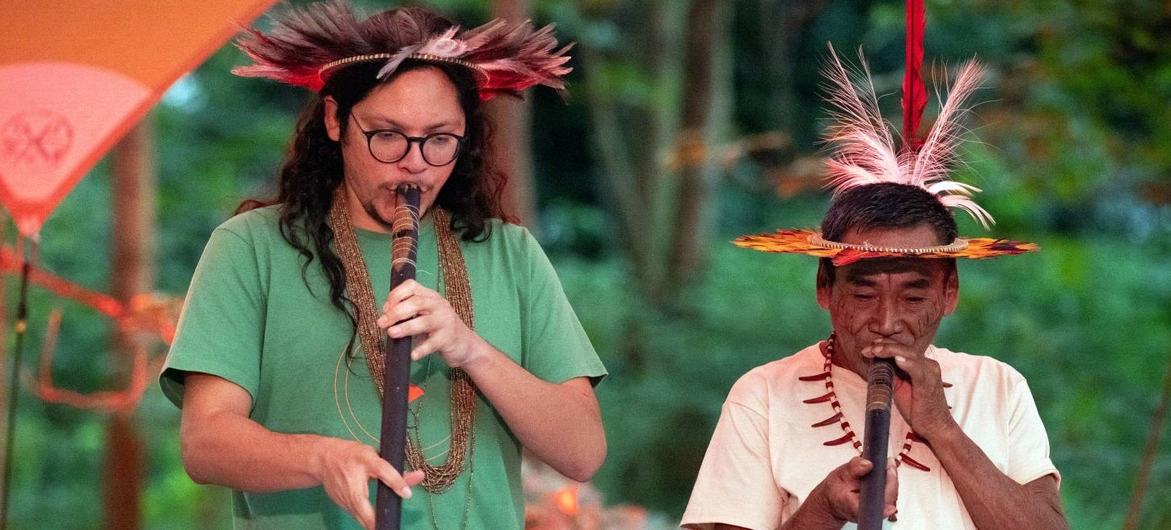
    Idjahure Terena playing the japurutu flute with his father-in-law Francisco Baniwa in Brazil.

    © Courtesy of Idjahure Terena

    Idjahure Terena playing the japurutu flute with his father-in-law Francisco Baniwa in Brazil.

    ‘The future is going to be very hot’

    Indeed, “the future is going to be very hot,” said Ms. Flow, adding that “it is already very hot in Brazil, and this is urgent for us because without water, we cannot live, and without food, [we cannot] either.”

    Advocating for issues affecting indigenous communities, including the burning impacts of climate change on the natural resources of her home country, she said collectively not enough is getting done.

    “We need more communication and more exchanges. By exchanges, I mean listening, speaking, listening, speaking and thinking about new ways of living well so that we can keep heading into the future.”

    Brazilian federal deputy Célia Xakriabá (right) performs with artist Brisa Flow at the Stand Up for Social Justice concert.

    Brazilian federal deputy Célia Xakriabá (right) performs with artist Brisa Flow at the Stand Up for Social Justice concert.

    Amplifying marginalised voices

    The event is the brainchild of UNRISD communications chief Karima Cherif, who wanted to bridge art and research through the initiative.

    She says her institute works with scholars from the global South to ensure that the voices and expertise of minorities are heard.

    “We’re giving voices to the marginalised and the youth,” explained Ms. Cherif, who sees art as a way to “translate what we do in a language that can touch hearts”.

    ‘Never give up’

    Thuy-San Dinh, who heads Antigel, echoed her vision and encouraged the young audience to pursue their goals, recalling when she co-created the annual event 15 years ago.

    “You have to believe in your ideas and never give up,” Ms. Dinh said.

    Melanie Rouquier, who created SHAP SHAP, a non-profit that fights global inequality and discrimination through cultural projects, told several activists in the room that each of their actions showed citizen engagement was not a lost cause.

    “To resist, we have to get together,” she said.

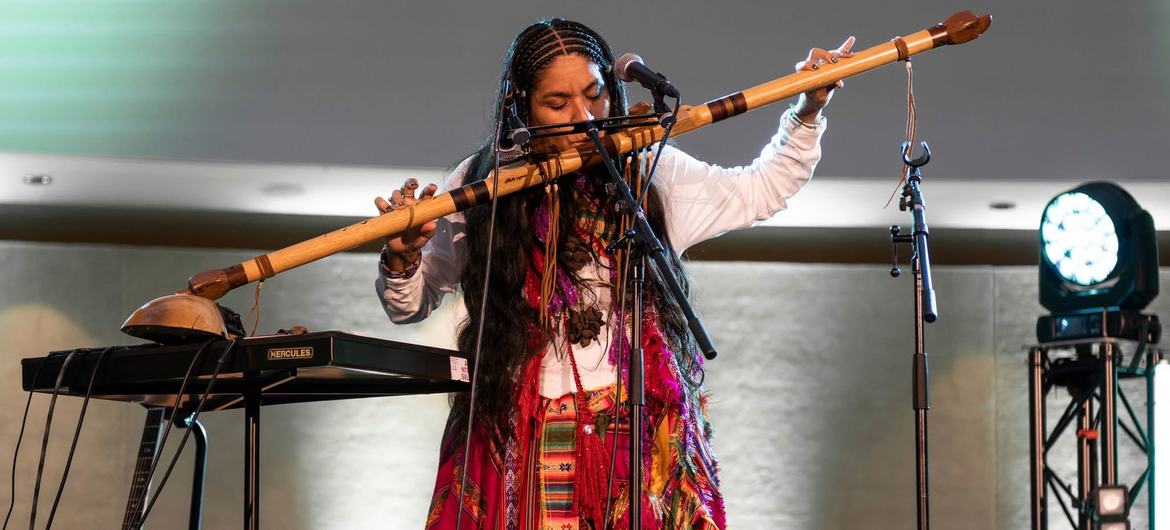
    Brisa Flow playing a traditional instrument at the Stand Up for Social Justice concert in Geneva in February 2025.

    © City of Geneva/ANTIGEL/Giona

    Brisa Flow playing a traditional instrument at the Stand Up for Social Justice concert in Geneva in February 2025.

    Connecting generations

    For Aryan Yasin, a designer from Geneva who founded a cultural non-profit supporting disadvantaged youth, the show was an opportunity for cross-pollination and broadening his network by connecting with UN staff.

    The exceptional venue “is not a place where you would necessarily see young people”, he said. “But, that actually allows us to create an intergenerational connection, with people who are more experienced, more established,” he added.

    After the show, management student Ludivine said she was mesmerised by the experience. Putting on a concert with one of her favourite artists there to denounce inequalities “makes sense… because at the UN, people get together to talk about inequalities around the world.”

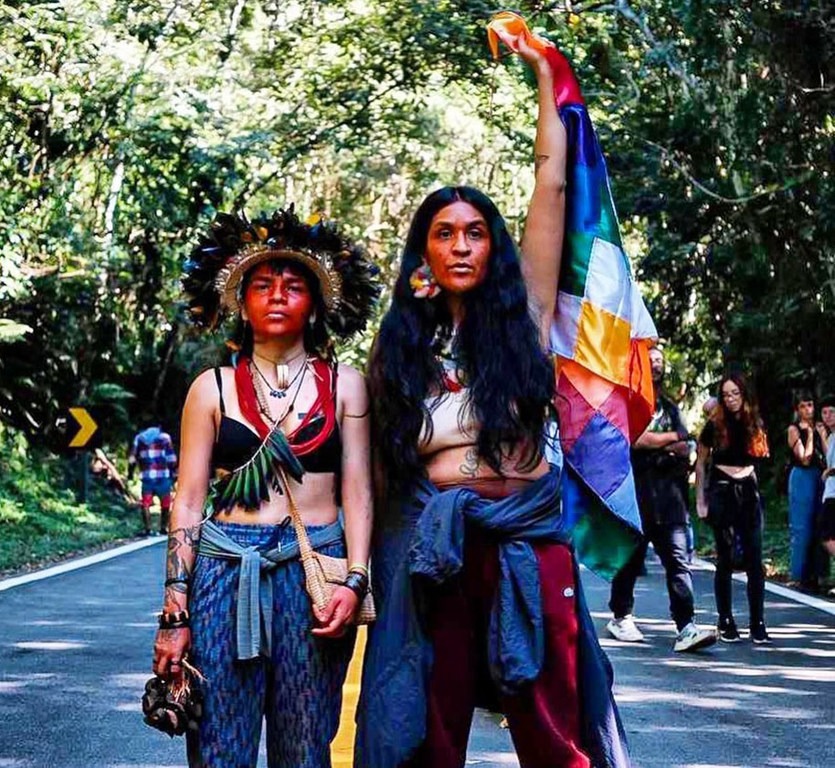
    Ms. Flow (right) at a protest by the Guarani people of Brazil.

    © Courtesy of Brisa Flow

    Ms. Flow (right) at a protest by the Guarani people of Brazil.

    What is social justice?

    After the event ended, doctoral students Beatrice and Thomas shared what the concept of social justice, which can seem quite abstract, meant to them.

    “It’s about recognising and taking differences into account while ensuring that everyone has the same access” to the same opportunities, said Beatrice, from Italy, who studies at École Polytechnique Fédérale de Lausanne.

    “That may mean that some people will need more support, while others may not need as much, but have different needs.”

    Thomas offered a more societal vision of the idea.

    “For me, it’s something that is both individual and collective – something that must be built as a society. It is entirely dependent on the structures we have put in place, but it also relies on everything that is local.”

    Read our social justice explainer here.

    ‘We need to be united’

    Ahead of the concert, Tatiana Valovaya, Director-General of the UN Office at Geneva set the tone in her opening remarks in the Human Rights and Alliance of Civilizations Room.

    “This room sees a lot of very important and challenging negotiations,” she told the audience. “But, today we open this room to everyone.”

    Geneva Mayor Christina Kitsos, whose term is guided by the motto “what connects us”, reminded the youthful audience of the UN’s fundamental role despite the worrying rise of “desire to undermine all the work [that has been done] around humanitarian aid and human rights”.

    “We need to be united, strong and truly hopeful and courageous to ensure that we stay the course, that we remain a beacon in this world in turmoil,” she said.

    Source link

  • DR Congo violence has pushed 35,000 to Burundi, says UN refugee agency

    UNHCR, the UN refugee agency, reported on Thursday that 35,000 Congolese nationals have now reached Burundi since the beginning of February, as Rwanda-backed M23 fighters continue to advance across both South and North Kivu.

    The UN human rights office (OHCHR) in DRC also expressed concern over growing lawlessness as warlords responsible for grave crimes including rape, were reportedly sprung from prison in Goma, Kabare and Bukavu in recent days.

    These former detainees are now at large and pose a threat to their former victims and judges who sentenced them, along with the lawyers who represented victims of sexual violence, said Patrice Vahard, Director of the UN Joint Human Rights Office in DR Congo (UNJHRO).

    The consequences will be huge, first for the state of law, but in particular for these women who believed in justice because they received help, but who unfortunately now risk being confronted by some of their tormentors.”

    Burundi arrivals

    UNHCR spokesperson Olga Sarrado told UN News that those fleeing DR Congo are entering Burundi via its northwestern border.

    “The vast majority are women and children, they are arriving exhausted, tired,” she said. “Many of them tell our teams on the ground that they have lost family members, sometimes children, while they were fleeing.”

    Ms. Sarrado described dire conditions at the border and said that the majority of those arriving from DRC do so by unofficial means, with many taking risks to cross the Ruzizi River.

    “Some of them are sheltering in the open, just in makeshift shelters, others are being sheltered in schools and also in a stadium at the border,” the UN refugee agency official added.

    Needs are increasing and there is a significant shortage of basic services in the displacement shelters including toilets, food and water.

    Goma aid lifeline resumes

    The UN World Food Programme (WFP) announced on Thursday that it had partially resumed food assistance to parts of Goma, which fell to M23 rebels three weeks ago.

    But as fighting between M23 and national troops continues, the UN aid agency expressed alarm at “soaring hunger” caused by people fleeing displacement camps.

    In North Kivu, WFP has reached 9,000 people with emergency food assistance out of a target of 83,000. “Security must improve for WFP to reach tens of thousands more of the most vulnerable populations at risk,” it stressed.

    Where possible, the UN agency is delivering vital nutrition supplies to treat moderate acute malnutrition in children aged six to 59 months, amid surging staple food prices that have made it increasingly difficult for families to eat.

    Prices rise along with insecurity

    The price of maize flour has risen by nearly 67 per cent, salt is 43 per cent more expensive than before the crisis erupted and the cost of cooking oil has increased by up to 45 per cent, WFP said.

    Escalating violence is forcing more families to flee – and now they have no food, no security and nowhere safe to go,” said WFP spokesperson Shaza Mograby. “The desperation of affected communities continues to grow by the day.”

    Humanitarians continue to struggle to reach the most vulnerable while major access routes remain blocked and Goma International airport remains closed.

    “WFP’s priority is to resume operations fully as soon as it is safe to do so,” the UN agency insisted.

    “The longer we are unable to give food and emergency assistance to families affected by the conflict, the greater and more dire their needs are,” said Peter Musoko, WFP’s Country Director and Representative in DRC.

    “I do not want to see children and mothers sink deeper into hunger and severe malnutrition. We need the violence to stop so we can resume our humanitarian activities. The most vulnerable people in DRC cannot afford to be overlooked during this crisis.’

    WFP plans to reach seven million of the most vulnerable women, men, and children in DR Congo with lifesaving food and nutrition assistance this year. It is working with other UN agencies, NGOs and Government partners to address immediate needs and prepare for a potential large-scale response once conditions allow.

    A key part of this operation is the WFP-run UN Humanitarian Air Service (UNHAS) operation. It provides aid teams with critical access and logistical support for their work across the country but it urgently requires $33.1 million to avoid the suspension of operations by the end of March.

    In recent weeks, the UNHAS fleet relocated to Kalemie in Tanganyika, establishing a new operational hub for eastern DRC.

    So far this year, the air service has transported 2,464 passengers, including humanitarian workers relocated from Goma and Bukavu; it has also delivered 23 metric tons of essential light cargo across DR Congo. 

    Source link