
Author: chiefeditor

  • In Haiti’s storm-hit south, food vouchers restore choice and dignity for families

    In Haiti’s storm-hit south, food vouchers restore choice and dignity for families

    In Haiti’s storm-hit south, food vouchers restore choice and dignity for families

    Ketia and her husband are both teachers. Before Hurricane Melissa swept through the Caribbean this past October, they were able to support their three children. However, when, the storm struck, their coastal community of Petit Goâve was among the most affected.  

    “I lost everything I owned: my furniture, my car, everything I had in my home,” lamented Ketia.

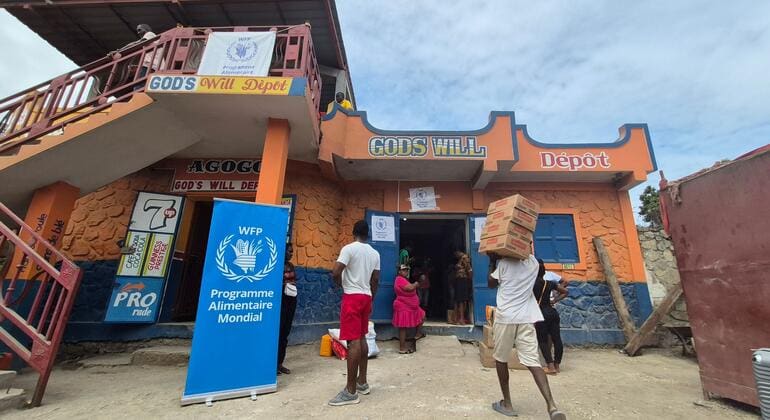
    Ketia and her family are among approximately 225,000 people receiving assistance from the UN World Food Programme (WFP) in the wake of the storm. She is receiving assistance from a voucher system which allows families to purchase goods from selected retailers – a programme which supports those affected by the storm while also helping stimulate the local economy.  
    A woman in Haiti, identified as Ketia, is seen holding a box of aid supplies received through the World Food Programme's voucher system, which helps families purchase goods from local retailers after a storm.

    “The shop is using an electronic system which records the transactions which are happening, and WFP pays the retailer,” explained Channon Hachandi, Head of Supply Chain for WFP Haiti. “It’s a good method to support affected families, because instead of going to receive assistance at a distribution, the recipient is acting like a normal shopper, going to the market.”  

    Even before Hurricane Melissa, more than half of the residents in the most affected regions were already facing acute food insecurity, an indication of the acute humanitarian crisis that Haiti has been facing for many years.  

    It is a good method to support affected families – instead of receiving assistance at a distribution, they are like a normal shopper at a market
    – Channon Hachandi, WFP

    The storm killed more than 40 Haitians, and many others lost their homes, businesses and belongings. In a region highly dependent on small-scale agriculture, there was widespread damage to farmland and a near total loss of harvests.  

    WFP provided assistance before, during and after the hurricane. Together with the government, the agency sent 3.5 million early warning text messages via cellphones, and provided cash payments to people to help them prepare and mitigate the effect of the hurricane. 

    During the storm itself families who relocated in temporary shelters were provided with rations. Immediately after, as families assessed the devastation, food rations for 15 days were distributed.  

    To help the community rebound, the response has evolved, through provision of cash and vouchers thus giving families what WFP described as “the dignity of choice.” 

    Right now, approximately 10 per cent of Haitians receiving assistance after Hurricane Melissa are benefitting from the voucher programme- an approach WFP aims to expand.

    An aerial view of a Haitian community affected by a storm, showing houses, roads, and vehicles, with WFP providing food assistance through a voucher system.

    Wilfred Nkwambi, Head of Programmes at WFP in Haiti, emphasized that vouchers are more than simply a means of feeding people — they are a breath of fresh air for the local economy.  

    “In this shop alone, the owner employs eight additional people for these distributions. In this part of Petit Goâve, there are five other shops, employing a total of 40 people, mostly women and young people. Not only is it good for the recipients, but also for the city’s merchants and local producers,” explained Mr. Nkwambi.

    At the same time, WFP employs day labourers for logistics, generating additional income for local families. This approach benefits everyone, transforming aid into an engine for economic recovery.

    Placing dignity and choice at the heart of intervention demonstrates humanitarian assistance can be synonymous with resilience for the Haitian people, according to WFP.

    “Thanks to the food voucher distribution, we won’t go hungry in the coming weeks, and we have the chance to start rebuilding our lives,” said Ketia, as she loaded her groceries onto a motorcycle taxi and headed back to her family.  

    Source link

  • Raise taxes on sugary drinks and alcohol to save lives, WHO urges

    Raise taxes on sugary drinks and alcohol to save lives, WHO urges

    Raise taxes on sugary drinks and alcohol to save lives, WHO urges

    Raise taxes on sugary drinks and alcohol to save lives, WHO urgesWHO is calling on governments to significantly increase taxes on sugary drinks and alcohol, as two new reports reveal levies remain low in many regions. “Health taxes have been shown to reduce the consumption of these harmful products, help prevent disease and reduce the […]
    Originally published at Almouwatin.com

  • World News in Brief: Ending famine, refugee solidarity in Kenya, Ukraine civilian casualties update

    World News in Brief: Ending famine, refugee solidarity in Kenya, Ukraine civilian casualties update

    World News in Brief: Ending famine, refugee solidarity in Kenya, Ukraine civilian casualties update

    In an alert, Cindy McCain – who heads the World Food Programme (WFP) – attributed a “dangerous and deepening global hunger crisis” to violent conflicts, extreme weather and economic downturns.  


    The development comes as WFP faces massive shortfalls in funding; it has received less than half of the $13 billion it needs to reach 110 million of the world’s most vulnerable people.

    This means that millions may be cut off from vital assistance, threatening lives and the stability of regions, the agency warned.

    “WFP has proven time and again that early, strategic and innovative solutions can halt famine, stabilize communities, deter migration and enable families to recover,” Ms. McCain insisted.

    Her comments come in a context of increasing hunger crises now affecting 318 million people around the world. In addition, “hundreds of thousands” are already suffering from “famine-like” conditions, WFP says.

    Kenya plan showcases bold vision for refugee self-reliance

    Barham Salih has made his first official visit as UN High Commissioner for Refugees, in charge of UNCHR, calling in the Kenyan capital for stronger global support to develop the solutions refugees need to rebuild their lives.

    Over 800,000 refugees and asylum seekers live in the East African nation. Some 300,000 refugees, mostly from South Sudan, Burundi and the Democratic Republic of Congo, have found safety in the Kakuma region over many years – a place of “transformation and innovation,” said the UNHCR chief.

    He warned that the consequences of a growing lack of humanitarian funding were “stark” in Kakuma.  

    “Despite scarce resources, Kenya continues to show remarkable solidarity for people in need, through smart policies that foster self-reliance and economic growth,” said Mr. Salih.  

    Lack of funding  

    Last year, less than a quarter of UNHCR’s budget for Kenya was funded – severely constricting access to healthcare, water, education and protection services for both refugees and host communities.  

    In light of this, Kenya’s Shirika Plan seeks to transition from humanitarian aid to refugee self-reliance and harmony with host communities, providing refugees with legal IDs, financial services, education, and health care.

    “These inclusive policies hold great promise for transforming the futures of both refugees and the communities hosting them.” said M Salih.  

    Ukraine: 2025 was deadliest for civilians since full-scale conflict erupted

    More than 2,500 civilians were killed in Ukraine in 2025, and nearly 12,250 injured – marking a 31 per cent increase compared to 2024, according to UN human rights monitors.  

    The figures refer to those verified, with the actual total likely to be considerably higher.  

    In December alone, more than 150 were killed and 888 injured. During that month, long-range attacks by Russian forces using missiles and drones caused 33 percent of all civilian casualties (34 killed and 308 injured), hitting cities and towns far from the frontline.

    Some 67 per cent of civilian casualties occurred near the frontline (122 killed and 571 injured).  

    Attacks on energy infrastructure

    Since the conflict began in 2014, nearly 18,500 civilians have been killed.  

    According to the UN Human Rights Monitoring Mission (UNHRMM), the number of civilian casualties is likely to be significantly undercounted in cities such as Mariupol (Donetsk region), Lysychansk, Popasna, and Sievierodonetsk (Luhansk region), where there was protracted intensive fighting at the start of the full-scale Russian invasion which began in February 2022.

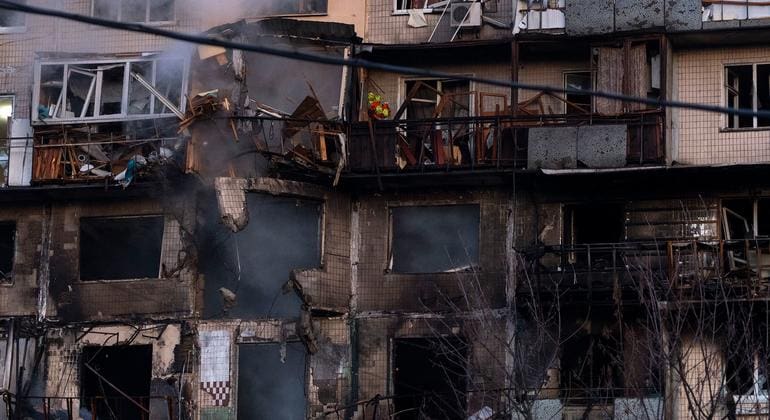
    On top of civilian casualties, the Russian Federation also conducted large-scale, region-specific attacks on Ukraine’s energy infrastructure.  

    In December, the Odesa region was among the most affected areas, experiencing repeated strikes that resulted in prolonged outages in several cities. 

    Source link

  • World news in brief: Ending famine, solidarity with refugees in Kenya and civilian casualties in Ukraine

    World news in brief: Ending famine, solidarity with refugees in Kenya and civilian casualties in Ukraine

    World news in brief: Ending famine, solidarity with refugees in Kenya and civilian casualties in Ukraine

    World news in brief: Ending famine, solidarity with refugees in Kenya and civilian casualties in UkraineOn alert, Cindy McCain – who heads the World Food Program (WFP) – blamed a “dangerous and worsening global food crisis” on violent conflicts, extreme weather and economic slowdown. The development comes as WFP faces huge funding gaps; she received less than […]
    Originally published at Almouwatin.com

  • Security Council LIVE: Attacks against Ukrainian civilians unacceptable, unjustifiable and must stop, says UN

    Security Council LIVE: Attacks against Ukrainian civilians unacceptable, unjustifiable and must stop, says UN

    Security Council LIVE: Attacks against Ukrainian civilians unacceptable, unjustifiable and must stop, says UN

    Security Council LIVE: Attacks against Ukrainian civilians unacceptable, unjustifiable and must stop, says UN

    Source link

  • Ukraine: Deadly Russian strikes push civilians deeper into winter crisis

    Ukraine: Deadly Russian strikes push civilians deeper into winter crisis

    Ukraine: Deadly Russian strikes push civilians deeper into winter crisis

    Under-Secretary-General for Political Affairs Rosemary DiCarlo told ambassadors the start of 2026 had brought “no peace or even respite to Ukraine, but renewed fighting and devastation.”

    “As temperatures plummet far below freezing, the Russian Federation has intensified its systematic attacks targeting Ukraine’s energy infrastructure,” she said, noting that the strikes had killed and injured scores of civilians and deprived millions of electricity, heating and water for prolonged periods.

    The impact, she added, is felt most acutely by older people, children and those with limited mobility.

    Drone and missile onslaught

    Ms. DiCarlo cited a major overnight barrage between 8 and 9 January in which Russia reportedly launched 242 drones and 36 missiles.

    In Kyiv, at least four people were reportedly killed and 25 injured, including a paramedic who died while responding to an earlier strike, reportedly hit by a so-called “double-tap” attack.

    Nearly half of the capital was left without heating, and hundreds of thousands of residents were affected.

    Energy and residential facilities were also damaged in western Lviv region, near the Polish border, where an intermediate-range ballistic missile known as “Oreshnik” was reportedly used for the second time since 2024.

    The weapon is believed capable of carrying nuclear payloads, heightening international concern.

    Ports and shipping have also come under attack. On 8 January, two foreign-flagged civilian vessels were struck by Russian drones in the Odesa region.

    Two people were reportedly killed and eight injured in subsequent port attacks that damaged storage facilities and containers. Odesa was hit again on Sunday, in what Ms. DiCarlo described as a “concerning escalation” targeting Ukraine’s port infrastructure and commercial shipping.

    Rosemary DiCarlo, Under-Secretary-General for Political and Peacebuilding Affairs, speaking at a UN Security Council meeting on Ukraine.

    USG DiCarlo briefs the Security Council.

    Humanitarian consequences

    The humanitarian impacts were outlined by Ramesh Rajasingham, Director of the Humanitarian Sector at the UN Office for the Coordination of Humanitarian Affairs (OCHA).

    He said large-scale strikes were pushing “the very means of winter survival to the brink,” as temperatures dropped to nearly minus 10 degrees Celsius.

    “What makes these attacks especially devastating is that they cripple the systems that keep civilians alive during winter,” he said.

    In Kryvyi Rih, families have been melting snow for washing and heating water over candles during prolonged power cuts.

    In Kyiv, more than 1,200 heated safe spaces are operating, alongside 68 additional heating points set up by emergency services and humanitarian partners.

    A wide view of the UN Security Council meeting focused on the maintenance of peace and security in Ukraine, with delegates seated around a large circular table.

    A wide view of the Security Council meeting.

    Displacement continues

    Civilians continue to flee frontline areas under dangerous conditions, particularly from the Donetsk region, with many arriving in safer areas needing shelter, medical care and winter assistance. Humanitarian access remains constrained.

    According to UN estimates, 10.8 million people in Ukraine need humanitarian assistance.

    On Tuesday, the UN and partners are set to launch a $2.31 billion humanitarian appeal for 2026 to support 4.12 million people facing the most severe needs.

    Both officials reiterated that attacks on civilians and civilian infrastructure violate international humanitarian law. “They are unacceptable, unjustifiable, and must stop immediately,” Ms. DiCarlo said.

    “Civilians who are enduring these attacks need more than statements of concern from this council. They need concrete action to reduce civilian harm and ensure that humanitarian support continues to reach people when they need it most,” Mr. Rajasingham added.

    Source link

  • Gaza: Storms worsen already disastrous humanitarian situation, UN warns

    Gaza: Storms worsen already disastrous humanitarian situation, UN warns

    Gaza: Storms worsen already disastrous humanitarian situation, UN warns

    Gaza: Storms worsen already disastrous humanitarian situation, UN warnsSpeaking to correspondents in New York, spokesperson Stéphane Dujarric reported that ongoing torrential rains are damaging and destroying fragile shelters, leaving large numbers of displaced people exposed to the cold. “To meet the immense shelter needs, our partners delivered supplies to 28,000 families last week, including […]

    Originally published at Almouwatin.com

  • Protection against winter vomiting bug spread with arrival of agriculture

    [ad_1]

    A genetic variant that protects against stomach virus infections appeared when humans began farming. This is shown by

    [ad_2]

    Source link

  • “Beyond GDP”, economists call for clearer measures on well-being and sustainability

    “Beyond GDP”, economists call for clearer measures on well-being and sustainability

    “Beyond GDP”, economists call for clearer measures on well-being and sustainability

    “Beyond GDP”, economists call for clearer measures on well-being and sustainabilitySupported by the United Nations trade and development agency, UNCTAD and other partners, the Beyond GDP initiative recognizes a warning from Secretary-General António Guterres that global policymaking is too dependent on global domestic product data. “Every day we witness the consequences of our incapacity […]

    Originally published at Almouwatin.com

  • Jehovah’s Witnesses, the most persecuted religious minority in Putin’s country

    Jehovah’s Witnesses, the most persecuted religious minority in Putin’s country

    Jehovah’s Witnesses, the most persecuted religious minority in Putin’s country

    Since 2017, over 900 criminal prosecutions, resulting in over 1,000 years of prison sentences on bogus charges of extremism

    Apart from several religious minorities in China, Jehovah’s Witnesses in Russia are the faith community that is most persecuted by the state in the world but most human rights or religious freedom organizations fail to report about this severe repression.

    Jarrod Lopes, a spokesman for Jehovah’s Witnesses, recently stated in a press release: “Local Russian authorities with religious animus for non-Orthodox believers continue to unjustly target Jehovah’s Witnesses. Since 2017, there have been more than 900 criminal prosecutions, resulting in over 1,000 years of prison sentences on bogus charges of extremism. Authorities have unconscionably tortured innocent men, imprisoned the elderly and disabled, and deployed Soviet-era tactics of infiltration and surveillance. By attacking Jehovah’s Witnesses for peacefully practicing their Christian beliefs, Russian authorities have become what they claim to be fighting—extremists.”

    Despite 2024 giving signs the crackdown was subsiding, 2025 saw an increase in home raids, prosecutions, and prison sentences over the previous year.

    The Human Toll

    Valeriy Baylo died in custody in 2025 due to not receiving proper medical care. (link)

    Aleksey Lelikov, 64, a disabled piano teacher who reached the finals of Krasnodar’s “Teacher of the Year” competition in 1994, was sentenced in February to 6.5 years in prison. He had no criminal record. (link)

    Anatoliy Marunov, 72, is serving 6.5 years despite having a stroke and a prostate tumor. When he needed life-saving surgery, courts refused to reduce his sentence. In a cruel irony, Moscow’s mayor recently sent the separated couple a congratulatory letter on their 50th wedding anniversary, praising them as “an example for young people” and wishing them “many happy years together in a loving family home.”

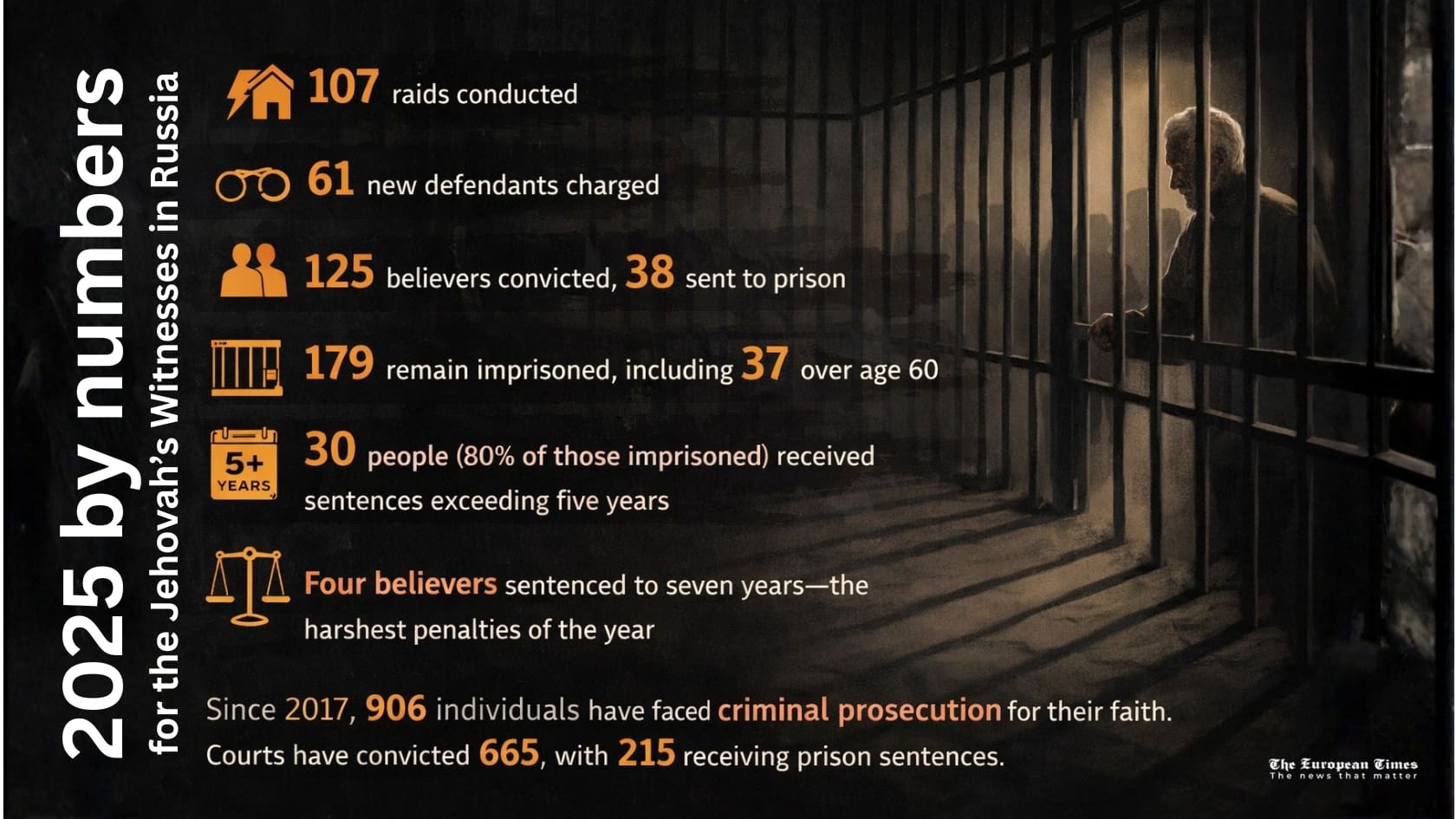
    2025 By the Numbers

    • 107 raids conducted
    • 61 new defendants charged
    • 125 believers convicted, 38 sent to prison
    • 179 remain imprisoned, including 37 over age 60
    • 30 people (80% of those imprisoned) received sentences exceeding five years
    • Four believers sentenced to seven years—the harshest penalties of the year

    Since 2017, 906 individuals have faced criminal prosecution for their faith. Courts have convicted 665, with 215 receiving prison sentences.

    Systematic Abuses

    Torture and violence: At least eight cases of unprovoked violence and cruel treatment occurred in 2025, bringing the total to over 70 victims across eight years. No perpetrator has faced justice.

    Targeting the vulnerable: Nearly one-third of defendants (266 people) are over 60. At least 81 have serious health conditions; 34 are officially disabled. Currently, 36 seriously ill believers languish in colonies and detention centers where proper medical care is often impossible.

    Family persecution: At least 172 prosecuted believers have relatives facing similar charges. In 2025 alone, authorities opened cases against four married couples. “It’s become a gold mine for law enforcement,” one defense lawyer observed. “Why go after real criminals? That’s dangerous. It’s much easier to target relatives of Jehovah’s Witnesses already under investigation.”

    Secret informants: At least 30 criminal cases rely on testimony from undercover agents who infiltrated congregations, some for years, posing as Bible students. Agent Yekaterina Petrova’s surveillance of 17 believers—including elderly individuals—led to prison sentences up to eight years. Yet even these spies can only confirm believers discuss the Bible and pray.

    Citizenship revocation: In 2025—at least 12 convicted believers had their acquired Russian citizenship annulled, facing deportation and indefinite family separation. Mikhail Moysh hasn’t seen his two young sons since October 2021; deportation could extend that separation indefinitely. (link)

    Jehovah’s Witnesses banned in Russia in 2017: Some International Criticism

    Since the 2017 decision by Russia’s Supreme Court (upheld on appeal) that liquidated the Jehovah’s Witnesses’ legal entities and effectively banned their activity in Russia, several international courts and bodies have formally criticized or condemned Russia’s actions as persecution or violations of human rights, including religious freedom.  

    European Court of Human Rights (ECHR)

    Key judgments:

    On June 7, 2022, the ECHR ruled that Russia’s 2017 ban on Jehovah’s Witnesses was unlawful and in violation of the European Convention on Human Rights. It ordered Russia to end criminal prosecutions, release imprisoned Jehovah’s Witnesses, and return confiscated property or pay compensation.

    Subsequent ECHR rulings (e.g., March 6, 2025, in Loginov and Others v. Russia) also found violations related to detention and mistreatment of Jehovah’s Witnesses.

    The ECHR has repeatedly found that Russia’s actions violated freedom of religion and association protections under the Convention.

    United Nations Human Rights Committee (CCPR)

    The CCPR (which monitors compliance with the International Covenant on Civil and Political Rights) has issued Views concluding that Russia violated Jehovah’s Witnesses’ rights under Article 18 (freedom of religion) and Article 22 (freedom of association) in specific cases involving liquidations of local religious organizations. It ordered Russia to take corrective measures, though implementation has been lacking.

    Organization for Security and Co-operation in Europe (OSCE)

    The OSCE Permanent Council (including statements from the EU and participating states such as Australia, Canada, and Norway) publicly condemned Russia’s ban and called on Russia to respect freedom of assembly and religion, emphasizing Russia’s international human rights commitments.

    European Union (EU) and European Institutions

    The European Union, often speaking through the OSCE framework or its own foreign policy statements, has criticized the ban and persecution as incompatible with international human rights standards and Russia’s obligations.

    Amnesty International

    Amnesty International publicly denounced the 2017 ban as “an assault on freedom of assembly and conscience,” framing it as a serious regression in religious freedom protections.

    U.S. Commission on International Religious Freedom (USCIRF)

    The USCIRF, an independent U.S. federal body focused on global religious freedom, condemned the Supreme Court ban and subsequent decisions, and welcomed the ECHR’s ruling against Russia’s actions. It has urged Russia to respect religious freedom and cease persecution.