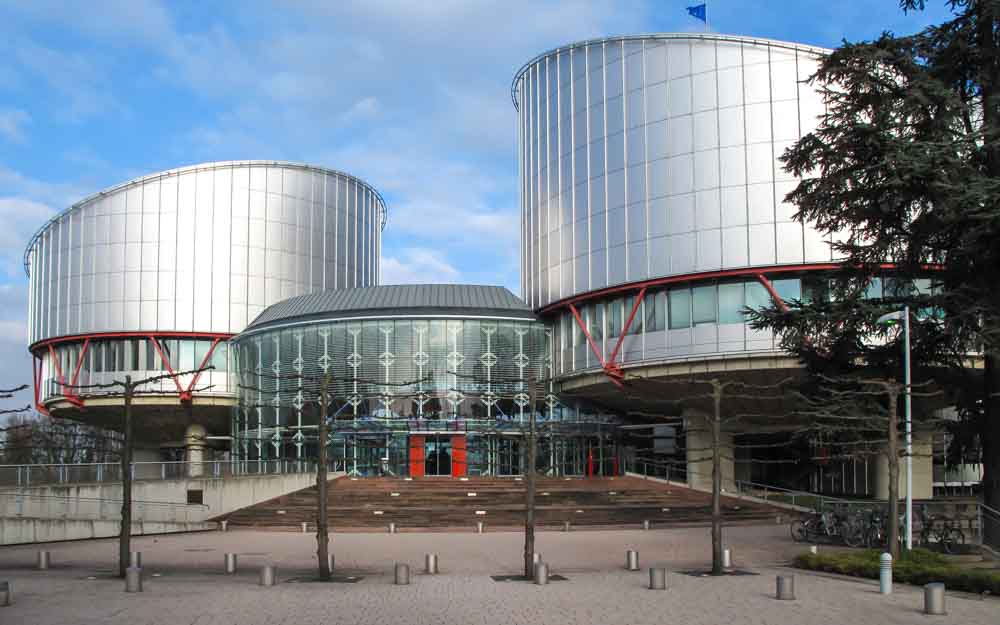
A lengthy Romanian legal drama finally came to an end in January 2025 when Romania’s High Court of Cassation and Justice fully acquitted Gabriel ‘Puiu’ Popoviciu in a final and irrevocable ruling.
This decision maintained the Bucharest Court of Appeal resolution from July 2024, through which all the defendants were acquitted in the case surrounding the Băneasa shopping, office and residential development.
In her July 2024 ruling, Judge Liana Arsenie, the head of the Court of Appeal, had exonerated Popoviciu, along with the other ten defendants in the case. In the judgment she handed down, she was critical of prosecutor Nicolae Marin (of Romania’s National Anti-Corruption Directorate, known as the DNA) and his conduct in the case. Her ruling, all of which was reconfirmed on 15th of January 2025 in the High Court of Cassation and Justice, was that she was ordering the acquittal of all 11 defendants on the grounds that the alleged offences do not exist.
As Judge Arsenie explained at the time, “The investigating authority assigned fictitious roles and functions and imagined authority relationships. The prosecution was built on a scenario imagined by the prosecutor.”
She highlighted “truncated interpretations, the breaking of logical-legal algorithms and the attribution of criminal connotation to the exercise of civil rights and obligations.” The case had raised concerns internationally regarding the abuse of the legal system to persecute Popoviciu and his fellow defendants.
The legal battle was not limited to Romania. In July 2023, the UK’s Supreme Court discharged Romania’s extradition request for him. That was the UK court’s final decision on the matter and meant that Popoviciu would not be extradited to Romania.
That final UK outcome followed the 11 June 2021 decision by London’s High Court to refuse Popoviciu’s extradition to Romania.
In that ruling, British judge Lord Justice Holroyde stated: “The evidence shows a real risk that the appellant suffered an extreme example of a lack of judicial impartiality, such that there can be no question as to consequences for the fairness of the trial.” Edward Fitzgerald KC said that Popoviciu would suffer a “flagrant denial of justice” if sent back to serve his sentence in Romania.
Willy Fautre, Director of HRWF, commented:
“This final court decision is to be welcomed, building as it does on the Bucharest Court of Appeal’s ruling last July, as well as earlier court decisions in the UK to refuse Romanian requests to extradite Mr Popoviciu. However, for those of us focused on human rights within the European Union, there is concern that such a lengthy injustice even took place in Romania, an EU country. There should be particular concern that several courts have now ruled that Mr Popoviciu suffered persecution at the hands of a prosecutor in what is an EU, and now even Schengen, country.”
By Willy Fautré from Tbilissi – During yesterday’s demonstrations at the parliament, some citizens have brought diplomas – to mark the fact that the “Georgian Dream” presidential candidate, ex-footballer Mikheil Kavelashvili, is just a puppet of the pro-Kremlin party and lacks the needed education to bear the title of “President of Georgia.”
The protesters stated that the ongoing presidential elections in the Parliament of Georgia are an illegitimate process.
Protesters marching to the Georgian Parliament from various locations in Tbilisi on Monday 16 December
President Salome Zurabishvili has also arrived at Parliament, and police and special forces have been mobilized. Ministry of Internal Affairs personnel are stationed in the area surrounded by iron railings in front of the building.
The police forces are also deployed at Freedom Square, where water cannon vehicles are on standby.
Protesters marching to the Georgian Parliament from various locations in Tbilisi on Monday 16 December Source: Willy Fautré (HRWF) w.fautre@hrwf.org
Contested election of the new president
On 14 December, the electoral college elected the president of Georgia. Only one candidate, Mikheil Kavelashvili, had been nominated for the position. Opposition parties were not participating in the elections because they considered them illegitimate.
He is the first indirectly elected president in Georgia, a position he will hold for five years.
The presence of the majority of the full composition of the electoral college – at least 151 members – was sufficient to conduct indirect elections of the president.
The vote of 2/3 of the full composition of the collegium – at least 200 members – is enough to elect a president.
The collegium includes 150 members of the parliament, all members of the highest representative body of the Autonomous Republic of Adjara – a total of 21 deputies, all 20 members of the highest representative body of the Autonomous Republic of Abkhazia and 109 members from the city councils.
The Chairman of the Central Election Commission said 225 members participated in the vote, with 1 ballot being invalid.
Kavelashvili received 224 votes in his favor. His candidacy was not supported by Ada Marshania, a member of the Supreme Council of Abkhazia, who stated that she did not approve of Kavelashvili’s candidacy.
The procedure took place in the Parliament’s plenary session hall.
The Chairman of the CEC handed over the final protocol to the Speaker of Parliament, Shalva Papuashvili, and declared the election process complete.
Amendments to the Code of Administrative Offenses to make it more repressive
This weekend, the Georgian Dream party adopted in a hurry amendments that will significantly increase sanctions for violations that the police usually use against demonstrators.
The new regulations provide for:
Increasing the fine for obstructing traffic from 1,000 to 2,000 GEL, and suspension of driving privileges for 1 year;
Increasing the fine for damaging the appearance of the city from 50 to 1,000 GEL and 2,000 GEL for repeat violations;
Increasing the fine for violating the norms of assemblies and demonstrations from 500 to 5,000 GEL and a fine of 15,000 GEL or administrative imprisonment for organizers;
Illegal wearing of an MIA uniform, punishable by a fine of 2,000 GEL and its confiscation;
Failure of a parent or other legal representative of a child to raise and educate a minor or to fulfill other duties towards him/her. This has been added to the commission of an act provided for in Article 173 of the same Code (disobedience to a lawful request of a law enforcement officer).
The amendments also expand the grounds on which a person can be detained, and their items or documents seized.
The new government is obviously trying to intimidate the population by disproportionately increasing sanctions for actions related to gatherings, demonstrations and protests.
In the last few months, the number of criminal proceedings against religious conscientious objectors has suddenly dramatically increased in Ukraine, mainly affecting the members of the Jehovah’s Witnesses’ community and even their religious ministers. The convictions are severe: imprisonment for a term of 3 years.
As of late October, police and prosecutors were investigating about 300 criminal cases against conscientious objectors (over 280 were Jehovah’s Witnesses), according to Forum18. Some others were Adventists, Baptists, Pentecostals and non-believers.
This situation is the consequence of a decision of the Supreme Court which clearly confirmed on 13 June 2024 the suspension of the right to conscientious objection and to an alternative civilian service during the war with Russia, in a case opposing the Adventist Dmytro Zelinsky to the Ukrainian state.
Quote from the decision of the Supreme Court:
“According to Art. 17 of the Law of Ukraine of 06.12.1991 № 1932-XII ‘On Defense of Ukraine’ protection of the Fatherland, independence and territorial integrity of Ukraine is a constitutional duty of the citizens of Ukraine. Male citizens of Ukraine, eligible for military service for health and age, and female citizens, also with appropriate professional training, must perform military service in accordance with the law.
Thus, no religious beliefs can be the basis for evading a citizen of Ukraine, recognized as fit for military service, from mobilization in order to fulfill his constitutional duty to protect the territorial integrity and sovereignty of the state from military aggression by a foreign country.”
Dmytro Zelinsky appealed to the Constitutional Court and on 24 September 2024, proceedings were opened about his complaint. An answer is not expected until several months.
Constitutional and legal framework
The Constitution of Ukraine (Article 35) enshrines the right to freedom of religion and worldview. While granting freedom to profess any religion or not to profess any, to freely perform religious and ritual rites individually or collectively, to conduct religious activities, the Constitution states that no one can be relieved of his duties to the state or refuse to comply with the laws on the grounds of religious beliefs. If it is contrary to the religious beliefs of the citizen, the fulfillment of this duty must be replaced by an alternative (non-military) service.
The legislation of Ukraine protects the right of its citizens to conscientious objection to military service, but only for ten categories of religious associations:
Reformed Adventists
Seventh-day Adventists
Evangelical Christians
Evangelical Christian Baptists
Pokutniki (stemming from the Uniate Church in the mid-1990s)
Jehovah’s Witnesses
Charismatic Christian Churches (and similar Churches according to the registered statutes)
Christians of the Evangelical Faith (and similar Churches according to the registered statutes)
Christians of the Evangelical Faith
Society for Kṛiṣhṇa Consciousness.
Believers of other religions and followers of non-religious worldviews (atheists, agnostics…) are not eligible for the status of conscientious objection.
Noteworthy is also that while Adventists can accept an alternative civilian service under military supervision, Jehovah’s Witnesses refuse any form of alternative service under the authority of the army.
The specific law of Ukraine “On Alternative (Non-Military) Service” provides for the possibility of replacing only fixed-term military service with alternative (non-military) service, i.e. only military service that is valid in peacetime.
Fixed-term military service was abolished with Russia’s invasion of the territory of Ukraine on 24 February 2022. Ukraine declared a state of martial law and general mobilization was quickly introduced by presidential decree. All men between the ages of 18 and 60 were deemed eligible for call-up in a general mobilisation and were banned from leaving the country.
The law does not provide for the possibility and a procedure for replacing military service with alternative (non-military) service during military conscription (mobilization). The decisions of the courts dealing with conscientious objectors in this context were first uncertain.
Number of arrests on the rise
From February 2022 to July 2024 (28 months), the number of sentences in criminal cases issued against Jehovah’s Witnesses who refused to be mobilized due to their religious beliefs was only 4 cases. In the period from July to November 2024 (5 months), their number escalated to 14 cases.
It must be stressed that there are about 100,000 Jehovah’s Witnesses in Ukraine and thousands of them have the age to be mobilized. It means that the problem could quickly become daunting with a massive number of convictions to prison terms. In the meantime, their only option will be to go into hiding, to live at a place different from their official address, to choose self-confinement, to stop working outside or to be careful on their way to their workplace, to avoid public transport, train and bus stations, public events…
On 25 October, 46-year-old Jehovah’s Witness Roman Mareev was released after having served his prison term but many others are still behind barbed wires: 147 according to the database of religious prisoners of Human Rights Without Frontiers in Brussels.
According to Article 111 Part 1 of the Russian Federation’s Criminal Code, grievous bodily harm draws a maximum of 8 years sentence.
According to Article 126 Part 1 of the Criminal Code, kidnapping leads to up to 5 years in prison.
According to Article 131 Part 1 of the Criminal Code, rape is punishable with 3 to 6 years in prison.
Anatoliy Marunov and Sergei Tolokonnikov sentenced to 6 ½ years and 5.2 years
In July 2023, the Savelovsky District Court of Moscow sentenced Mareev to 4.5 years in a general regime colony. He was found guilty of involvement in the activities of a banned organization (p. 1.1 Art. 282.2 of the Criminal Code).
Mareev was arrested in October 2021. He spent a little more than three years, or 1100 days, in three Moscow detention centers. Since one day in custody is equivalent to one and a half days in a general regime colony, Mareev’s term was considered served.
For some time the believer did not have his own bed in the cell and he slept on the floor. Mareev said that in the detention center he was supported by letters from family, friends and strangers. In three years, he received letters from 68 countries.
Two other believers who were convicted together with Mareev remain in prison – Anatoliy Marunov and Sergei Tolokonnikov. The first one was sentenced to six and a half years in a general regime colony, and the second one to five years. In the appeal, Tolokonnikov’s term was increased to five years and two months.
They did not plead guilty, and one of the lawyers emphasized that they were persecuted only for their religion.
The usual charges for Jehovah’s Witnessesr are the spread of their religious beliefs and participation in religious services.
A native Muscovite Sergey Tolokonnikov worked for many years as a security guard. After becoming a Jehovah’s Witness, he refused to carry weapons and to use violence against others. Despite this, in October 2021, the authorities considered him a dangerous criminal, charging him under two extremist articles for his faith.
Anatoliy Marunov worked for almost 40 years in the publishing house and printing house of the “Krasnaya Zvezda” newspaper, which for a long time was the central printed organ of the USSR and Russian Federation Ministry of Defense. He joined the movement of Jehovah’s Witnesses at the end of the 1990s.
Jehovah’s Witnesses banned since 2017
In 2017, the Supreme Court recognized the “Jehovah’s Witnesses Management Center in Russia” as an “extremist organization”, liquidated it and banned its activities on the territory of Russia. All Jehovah’s Witnesses organizations were included in the banned list, after which the flow of criminal cases against believers began.
Rosfinmonitoring included hundreds of Russian followers of Jehovah’s Witnesses in the list of “extremists and terrorists”. Most of the people on the list are believers aged 40 to 60.
On 7 June 2022, the European Court of Human Rights declared the ban of Jehovah’s Witnesses organizations and the subsequent persecution of believers illegal.
From the point of view of the ECHR, the decision to liquidate the organization and criminal cases against Jehovah’s Witnesses is based on too broad a definition of “extremism”, which in Russian legislation “can be applied to absolutely peaceful forms of expression”.
Oral statement denouncing the discrimination by the Dutch branch of Human Rights Without Frontiers at the OSCE Warsaw Human Dimension Conference on 7 October
“Mensenrechten Zonder Grenzen Nederland is deeply concerned about a decision in Norway which arbitrarily revoked the registration of Jehovah’s Witnesses present in the country for over 130 years. This measure puts an end to their eligibility for state grants they had received for 30 years.
The registration of the Norwegian Jehovah’s Witnesses as a religious organization for 39 years was put to an end on unclear and controversial grounds in 2022.
In addition, on 4 March of this year, the Oslo District Court upheld the decisions of the County Governor of Oslo and Viken who has denied Jehovah’s Witnesses state subsidies since 2021. The financial loss is estimated at 1.6 million EUR for 2021. An appeal has been lodged.
We recommend that the Government of Norway
cancel the discriminatory decision to remove the registration of Jehovah’s Witnesses as a religious community;
reconsider and reverse the denial of state grants since 2021;
abide by their commitment to uphold fundamental freedoms guaranteed by the Constitution of Norway, the ICCPR and the European Convention on Human Rights for all citizens, including Jehovah’s Witnesses.
State subsidies in Norway are not a gift. The Lutheran Church of Norway which is a state church is financially supported by the government and gets state subsidies proportional to the number of its members. For the sake of coherence and non-discrimination, the Constitution mandates that other religions should also benefit from the same financing system and get subsidies in proportion of the number of their members. Over 700 religious communities receive such state grants in Norway, including Orthodox parishes subordinated to Patriarch Kirill of Moscow who blessed Russia’s war on Ukraine.”
With its recognition of more than 700 registered faith communities, Norway is often admired as a bastion of religious freedom. But after Norway deregistered the Jehovah’s Witnesses last year, some human rights experts say that reputation could be in question. Now, the Jehovah’s Witnesses of Norway are suing the state for revoking their national registration and withholding state funds. According to Jehovah’s Witnesses, they are the first religious group to lose their national registration in Norway.
The trial, which began Jan. 8, 202 will determine whether some practices of the Jehovah’s Witnesses violate Norway’s Religious Communities Act or whether withdrawing the Jehovah’s Witnesses’ registration violates their right to freedom of religion and freedom of association, as guaranteed in the European Convention on Human Rights.
OSCE 2024″ class=”wp-image-157549″ style=”width:303px;height:auto”/>Willy Fautre at OSCE 2024
“It’s certainly the most important trial about a religious freedom issue in Norway in decades,” Willy Fautré, director of the Brussels-based organization Human Rights Without Frontiers, told Religion News Service.
In January 2022, Valgerd Svarstad Haugland, the county governor of Oslo and Viken, in Norway, denied Jehovah’s Witnesses state grants for the year 2021 in response to concerns about what she perceived as exclusionary practices. The Jehovah’s Witnesses had received the grants, which currently amount to around $1.5 million annually, for three decades. These funds are typically used for international disaster relief work and supporting religious activity in Norway, including translating literature and building kingdom halls, according to Jørgen Pedersen, spokesperson for Jehovah’s Witnesses in Norway.
In an announcement originally written in Norwegian, the county governor of Oslo and Viken claimed that Jehovah’s Witnesses are forbidden to contact disfellowshipped members, as well as people who voluntarily dissociate, which can hinder a person’s ability to freely withdraw from the group. She also argued that Jehovah’s Witnesses may disfellowship children who have chosen to be baptized if they break the religious community’s rules, a practice she said constituted “negative social control” and violated children’s rights. These practices, the county governor argued, defy Norway’s Religious Communities Act. “We have assessed the offenses as systematic and intentional, and have therefore chosen to refuse grants,” the press release said.
In an email to RNS, Jehovah’s Witnesses spokesperson Jarrod Lopes said Witnesses only disfellowship an unrepentant member who “makes a practice” of serious violations of “the Bible’s moral code.” Even then, Lopes added, Jehovah’s Witnesses don’t force members to limit or cease association with former congregants, whether they’ve been disfellowshipped or withdrawn voluntarily — that’s up to individuals. “Congregation elders do not police the personal lives of congregants, nor do they exercise control over the faith of individual Jehovah’s Witnesses,” wrote Lopes.
Pedersen added that the serious sins that might lead to disfellowship include manslaughter, adultery and drug use. He said a congregation will always try to help an individual restore their relationship with God, but if the problem persists, Jehovah’s Witnesses feel compelled to respect the entire Bible, including instructions to not associate with unrepentant sinners, such as 1 Corinthians 5:11.
Though the Witnesses appealed the county governor’s decision, in September 2022 the Ministry for Children and Families upheld the ruling. In October that same year, the county governor said in a press release that unless Jehovah’s Witnesses would “rectify the conditions that led to the refusal of state subsidies,” they would lose registration, which they did a few months later, in December. Without its national registration, Jehovah’s Witnesses cannot perform marriages, and they lose entitlement to government grants.
The Jehovah’s Witnesses of Norway filed two lawsuits against the state in December 2022: one challenging the denial of state grants and another challenging their loss of registration. Those lawsuits have since been combined. Though the Oslo District Court initially granted the Jehovah’s Witnesses an injunction that suspended their deregistration until that case was argued, the Ministry challenged the injunction, and in April 2023, the court removed it.
As the trial plays out at the District Court of Oslo, Jason Wise, an attorney who is acting as a consultant on the case for the legal team representing the Jehovah’s Witnesses in Norway, said part of the Witnesses’ argument is that there is no evidence of harm and that it’s not the place of the state to interpret religious texts. The state continues to contend that the Jehovah’s Witnesses’ practices are in conflict with the Religious Communities Act, particularly, they claim, by exposing children to psychological violence.
Since 2022, Jehovah’s Witnesses have reported an increase in vandalism, harassment and physical assaults in Norway. In September 2022, two Jehovah’s Witnesses in Harstad, Norway, reported that a man screamed at them and repeatedly attempted to hit one of them. That same month, a man in Kristiansand, Norway, reportedly set a Jehovah’s Witnesses mobile display car on fire, and a month later, someone attempted to set fire to a Jehovah’s Witnesses meeting place in Fauske, Norway.
Norway isn’t the only place where Jehovah’s Witnesses’ practices have been under scrutiny. In December, the Belgian Court of Cassation — the highest court in the Belgian judiciary — rejected an appeal of a lower court’s decision, ruling in favor of Jehovah’s Witnesses’ right to avoid contact with former members. “Norway is just the tip of another phenomenon. That is a source of concern, because we see that there are more and more attempts in Europe by state institutions to interfere and intrude into the teachings and practices of religious groups, which is forbidden by the European Convention,” said Fautré. “The risk is they would open the door to more court cases against other religious groups.”
The starting point was a personal revenge by an academic who got a suspended sentence of four months in prison for harassment
On 28 November 2023, just after 6 a.m., a SWAT team of around 175 policemen wearing black masks, helmets, and bullet proof vests, simultaneously descended on eight separate houses and apartments in and around Paris but also in Nice. They were brandishing semi-automatic rifles, shouting, making very loud noises, crashing doors and putting everything upside down.
For comparison, in late August 2024, the French anti-terrorism prosecutor’s office engaged about 200 police officers to hunt a suspect who had tried to set a synagogue ablaze in the southern French city of la Grande-Motte and caused an explosion wounding a police officer and destroying several cars nearby.
The November 2023 raids were not an operation against a terrorist or armed group or a drug cartel. It was a raid targeting eight private places mainly used by peaceful Romanian yoga practitioners.
Most of them had chosen to combine the pleasant with the useful in France: to practice yoga and meditation in villas or apartments kindly and freely put at their disposal by their owners or tenants who were mainly yoga practitioners of Romanian origin and at the same time to enjoy picturesque natural or other environments.
The first objective of the operation was to arrest people involved in “trafficking in human beings”, “forcible confinement” and “abuse of vulnerability” in organized gang. The second objective was to save victims of these illegal activities but there were no such victims.
About 50 of them happened to be at the wrong place at the wrong time and had nothing to do with the search warrant justifying the operation. At any rate, they were victims of the police intervention as they were kept in custody in inhuman and humiliating conditions for two days and two nights, or more in some cases, for interrogations. Human Rights Without Frontiers interviewed about 20 victims of the police raids and abuses, in particular in Villiers-sur-Marne, Buthiers and Vitry-sur-Seine. None of them and others was interviewed by the French media.
The Romanian yoga practitioners were not treated with the same respect and humanity as Pavel Durov, the big boss of the famous social media Telegram, when he was arrested at the end of August 2024, getting off his private jet in Paris. After four days of police custody and interrogation, he was released on bail despite 12 serious charges – child pornography, complicity in all sorts of arms and drug trafficking for willfully failing to regulate Telegram according to the French law. The authorities put him under judicial control at the risk of letting him escape as the Lebanese businessman Carlos Ghosn managed to do by concealing himself inside a large box shipped as freight on a private jet while he was under house arrest in Japan awaiting trial in 2019. Double standards. “Depending on whether you are powerful or miserable, the court judgments will make you white or black…,” wrote the famous French writer La Fontaine in one of his numerous fables.
The testimonies collected by Human Rights Without Frontiers about the inhuman and humilitating conditions of the custody of the Romanian yoga practitioners detained and interrogated by the French police after the November 2023 raids were confirmed by a Canadian researcher: Susan J. Palmer, an Affiliate Professor in the Religions and Cultures Department at Concordia University in Montreal who is also directing the Children on Sectarian Religions and State Control project at McGill University. She published her own findings after interviewing in Romania the yoga practitioners who had been arrested and kept in custody in France: The Police Raids Against MISA in France: Conflicting Narratives – MISA Students Tell Their Stories – The Yogis’ Complaints About The Police – The MIVILUDES Behind The Raids.
The question raised by this paper is “What is the origin of such a disproportionate police operation targeting yoga practitioners?”
At the origin, a university researcher sentenced for harassment against a female colleague
According to the French media, the story of the widescale police raids targeting yoga practitioners started with a University of Angers medical researcher called Hugues Gascan.
His peer-reviewed publications in scholarly journal shows that he is an esteemed scientist, said Massimo Introvigne in Bitter Winter. Some of his earlier articles were co-authored with a female colleague, P.J., and others.
At one stage, a dissent emerged between Gascan and P.J. about alternative therapies for cancer and perhaps other matters as well. Gascan accused P.J. of being influenced by her participation in a “cult” led by a Canadian teacher of tantric yoga.
The conflict in the laboratory became so acute that the University of Angers in 2012 decided to close the research center where both Gascan and P.J. had worked. Gascan now presents himself as a victim of a “cultic infiltration” into his laboratory but court records tell a different story.
His female colleague P.J. filed criminal charges against him for “moral harassment” and had him sentenced in first instance, and on appeal, and finally by the Court of Cassation on May 14, 2013, which confirmed the suspended sentence of four months in prison. The term “harassment” was used 11 times in the final judgment.
According to the court decisions, he also harassed other employees of his laboratory. Several people in the university testified that they had personally been subjected to a similar pattern of denigration of their work, and to various forms of bullying which led to their isolation from the group and their removal from the department.
The judges noted as well that a forensic psychological examination of P.J. had confirmed she was in a good mental health, and that even the governmental anti-cult agency MIVILUDES, reported that no cultic deviances had been identified” in her behavior.
This experience seems to have developed a deep hatred of Tantric yoga groups in Gascan.
Gascan and MIVILUDES behind the massive police raids
After this failure, Gascan declared war on cults. In 2022 he created a small confidential anti-cult group of two persons called GéPS (Groupe d’étude du phénomène sectaire/ Study Group of the Cult Phenomenon). This ‘group’ was almost unknown until November 2023, has no website and no public report of activities but surfing on the anti-cult wave in France easily attracts the attention of the media in a positive way. It was a way for Gascan to bury in the sands of oblivion his judicial troubles and his suspended sentence of four months in prison, and to restore his personal public image.
He boasted in some French media, as Le Point and Nice-Matin, that for 10 years he had investigated the activities in France of the Romanian Tantric yoga group MISA founded by Gregorian Bivolaru who had been accused of using it for sexual abuse. Moreover, he claimed that he had provided testimonies and his research documents to the governmental anti-cult agency MIVILUDES (Interministerial Mission of Vigilance and Combat against Cultic Drifts) but they never emerged in any trial. His thunderous declarations earned him the pinnacle of certain media outlets in search of sensationalism as “The man who brought down MISA.”
According to him, the then president of MIVILUDES, Hanène Romdhane, transferred his reports to Claire Lebas of the Cellule d’assistance et d’intervention en matière de dérives sectaires/ Assistance and intervention unit with regard to cultic deviances (Caimades) and from there to Major Franck Dannerolle, head of the Office central pour la répression des violences aux personnes/ Head office for the repression of violence against persons (OCRVP). The result was the police raids of 28 November 2023 on eight separate houses and apartments in and around Paris but also in Nice, Gascan said.
While readers of French media are led to believe that this operation was the result of a Sherlock-Holmes-like work by GéPS, the sensational stories and accusations that he shared with some journalists had been known for years by the French authorities. At this stage, the accusations of trafficking in human beings and sexual abuse of foreign women have never been confirmed by any court decision in Europe.
Moreover, two scholars have investigated the testimonies of so-called victims of sexual abuse and have highlighted their unreliability: the Italian scholar Massimo Introvigne in his book Sacred Eroticism: Tantra and Eros in the Movement for Spiritual Integration into the Absolute (MISA) (Milan and Udine: Mimesis International, 2022) and the late Swedish scholar Liselotte Frisk in her research the case of Finnish women claiming to have been victims
Surprisingly for the 175 policemen wearing bullet-proof vests and armed with semi-automatic rifles, none of the women reportedly ‘liberated’ and interrogated by the police confirmed Gascan’s story but numerous women were victims of abusive police custody in humiliating and traumatizing conditions during which there were serious breaches of the law as Human Rights Without Frontiers brought to light throughout interviews of about 20 female yoga practitioners.
Whether Gascan’s fake story about the alleged trafficking and detention of several foreign women for sexual abuse in France really influenced the MIVILUDES and the French judicial authorities in the decision that was taken to launch such a huge operation finding no victim will only be verifiable if access to key administrative documents of the MIVILUDES is granted to researchers.
Concern mounts about the increasing purchase of properties by the Russian Orthodox Church near military sites in Norway, which poses security issues.
In recent years, the Russian Orthodox Church (ROC) in Norway has acquired properties next to military bases, which has been a source of concern since the beginning of Putin’s war on Ukraine.
More than 700 religious communities receive state grants in Norway, including Orthodox parishes subordinated to Patriarch Kirill of Moscow and all Rus’ who blessed Russia’s war on Ukraine.
Purchase of properties
In 2017-2021, a number of properties were purchased by the ROC in the coastal area of Rogalan.
According to cadastral data, the ROC bought in 2017 a building in the town of Sherrey (Bergen community), located on a hill three kilometers away from Haakonsvern, which offers a view onto the main base of the Royal Norwegian Navy and the largest naval base in the Nordic area. Before the acquisition of this house, the religious community was located in the city center. The Orthodox priest in Bergen, Dimitry Ostanin, is Ukrainian and was appointed by Patriarch Kirill of Moscow and All Rus’ in 2008 when the Ukrainian Orthodox Church (UOC) was fully subordinated to him. Before that, he had served in Kaliningrad and Smolensk (Russia).
In the town of Stavanger, the former priest of the local community of the Russian Orthodox Church has a property near the NATO Joint Warfare Centre (JWC) in Jatta, according to Dagbladet. It is located just one kilometer away from an important military building, about fifteen minutes’ walk. That NATO Centre celebrated its 20th anniversary during a formal ceremony on 26 October 2023. Over the last two decades, the JWC has planned and delivered more than 100 exercises and training events and ensure that NATO’s commanders and their staffs are well-prepared and ready to respond to any mission, whenever and wherever the call may come.
The Russian Orthodox Church also has a parish in Trondheim. On 21 March 2021, the first Orthodox service in the city was celebrated for almost a thousand years as part of the celebrations of the feast of the Triumph of Orthodoxy at the parish of the Holy Princess Anna of Novgorod, in Russia. News of this important event in the life of Orthodox Christians in Norway was shown on the Russian The Saviour and Unity TV channels.
In 2015, the Russian Orthodox Church also bought a property in Kirkenes (Finnmark county) in the far north-east of Norway, on the border with Russia.
In addition, the Moscow Patriarchate sponsors work in Tromsø in northern Norway and in Svalbard, also known as Spitzbergen.
In 1996, the Moscow Patriarchate established a parish in Oslo. Among all Orthodox Churches in Norway, the parish of St. Olga in Oslo, is currently the largest one; another parish under the Moscow Patriarchate in the capital city is Saint Hallvard.
The presence of Orthodox Churches subordinated to the Russian Orthodox Church/ Moscow Patriarchate in EU countries has also raised national security concerns because in a number of cases they were suspected or accused of serving as relays for Putin’s propaganda or Russia’s spying activities. Czechia, Estonia, Lithuania, Sweden and Ukraine have taken various measures to anticipate or tackle security risks, including with the assistance of the Patriarchate of Constantinople.
In Norway, an Orthodox parish dedicated to St. Nicholas under the Patriarchate of Constantinople was founded in Oslo in 1931 by a small group of Russian refugees who fled the Bolshevik Revolution. In light of security threats attributed to the Russian Orthodox Church/ Moscow Patriarchate in several European countries, the ROC in Norway remains registered and surprisingly continues to receive state grants. One can wonder why Norway is so laxist with this security issue. Voluntary blindness or lack of political will or both?
On 28 November 2023, just after 6 a.m., a SWAT team of around 175 policemen wearing black masks, helmets, and bullet proof vests, simultaneously descended on eight separate houses and apartments in and around Paris but also in Nice, brandishing semi-automatic rifles.
These searched places which were located in various pleasant and attractive environments for vacation were used by practitioners of yoga connected with MISA yoga schools in Romania for informal spiritual and meditation retreats. They included IT experts, engineers, designers, artists, medical doctors, psychologists, teachers, university and high school students, and so on.
On that fateful morning, most of them were still in bed and were awakened by the crash of doors being violently broken down, very loud noises and shouting.
The first objective of the operation was to arrest, interrogate, detain and indict people supposed to be involved in “trafficking in human beings”, “forcible confinement”, money laundering and “abuse of vulnerability” in organized gang.
The second goal was to rescue “their victims” and to obtain their declarations as elements of evidence but no woman interrogated in the framework of the SWAT operation on 28 November 2023 has ever filed any complaint against anybody.
The report of Human Rights Without Frontiers (HRWF) that follows is based on testimonies of over 20 Romanian yoga practitioners who happened to travel on their own accord and by their own means to various places used for yoga and meditation retreats in France where they were suddenly targeted by simultaneous police raids. They were put in police custody (garde à vue) for hearings and interrogations and released after two days and two nights or more without further ado.
The search warrant at the origin of the abuse of the police
Such a nationwide operation was launched on the basis of a search warrant reporting extremely serious suspicions: human trafficking from Romania, kidnapping, sexual and financial exploitation of these victims, abuse of vulnerability and money laundering. All this in an organized gang.
This was the backdrop to this police operation experienced by dozens of Romanian nationals.
Most of them did not speak the language of the country but had chosen to combine the pleasant with the useful in France: to practice yoga and meditation in villas or apartments kindly and freely put at their disposal by their owners or tenants who were mainly yoga practitioners of Romanian origin and to enjoy picturesque natural or other environments.
The allegations of the search warrant were perceived by all the actors involved in its execution as an authentic criminal case founded on a preliminary investigation. In their eyes, all that remained to be done was to document and close this case, after gathering evidence to be discovered on site, while at this stage the file was still empty. This prejudice, well established in people’s minds, would bias all procedures at all levels and disregard the presumption of innocence.
Intrusion by police forces with break-in
The massive special police intervention forces expected to find criminals and victims, poor young Romanian women exploited as prostitutes and their so-called protectors.
It was in this state of mind that the heavily armed intervention brigades acted like lightning, by surprise and with destructive violence in the places to be searched as if they were to expect strong resistance, even armed, of gangsters. There was no resistance from the people staying there. The owners or co-owners or official tenants of the premises were not present at the time of the raid, except Sorin Turc, a violinist who played with the Monaco orchestra.
The police forces violently broke down the entrance doors and the various bedroom doors while the people present were proposing them to use their keys. They searched everything, made a mess everywhere, confiscated their personal computers, their cell phones and even their cash.
The Romanian yoga practitioners, mostly women, were wondering what was happening, who these aggressors were and what they wanted. The explanations from the police were very brief and were not necessarily understood.
One person had 1200 EUR confiscated. A couple driving from Romania were left without cash after police took all of their holiday money – EUR 4,500. No receipts were given to the dispossessed people that HRWF interviewed.
A Romanian woman who knew some French testified to HRWF that she had heard agents say after taking around EUR 10,000 in cash from several people that they had “enough”. A connection may perhaps be made with statements made in the press by some investigating authorities saying they “discovered” large sums of cash in several homes that were searched. No doubt it was then to give the impression that the accusation of money laundering was credible in this affair of national proportions.
During the searches in the targeted villas and apartments, the guests had to remain in night clothes or were often not given the privacy required to change. Others were gathered outside in the cold morning wearing only scanty clothing.
In face of the disorder and the damage caused by the search and the psychological violence of the police, the reaction of the retreating residents was stupor, psychological shock, fear and even terror, lasting and indelible trauma for some.
The first task of the police force was to identify and “release victims”. Their second task was to collect their testimonies in order to arrest their exploiters.
Amazement of the law enforcement: the sites targeted by the raids were not clandestine and financially exploited places of prostitution. No one among the yoga practitioners, neither woman nor man, declared themselves to be victims of anything or by anyone. However, it mattered little to the police at this stage of the operation. The next phase would take place in the police stations after handcuffing the people to be transferred by bus.
The fabrication of victims against their will at all costs
Indeed, a controversial theory in human trafficking cases is that such “victims” refuse to be considered as such because of their psychological vulnerability and their habituation to their state of subjection. Some even talk about brainwashing and Stockholm syndrome. Hence this need to “convince” them, including through psychological pressure, that they were victims even if they do not always realize it. This psychological-judicial drift which leads to the fabrication of false victims is spreading more and more in democratic states of Europe and America.
In Argentina, a very similar case, even in its details, to that in France ultimately resulted in the innocence of a yoga group, its octogenarian founder and its leaders. They had been accused, arrested and imprisoned for months for alleged human trafficking, abuse of weakness, sexual exploitation and money laundering.
The manufacturing of victims against their will which was inspired by a certain controversial branch of feminism, the abolitionists, was at the origin of that drift. These activists who campaign for a total ban on the commodification of sexual services consider that all prostitutes are de facto victims, even if they are free-lance and declare it is their choice. In Argentina, lawyers, psychologists and magistrates have begun to successfully fight against this very worrying phenomenon of victim fabrication which is spreading in other contexts than prostitution.
Biased interrogations in police stations in inhumane detention conditions
Considering that the allegations mentioned in the search warrant would lead to a trial, the presumption of innocence was never present in the minds of the police officers in the police stations. Their only goal was to extract incriminating testimonies concerning other people. To this end, they did not hesitate to take advantage of the situation of distress and vulnerability of the alleged victims from whom they wanted to extract incriminating declarations against other people and they threatened them to extend their police custody beyond the legal 48 hours, which actually happened in several cases.
The interviewees clearly told HRWF that they were put under pressure to say things that were not true so that their statements could match the contents of the warrant and make it possible to prosecute other people.
Furthermore, their conditions of detention were truly inhumane and humiliating. They practically had to beg the officers to be able to go to the toilet, even in urgent cases, and it was at their discretion. They also had to beg for a small glass of water and only got some food on the second day of their detention. Not enough mattresses and blankets in collective cells. Lack of hygiene. No heating in November. This was the treatment reserved for people transferred with handcuffs to police stations although there was no allegation of illegal activities against them and they only had to testify.
Failing assistance from lawyers and interpreters
In many cases, the Romanian yoga practitioners were unable to count on the assistance of a lawyer during their interrogation. The reason given was that there had been too many arrests and not enough lawyers available. When they received the requested legal assistance, they wrongly believed, due to not having been correctly informed, that it was to defend them but in fact their mission was only to monitor the legality of their interrogation.
Often, they had the clear impression that their counsels were more on the side of the police when they told them they were involved in a very serious criminal case, that their recourse to the right to silence would be interpreted negatively and could lead to prolonged custody or more.
The issue concerning the interpreters constitutes another weak point of the procedure. Many interviewees highlighted their incompetence and inability in accurately translating their responses to questions. The interpreters were also perceived as believing they were dealing with victims or criminals and as aligning themselves with the attitude of the police.
In addition, a number of yoga practitioners were not asked to check and sign the minutes of their interrogation; others were required to sign them although they were not translated to them or were just roughly and poorly translated verbally in Romanian. None of HRWF’s interviewees received a copy of the document.
However, this phase of the procedure is of crucial importance. If the minutes and their translation contain errors that cannot be rectified, this can have dramatic implications in trials and lead to serious injustices.
In some cases, a few people with sufficient knowledge of the French language have had biased reports corrected but what about all the others?
Upon their release from police custody, the interrogated persons were thrown onto the street, often in the evening, without telephone and without money even though they naively expected an apology…
Conclusions
In short, this is the situation experienced by dozens of ordinary Romanian nationals who were neither actors nor victims of human trafficking or kidnapping, who had not been involved in money laundering or criminal organization.
On the other hand, they were the real “collateral” victims of excessive and disproportionate police action organized by the French judicial authorities. They had the misfortune of being in the wrong place at the wrong time.
These Romanian victims remain traumatized by this experience and prefer to delete it from their memory. HRWF thanks those who despite everything had the courage to bring up these painful memories for the purposes of its investigation.
Back home, these people who were arrested in France and summoned in handcuffs to be questioned in police stations were no longer contacted by the French authorities. They believe that French justice will never spontaneously return the money and equipment that was stolen from them. They should be entitled to file a complaint as victims of French justice in order to recover their property but they prefer to forget this traumatic experience and turn the page.
This HRWF investigation highlights serious procedural flaws, illegal fabrication of victims for the purposes of prosecuting others, biased interrogation methods, inhumane treatment and serious dysfunctions of the judiciary and police in France in the context of police custody of citizens from other EU member states and beyond.
Ukrainian businesses report unfounded repressions during Russia’s war on Ukraine
August 2024
In July 2024, owners and top managers of Ukrainian enterprises gathered again at a roundtable in Kyiv to declare that not a single high-profile case of corruption pressure on business, monitored by the public movement “Manifesto 42,” has been transferred to court with an indictment.
Officials continue to use criminal proceedings to extort bribes and property
“Manifesto 42” is a non-governmental public movement of Ukrainian businessmen created in June 2023 to protect their enterprises against the arbitrariness of officials, judges, and special services. The name refers to Article 42 of the Constitution of Ukraine about the right to entrepreneurial activity.
Manifesto 42
The consolidated protest of prominent representatives of Ukrainian business emerged in the spring of 2023 in response to the actions of certain government representatives.
In November 2022, several large enterprises were forcibly taken from their owners, including shareholders without dominant influence (minority shareholders).
The most significant and valuable companies among them are “Ukrnafta” and “Ukrtatnafta.” However, smaller companies and medium-sized businesses are also under pressure.
Ukrnafta is the main oil and gas producing company in Ukraine, producing 86% of oil, 28% of gas condensate and 16% of gas (from fossil hydrocarbons).
At the same time, the manufacturer of rubber products and tactical first aid kits for the army, Kievguma, which cannot be considered a leader in terms of business size, also encountered problems with law enforcement agencies.
The Security Service of Ukraine (SSU) conducted a series of searches in the company’s offices, arrested management leaders and publicly accused the company of supplying first aid kits to the enemy – Russia.
This is a typical charge when attempting to take over a business, as it appeals to public opinion. The general director of Kievguma, Andrii Ostrogrud, who joined the Manifesto 42 movement, answered that competitors offered him to divide the market in order to avoid healthy competition and when he refused, with the help of law enforcement officers, they began to destroy the reputation of his company.
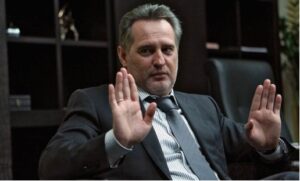
In 2022-2023, Dmytro Firtash, a gas business owner residing in Austria since 2014, whose extradition Washington has been seeking for many years, was deprived of his assets in Ukraine.
His gas distribution companies were nationalised: corporate rights were confiscated at the request of the State Bureau of Investigation (SBI), and the enterprises themselves were transferred to the management of the state Asset Recovery and Management Agency (ARMA).
The High Anti-Corruption Court of Ukraine (HACC), considered the most impartial institution and recently created to handle corruption cases, lifted the arrest on the company’s shares.
However, Firtash did not regain his property. His assets were transferred under the control of the state company “Naftogaz.”
Dmytro Firtash
Since the beginning of 2023, troubling processes for businesses have continued and expanded
News about searches and criminal cases against well-known businessmen have become frequent, with many left bewildered by the claims made against them.
Oleksandr Kosovan, the founder of the IT company MacPaw, whose programs are installed on one out of every five Mac computers, invested over 25 million euros in a recreation centre for his company’s employees and faced searches due to unauthorised shoreline expansion on the plot where the wellness complex is being built.
The Bureau of Economic Security (BES), an agency created as a result of reforms to replace the tax police, initiated a case against the company “M-Kino,” which owns the “Multiplex” cinema chain, for tax evasion.
A sudden raid by the SSU and National Police on the office of the developer ImproveIT Solutions almost disrupted the company’s project for an important U.S. client. Investigators came under the pretext of a case involving the “creation and distribution of pornography,” seizing five laptops. Six days later, the equipment was returned without any explanation.
These are just a few examples of the large number of incidents that occurred with Ukrainian business at the end of 2022 – beginning of 2023. The two most high-profile events in the spring of 2023 concerned the activation of very old criminal cases to achieve dubious goals.
In April last year, the Pechersk Court of Kyiv seized the corporate rights of the gas production company “Ukrnaftoburinnya” as material evidence in a case that was initiated almost 10 years ago. Five days later, these rights were transferred to the management of ARMA, effectively taking the company away from its owners and forcibly nationalising it.
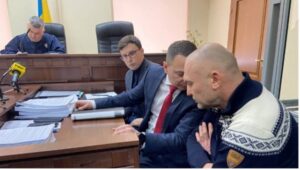
Another criminal case, also initiated 10 years ago around land privatisation, led to searches at the home of Igor Mazepa, the founder of the investment company Concorde Capital, who is popular among business circles and journalists. Mazepa called on the business community to organise self-protection against the arbitrariness of officials and judges. He was supported by other entrepreneurs, leading to the creation of “Manifesto 42.”
Ihor Mazepa in Pechersk Court of Kyiv
Mazepa’s initiative and that of his like-minded supporters led to a public discussion of the situation. Articles appeared in the press, where journalists sought answers to why the number of business complaints about repression had increased several times.
One of the most in-depth investigations was published in May 2023 in the Ukrainian Forbes under the eloquent title “Taxes, the ubiquitous Tatarov, the Russian trace. Businessmen complain that security forces are increasing pressure. There are at least five reasons for this and only one piece of advice.”
The article is the first to formulate an explanation and to name an official who is considered the “general producer” of pressure on business.
“Four interlocutors from the financial, economic and anti-corruption committees of the Verkhovna Rada, as well as the OP (Office of the President), believe that the pressure on business is directly or indirectly related to the fact that almost all law enforcement agencies came under the influence of the President’s Office, namely the deputy head of the OP, Oleh Tatarov.
Oleh Tatarov, Deputy Head of the Office of the President of Ukraine
“Since the times of the Revolution of Dignity, there has been no instance where all law enforcement agencies were under the control of one person,” says one interlocutor in the Verkhovna Rada, asking not to be named in this article.
“It is difficult to oppose such a person.”
Another interlocutor notes that this situation has led to the destruction of the system of checks and balances, saying that “Previously, there was competition between law enforcement agencies, and they were afraid of each other.”
“A businessman could complain about the SSU to the police. Now there’s no one to complain to – they’re all in the same harness.”
The publication garnered huge resonance and led to a meeting between business representatives and the President in June 2023
The business community hoped for the dismissal of Tatarov or at least his removal from positions of influence.
However, instead, in July 2023, Tatarov began participating in a coordination platform for resolving problematic issues between business and law enforcement agencies, signalling the retention of his dominant role.
On January 19, 2024, the initiator of the “Manifesto 42” movement, Mazepa, was arrested without a court decision on his way to the Davos Forum.
The arrest was carried out by employees of the State Bureau of Investigation (SBI) and the National Police – law enforcement agencies over which Tatarov has significant influence.
Why are Ukrainian businesses afraid of Tatarov?
Deputy head of the Office of the President (OP) Oleh Tatarov is disliked by business, anti-corruption activists and the press, since he personifies the corrupt pro-Russian government that Ukrainians got rid of during the Revolution of Dignity in 2014.
The democratic uprising in Ukraine was an anti-Russian, pro-European action triggered by the refusal of the authorities, led by the leader of the Party of Regions, President Viktor Yanukovych, to sign an Association Agreement with the EU. Russia was against this agreement.
At the end of November 2013, the police beat protesting students. This sparked a nationwide uprising, resulting in Yanukovych fleeing to Russia and the election victory of pro-European politicians in Ukraine.
From 2011 to 2014, Tatarov was the deputy head of the investigative department of the Ministry of Internal Affairs and publicly justified the actions of the authorities and police. Later, as a lawyer, he defended police officers involved in the shootings of demonstrators.
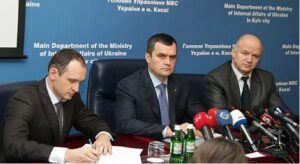
Tatarov (left) and the head of the Ministry of Internal Affairs during the Yanukovych era, Vitaliy Zakharchenko (center) in December 2013
He established his network of agents even before actor Volodymyr Zelensky won the presidential elections in 2019. Journalists found information about 59 people who defended their scientific dissertations with Tatarov’s participation between 2014 and 2020, when he was not yet working for the government. Among them were judges, police officers, and prosecutors considered loyal to him.
Tatarov’s personality was a discordant element with the programmatic theses of the new president, who shortly after his election signed a law on business protection, promised to bring Ukraine into the TOP-10 of the World Bank’s ease of doing business ranking within 3-4 years, and declared that “the State is a service agency creating conditions for business.”
Presumably, in 2020, the young, inexperienced, and romantically inclined government team needed a communicator with the old part of the official law enforcement and judicial system from which they could not quickly get rid of. The choice fell on Tatarov. Subsequently he used the transformation of power caused by Russia’s invasion to strengthen his positions.
Recently, Reuters published a major article on how, after his election, Zelensky tried to introduce the most liberal order in Ukraine, and now he is a president under the constraints of democracy caused by martial law.
Most of Forbes’ interlocutors, close to the Presidential Office and the economic wing of the government, confirm that Zelensky, deeply engaged in diplomacy and the situation on the front line, has no time and energy for the economy and business problems.
Tatarov demonstrated his growing influence two months after the war began
In April 2022, the criminal case initiated against him in 2020 by the National Anti-Corruption Bureau of Ukraine (NABU), an independent body created after the Revolution of Dignity, was closed.
NABU only managed to arrest Artem Shylo, who until recently headed the SSU department for investigating cases against businesses. Anti-corruption activists call him Tatarov’s main trusted person and the curator of ARMA, where nationalised assets are transferred for management.
It is also worth mentioning the conflict between Tatarov and NABU. The successful work of this anti-corruption body is one of the most important requirements of Ukraine’s Western partners. However, as Tatarov has stated, “NABU is not a Ukrainian story.”
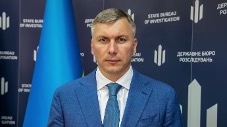
Oleksii Sukhachov, Director of the State Bureau of Investigation (SBI)
Tatarov’s orbit includes the head of the SBI (State Bureau of Investigation of Ukraine), Oleksiy Sukhachov. Their connection is so close and specific that it extends beyond official matters – Sukhachov, along with Tatarov and four other members of the selection committee for the head of the SBI, even co-authored and reviewed books.
It is possible that Tatarov also had a hand in the career of the current head of the SSU, Vasyl Maliuk. After Maliuk was dismissed from his position as the first deputy head of the SBU and head of the anti-corruption department in 2021, Tatarov facilitated his appointment as deputy minister of internal affairs.
Another ally of Tatarov is Rostyslav Shurma, the deputy head of the OP overseeing the economic bloc. These two are the only former members of Yanukovych’s notorious Party of Regions among all the employees of the Presidential Office.
The relationship between Tatarov and Shurma was recently solidified by a court decision. In March 2024, Judge Svitlana Shaputko of the Pechersk Court, who defended her dissertation with Tatarov’s help in 2018, dismissed the case against Shurma for violating conflict of interest prevention requirements, as accused by the National Agency on Corruption Prevention.
They appeared together at the business meeting in July 2023, crushing the hopes of “Manifesto 42” participants to convey the need for personnel changes to the President.
Their relationship is potentially very dangerous for business.
Tatarov has the leverage to organise the illegal seizure of private property through the courts and apply pressure from the security services. Shurma coordinates the appointment of state-controlled managers to positions managing confiscated assets.
Shurma’s desire to see his protégé lead the largest oil production and refining holding, consisting of “Ukrnafta” and “Ukrtatnafta,” may have led to the dramatic consequences for shareholders unjustifiably deprived of property rights and, more importantly, to damage to the state’s interests.
Click on the diagram below to have the full picture in a big window
Tatarov’s network
The story of “Ukrnafta” and “Ukrnaftoburinnya” has become a symbol of lawlessness
During the Davos Forum-2023, Shurma provided an explanation for why the authorities seized shares from private owners of “Ukrnafta,” including non-residents, in November 2022.
According to him, it was due to the company’s management refusing to supply petroleum products to the Ukrainian army.
At the same time, the former chairman of the board of “Ukrnafta,” Oleh Hez, called this information unreliable.
“Ukrnafta” is an oil production company; it does not produce petroleum products but only sells the extracted oil.
“Ukrnafta” has never had obligations to supply fuel for the needs of the Armed Forces of Ukraine. Despite the lack of obligations, since the Russian invasion, the then-management of “Ukrnafta” systematically provided assistance to military units and territorial defence units, refuelling military equipment at “Ukrnafta” gas stations for free.
The former head of the supervisory board of “Ukrnafta,” Mykola Havrylenko, was frankly surprised by this interpretation.
“All I can say is that I am unaware of any unmet obligations for the supply of petroleum products by ‘Ukrnafta.’ If such issues ever arose, they would have been brought up in meetings, and if not – I have no other information. What volumes are being discussed, and at what times… This is news to me,” he commented on the issue for the media.
The term “nationalisation” used by Shurma in the context of “Ukrnafta” sounds incorrect, as until November 2022, the controlling stake (51%) was already owned by the Ukrainian state through NJSC “Naftogaz of Ukraine.”
Nothing prevented the state, as the main shareholder, from changing the company’s management or deciding to direct all revenues to support the Armed Forces of Ukraine.
Instead, under the slogans of the need to “punish” “Ukrnafta” for not supplying fuel to the army, the Law of Ukraine “On the Transfer, Forced Alienation, or Exclusion of Property under the Legal Regime of Martial or State of Emergency” was used, to allow the confiscation of property from citizens and enterprises during wartime until its end.
Subsequently, the assets must be returned to the owners, or if this is impossible, their market value must be compensated.
According to the provisions of this law, only property necessary for military needs can be confiscated. However, in this case, it was not petroleum products (which, as we recall, “Ukrnafta” did not produce) that were confiscated, but 49% of the shares of “Ukrnafta” minority shareholders, signed by the Commander-in-Chief of the Armed Forces of Ukraine.
The seizure of private foreign investors’ shares allegedly for military needs appears strange. At the same time, a new director, Serhiy Koretsky, was appointed, fully controlled and accountable to the Deputy Head of the Presidential Office, Shurma.
There were no complaints about the performance of the management of “Ukrnafta,” which was unjustifiably dismissed in November 2022. Former Deputy Minister of Finance of Ukraine, Olena Makieieva, stated in an interview, “The Supervisory Board exercised appropriate oversight of the board’s activities, the audit committee(under the Supervisory Board of ‘Ukrnafta’ – ed.)had no complaints about the work of the head of the company and board members.”
One of the authors of the Ukrainian corporate law reform aimed at converging with the best European practices, Serhiy Boytsun, declared in March 2023 that the new Supervisory Board of “Ukrnafta” was illegitimate since it was formed in violation of the law on joint-stock companies.
Foto- Ukrnafta’s Head Office
This also applies to the company’s appointed head, Koretsky, as he was appointed by an illegitimate Supervisory Board.
Boytsun’s remark about the quality of corporate governance in “Ukrnafta” after the so-called “nationalisation” is noteworthy: “There can be no talk of corporate governance standards since the Supervisory Board consists solely of representatives of the shareholder (Ministry of Defence) and acts solely as silent signatories.”
Quality corporate governance in strategically important companies is a mechanism that should balance interests in a civilised manner.
It is obvious that after November 2022, such a statement is impossible regarding “Ukrnafta.”
“You don’t need to be an insider to understand that there is now manual control,” Boytsun asserted. From the perspective of corporate law, in his opinion, the decision to seize “Ukrnafta” shares from minority shareholders is deeply flawed.
Under full state control, “Ukrnafta” became the subject of corruption and management scandals. Instead of providing free fuel to the Armed Forces of Ukraine (the basis for applying the “military law”), the new company management sued its curator, the Ministry of Defense, to expedite the receipt of more money.
In violation of Cabinet of Ministers Resolution No. 178 of 02.03.2022, according to which operations for the supply of petroleum products to the army, National Guard, and other security structures during the war are subject to a zero VAT rate, “Ukrnafta” included a 7% VAT rate in the contract, and then, after its change, 20%.
Through this manipulation, it received an additional 350 million UAH (7.8 million euros).
To force the Ministry of Defense to pay even more money, the company went to court. This outraged a member of the Ukrainian parliament, the first deputy head of the parliamentary energy committee, Oleksiy Kucherenko, who sent a parliamentary inquiry to the Prosecutor General of Ukraine.
The situation is even worse at the oil and gas company “Ukrnaftoburinnya” (UNB). This was the second-largest gas producer in Ukraine among private companies. Now it has stopped operating altogether, even though Ukraine urgently needs its own energy resources and budget revenues from taxes during the war.
In the spring of 2023, the company was taken away from private owners for no apparent reason and transferred under the control of Koretsky. The reason for the confiscation was a criminal case related to a licence to develop the Sakhalin field in the Kharkov region, where Russian troops are trying to break through.
Over the course of a few days in April 2023, the Pechersky Court of Kyiv issued three court decisions. The company’s shares, seized as evidence in a criminal case, were transferred to ARMA, which, in turn, transferred them to the management of Ukrnafta. This decision was made by judge Vita Bortnitskaya, who once defended her dissertation with the help of Tatarov.
To legalise the actions of transferring “Ukrnaftoburinnya” under the management of “Ukrnafta,” it was necessary to obtain a document from the Antimonopoly Committee of Ukraine (AMCU) stating that such a merger did not result in market monopolisation.
This document was obtained, but with apparent signs of procedural and legal violations. In the future, it could become the subject of a criminal or anti-corruption case.
However, even these attempts at falsification proved pointless. What was supposedly being avoided by transferring the company to state management still happened.
The problematic licence, which was the reason for seizing “Ukrnaftoburinnya” from its owners, was annulled by the court. The company halted production at Sakhalinsk, at a time when Ukraine critically lacks energy resources.
Foto – Oil production in Ukraine
Deputy Kucherenko asked the ARMA management why, many months after the licence was revoked on November 28, 2023, the gas production company’s work had not resumed.
He also asked Koretsky whether the state manager of Ukrnaftoburinni, Oleg Malchik, was present at the court hearing on November 28, 2023. He further questioned the fact that instead of attending the court hearing about the fate of his company, Malchik went abroad, despite the fact that Ukrainian men aged 18 to 60 are prohibited from freely leaving the country during the war.
The main mystery is why ARMA, together with “Ukrnafta,” from August to November 2023, before the court’s decision to revoke the licence, did not appeal to the Cabinet of Ministers and the state geological service to withdraw the state regulator’s lawsuit?
Perhaps the true goal of the nationalisation of “Ukrnaftoburinnya” was not to save the enterprise but to destroy it, so that some company close to officials could profit from the field’s development?
The climax of absurdity from the perspective of state interests is the seizure of regional gas distribution companies from businessman Firtash into state ownership.
The payment level for gas by the population in Ukraine was already quite low before the full-scale war.
Following the sharp decline in income after the full-scale invasion, it fell to an extremely low level. Under the private owner (Firtash), the losses were borne by him, but after nationalisation, they became an additional burden on the state budget of Ukraine, which had a deficit of 18.6% of GDP in 2022 and 20.6% of GDP in 2023.
The budget deficit for 2024 is planned at 1.57 trillion UAH, but on July 15, the head of the parliamentary budget committee, Roksolana Pidlasa, announced that th budget still lacked 0.4-0.5 trillion UAH this year. At this time, the unpaid gas bills of impoverished Ukrainians are being covered by the state budget instead of billionaire Firtash.
It is likely that the initiators of the seizure of his gas distribution companies were guided by personal enrichment – schemes for gas misappropriation and theft are popular – rather than by state interests.
Will Ukraine be able to raise billions for its reconstruction if it cannot guarantee property rights to investors?
The July statement by the participants of “Manifesto 42” exudes pessimism. Nearly 2.5 years after Russia’s attack on Ukraine, Ukrainian businesses do not complain about the hardships of war and the severe destruction of the energy system that complicates their work.
They ask the authorities not to violate their constitutional rights to business and not to seize their property under the pretext of wartime needs.
Ukraine is desperately and heroically resisting Russian aggression. Each Russian missile strike leads to severe destruction and casualties in various cities across the country.
The destruction of the central children’s hospital in the capital, Kyiv, where Ukrainian children were being saved from cancer and other severe diseases, shocked the world. In a few hours, Ukrainian businesses raised tens of millions of euros to rebuild the clinic.
Not a single businessman who legally works in Ukraine, who financially and technically supports the army in countering Russian aggression, and who complains about the inconveniences associated with logistics issues, the partial occupation of Ukrainian territories and the mobilisation of the male population, can be completely sure that he will not face unfounded claims from corrupt judicial and law enforcement agencies and will not lose its business based on unfounded future accusations.
Tatarov Remains a Very Intimidating Figure
Investigative journalists and anti-corruption activists who consistently criticise Tatarov and claim that his actions delay Ukraine’s accession to NATO and the EU face criminal charges.
This threat extends even to those who have mobilised into the ranks of the Armed Forces of Ukraine (AFU), as was stated by Daria Kaleniuk, Executive Director of the Anti-Corruption Action Centre, in the corridors of the discussion “A Decade of Transformation: Rule of Law and Anti-Corruption in Ukraine with EU Support.”
She referred specifically to the well-known activist Vitaliy Shabunin.
According to estimates by the UN, World Bank, and European Commission, rebuilding Ukraine after the war’s destruction will require 480 billion euros over the next 10 years.
At the “Reconstruction of Ukraine 2024” conference in Berlin in June 2024, Ukrainian authorities presented numerous projects vying for private investments from foreign investors. However, the risks of investment and property loss were not addressed.
The business world remains observant and cautious
Co-owner of the IT company Genesis, Volodymyr Mnogoletniy, stated in an interview with Forbes that in the two years of war, he had not seen a single major foreign investor willing to invest in Ukraine.
The primary investors and job creators in the country are Ukrainian enterprises, which are being oppressed by high-ranking officials.
Currently, insurance is only available against losses caused by the war. However, there is no insurance against property seizures by officials who were members of Yanukovych’s pro-Russian party, and now, during the war, have received unlimited power by occupying key leadership positions in the Office of Zelensky, a president who probably doesn’t even suspect the critical character of the situation that his inner circle has created.
(*) Alexander Stern
Analyst and journalist, born in 1973. He graduated from Riga Technical University in 1995. Until 2016, he worked as an analyst at ABLV Bank, one of the largest private banks in the Baltic States, headquartered in Riga (Latvia) with representative offices abroad from 1993 to 2018. Afterwards, he worked in France as a freelance investigation journalist. Consultant on business mergers and acquisitions.
On 18 July 2024, the European Court of Human Rights examined nine complaints filed by Jehovah’s Witnesses in Russia who were subjected to illegal searches, arrests, and convictions because of their religious beliefs. The Russian Federation is obliged to pay 156,000 euros as financial compensation compensation and 4,000 euros in legal costs to Jehovah’s Witnesses.
Valeriy Moskalenko paid the fine imposed on him. Irina Buglak continues to serve a suspended sentence. Dmitriy Barmakin, sentenced to eight years in prison, is awaiting his transfer to a penal colony. And the case of Roman Makhnev is expected to go to court soon.
According to the ECHR decision, the Russian Federation violated three provisions of the Convention for the Protection of Human Rights and Fundamental Freedoms in relation to the applicants.
Thus, the court called the detention of the believers in metal cages during the hearings a manifestation of degrading treatment (Article 3), and considered detention, searches and seizure of property ungrounded and illegal (Article 5). The ECHR also found that the applicants had been subjected to arbitrary criminal prosecution merely for practicing their faith, which was in violation of the Article on Freedom of Thought, Conscience and Religion (Article 9).
Russia ceased to be a party to the European Convention on Human Rights on September 16, 2022, but the consideration of these complaints is still within the jurisdiction of the ECHR because they cover incidents that took place in 2018-2020.
A backlog of over 3,600,000 EUR fines decreed by the ECHR still unpaid to Jehovah’s Witnesses
The Russian Federation remains obliged to pay the financial compensation to the believers, including under other decisions of the European Court. The total amount already exceeds 3,600,000 euros.
On June 7, 2022, the ECHR declared illegal
the liquidation of the administrative center and another 395 legal entities of Jehovah’s Witnesses by Russia,
the ban on their activities,
the seizure of property,
the prohibition of printing their publications and
The decision was issued in the case “Taganrog LRO and others v. Russia”, in 2022, in which a total of 20 complaints filed by Jehovah’s Witnesses from 2010 to 2019 were combined.
The total number of applicants was 1444, of which 1014 are individuals and 430 are legal entities (some applicants appear in more than one complaint). According to the ruling, in total, Russian Federation is obliged to pay the applicants EUR 3,447,250 in respect of non-pecuniary damage and to return the seized property (or pay EUR 59,617,458).
By its actions, Russia violated the provisions of several articles of the Convention for the Protection of Human Rights and Fundamental Freedoms: right of personal freedom (Article 5), freedom of thought, conscience and religion (Article 9), freedom of expression (Article 10) and freedom of assembly and association (Article 11). In addition, Article 1 of Protocol No. 1 (the right to respect for property) was violated.
Yaroslav Sivulsky of the European Association of Jehovah’s Witnesses said: “We are grateful to the Strasbourg Court for its authoritative qualified legal understanding of the unprecedented situation that has developed in Russia with Jehovah’s Witnesses. We hope that today’s ruling will help the Russian authorities to restore the rule of law and rights in relation to more than 175,000 believers of our religion in the near future.”
After the era of Soviet repressions had ended in the early 1990s, Jehovah’s Witnesses received official registration in Russia in 1992. Thereafter, their meetings for worship were attended by up to 290,000 people. In 2017, the Supreme Court of the Russian Federation liquidated all legal entities and confiscated hundreds of religious buildings. Police crackdowns and searches started again and hundreds of believers were sent to jail for years.



 OSCE 2024″ class=”wp-image-157549″ style=”width:303px;height:auto”/>