
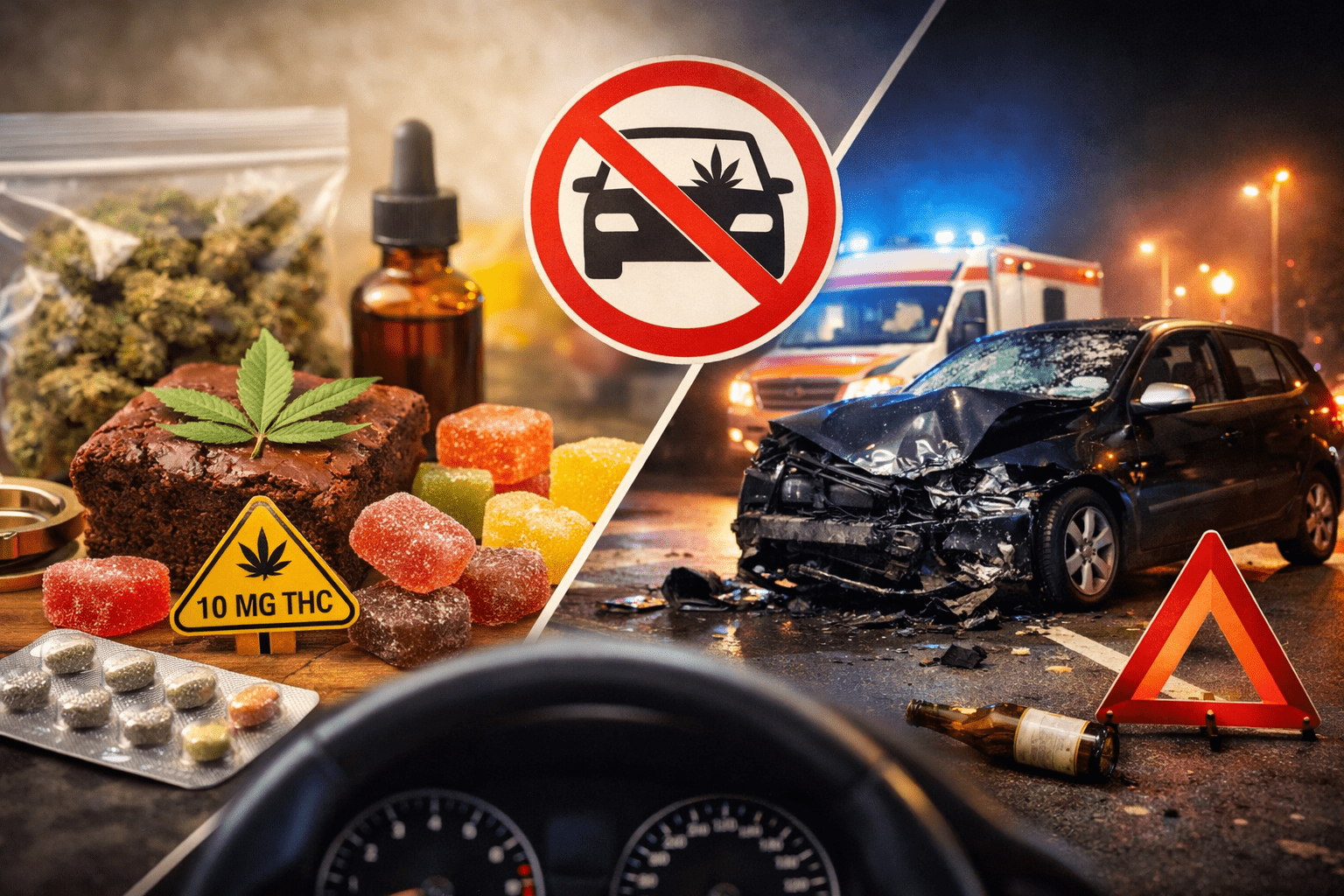
A Canadian simulator study found striking crash rates after THC edibles. In Europe—where road deaths remain high and cannabis use is widespread—the message is simple: drugs and driving do not mix, and the safest choice is not to use.
An 11 January report by Technology.org, based on research from the University of Saskatchewan, points to a major safety risk: young drivers who consumed a THC edible were far more likely to crash in a driving simulator, with impairment lasting for hours. For Europe—where nearly 20,000 people died on EU roads in 2024 and cannabis remains the most commonly used illicit drug—this is not an abstract debate. It is a public-safety issue, with real victims.
A study that challenges “I’m fine to drive” assumptions
The research highlighted by Technology.org originated at the University of Saskatchewan. It tracked driving performance in a simulator after participants consumed an edible containing 10 mg of THC—the psychoactive component of cannabis. Researchers assessed participants before consumption and again at multiple points after: 1.5, 2.5, 4, and 6 hours later.
The headline result was hard to ignore: more than three-quarters of participants crashed in the simulation after taking the edible. Even four hours after consumption, more than half still crashed. Researchers observed slower decision-making, poorer lane control, and delayed reactions—problems that, in real traffic, can mean a pedestrian hit in a crosswalk or a split-second failure to avoid a sudden stop.
Crucially, the study also cuts against a popular myth: that edibles “take a long time” to matter, so a short drive soon after eating one is safe. The researchers reported measurable impairment surprisingly early, and lingering effects hours later. While the findings come from a simulator rather than open-road testing, the point for policymakers and the public is the same: impairment is real, and it can last longer than users expect.
Why this matters in Europe right now
Europe is not watching cannabis from a distance. According to the European Union Drugs Agency (EUDA), cannabis is the most widely used illicit drug in Europe. Use is particularly high among younger age groups—exactly the demographic in the simulator study.
At the same time, Europe’s roads remain deadly. The European Commission reported that 19,940 people died on EU roads in 2024. Those deaths are not statistics to be managed—they are families permanently changed. Any factor that increases collision risk, even modestly, can translate into thousands of additional casualties across a continent of daily commuting, freight transport, and cross-border travel.
This is one reason European institutions have long treated drug-impaired driving as a serious threat. The European Commission’s Road Safety Observatory notes that, in EU research on seriously injured and killed drivers, cannabis is often the most common illicit drug detected in the bloodstream. Many countries have adopted strict approaches to enforcement and penalties for drug-driving, reflecting a basic principle: public safety outweighs the convenience of intoxication.
Edibles add a specific risk: delayed, prolonged impairment
One reason edibles are particularly concerning is that the “feel” of impairment does not always match the actual level of impairment. People may underestimate how affected they are—especially when there is no smoke, no smell, and no immediate “hit.”
In the Canadian study described by the University of Saskatchewan, impairment remained significant at the two-and-a-half and four-hour marks, tapering only later. In practical terms, that means a person who consumes an edible in the evening may still be meaningfully impaired when they decide—confidently—to drive later the same night.
For Europe, this matters because cannabis products and potency are changing, and debates over regulation are evolving. The EUDA has warned that road safety concerns are part of the policy landscape as legal availability changes in some jurisdictions. In Germany, for example, legislators have moved to define a statutory THC threshold for road traffic enforcement—an attempt to align enforcement with scientific evidence while still prioritising safety.
Europe’s policy direction: tighter enforcement, clearer deterrence
Across Europe, governments are increasingly signalling that drug-driving will be met with tougher enforcement, not tolerance. In the United Kingdom, the government’s new road safety strategy—launched on 7 January 2026—includes proposals aimed at stronger action against drink and drug driving, including new powers linked to suspected impairment and a broader enforcement push. The political message is direct: dangerous driving behaviour will not be normalised.
That deterrence matters. Road safety is one of the rare policy areas where public consensus is possible: people can disagree about drug policy, but few defend the “right” to drive while impaired. The harms fall on strangers—other drivers, cyclists, pedestrians, children—who did not consent to the risk.
A public-health perspective that is unambiguous
Europe’s wider conversation on drugs often includes “harm reduction.” But harm reduction does not mean harm denial. When it comes to driving, the ethical line is clear: impairment puts other people in danger, and there is no safe justification for it.
From a public-health standpoint, the simplest prevention message is also the strongest: do not use drugs. For those who do, the minimum safeguard is equally clear: do not drive, do not ride a scooter or e-bike in traffic while impaired, and do not accept a lift from someone who has used cannabis—especially edibles.
European cities already struggle with the wider costs of drug use: emergency admissions, dependency, violence linked to trafficking, and social harm that concentrates in vulnerable neighbourhoods. As previous reporting by The European Times on Brussels’ drug pressures has noted, communities often carry the burden long after the “choice” was made. On the road, that burden can be immediate and irreversible.
What Europeans should take from the evidence
- Drugs and driving don’t mix. The safest choice is not to use drugs at all.
- Edibles are not “safer” for driving. The University of Saskatchewan findings suggest impairment can appear earlier than expected and last for hours.
- Waiting “a bit” is not a plan. The study observed high crash rates even four hours after consumption.
- Policy should follow evidence. Public education, clear deterrence, and reliable enforcement matter—especially for younger drivers.
- Protect others. The right to mobility for everyone depends on keeping roads free from avoidable risks.
Europe’s road safety goals need a hard line on drugs
The EU’s “Vision Zero” ambition—moving towards eliminating road deaths—requires action on the causes we can control. Drug-impaired driving is controllable. It is a choice, and it is preventable.
The Canadian simulator study will not settle every scientific question on its own. But it adds to a growing body of evidence that cannabis—particularly edible THC—can significantly impair driving, and for longer than many users assume. For Europe, where cannabis use is common and road deaths remain a stubborn reality, the public-interest conclusion is straightforward: reject drug use, and enforce zero tolerance for driving under the influence.
Leave a Reply