
Category: Defense

  • EU demands respect after Trump’s Greenland tariff threat

    EU demands respect after Trump’s Greenland tariff threat

    EU demands respect after Trump’s Greenland tariff threat

    Extraordinary Brussels summit underscores Europe’s red lines on sovereignty and economic coercion, while raising fresh questions about the future tone of transatlantic ties.

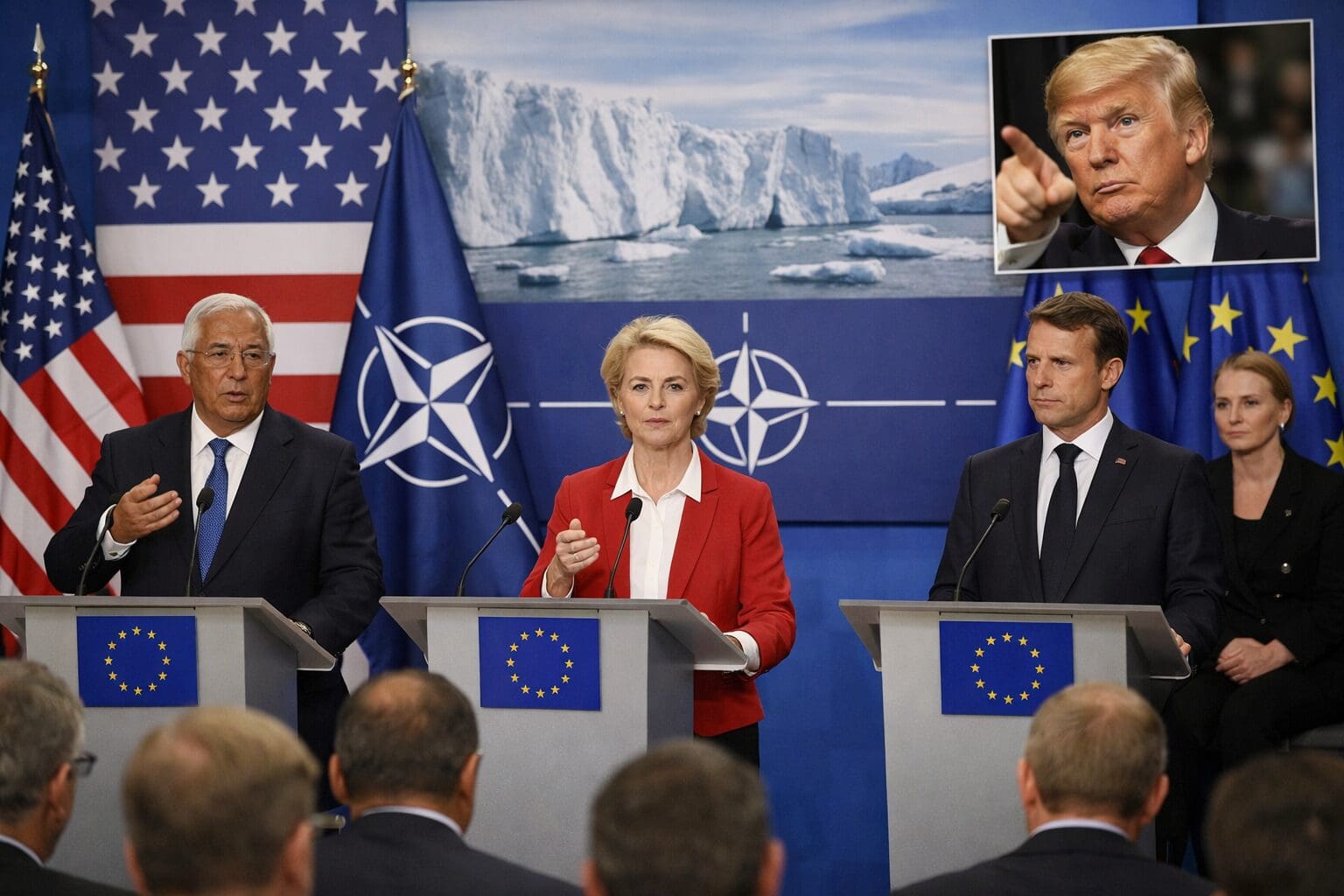
    EU leaders used an extraordinary summit in Brussels to send a blunt message to US President Donald Trump: Europe expects “cordial and respectful” dealings, especially after a crisis in which Trump threatened punitive tariffs linked to Greenland. The immediate confrontation eased after a NATO-brokered Arctic security framework was announced, but European officials signalled they are ready to defend sovereignty and markets—potentially with the EU’s powerful Anti-Coercion Instrument.

    Speaking after the emergency meeting, European Council President António Costa framed the issue as one of principle and method. “We believe that relationships between partners and allies should be managed in a cordial and respectful way,” he said, warning the EU would defend its interests “against any form of coercion,” according to a report by Euronews.

    European Commission President Ursula von der Leyen struck a similar note, presenting unity as the bloc’s main leverage. She said the EU had been “successful” in pushing back against territorial claims by being “firm, non-escalatory and most importantly very united,” Euronews reported. At the same time, she urged Europeans to strengthen economic resilience, diversify supply chains and reduce vulnerabilities in key sectors.

    A five-day crisis, then a fragile pause

    The episode—described by European diplomats as a near-brink moment—was defused when Trump backtracked and opted for a longer-term arrangement on Arctic security brokered by NATO Secretary General Mark Rutte. Yet details of that framework have not been released, feeding suspicion in several capitals that the political clash could reappear in another form.

    Leaders privately worried that a rapid escalation—tariffs met with countermeasures—could cause wider economic damage and complicate coordination on security priorities, including continued efforts to end Russia’s war against Ukraine. The relief in Brussels, however, came with a message: deterrence matters, and so do predictable rules between allies.

    Greenland’s sovereignty and the people at the centre

    Danish Prime Minister Mette Frederiksen drew the clearest line. Denmark is prepared to discuss matters related to Greenland with Washington, she said, but sovereignty is “off the table”—a “red line”—and “our democratic rules cannot be discussed,” according to Euronews.

    Greenland is an autonomous part of the Kingdom of Denmark with self-government established under the Self-Government Act framework. Any discussion about the island’s future also inevitably raises questions of democratic legitimacy and self-determination—especially for Greenlanders themselves, whose political agency can be sidelined when great-power competition dominates the headlines.

    For EU officials, that is not a rhetorical point. If territorial questions are even hinted at through economic pressure, it touches core European norms: sovereignty, the rule of law, and the right of peoples to decide their own future without coercion.

    The Anti-Coercion Instrument: Europe’s sharpest trade deterrent

    Before Trump’s reversal, the Commission began preparing potential responses in case tariff threats moved from rhetoric to action. Among the options discussed was using the EU’s Anti-Coercion Instrument, which entered into force in late 2023 and is designed to deter and—if needed—counter third-country “economic coercion.”

    The tool is intentionally broad. It can, in principle, target multiple areas at once—from trade in goods and services to investment flows, public procurement and intellectual property—while still operating within defined EU procedures and a “last resort” logic.

    The European Times has previously explored how this mechanism is meant to work in practice and why it matters for Europe’s economic security in an earlier explainer on the Anti-Coercion Instrument. The same debate is now returning in real time: how to remain non-escalatory, but credible, when pressure tactics appear at the edge of allied diplomacy.

    What this crisis reveals about the transatlantic relationship

    At its core, the Brussels summit was less about tariffs alone and more about trust. EU leaders signalled they want to preserve transatlantic cooperation, but not at the cost of normalising threats—territorial or economic—against a member state and its autonomous territory.

    The crisis has also revived a longer-running discussion in Europe: strategic resilience. Von der Leyen’s call to diversify supply chains and reinforce “economic power” fits a broader EU shift toward reducing single-point dependencies, alongside debates on industrial policy, defence cooperation, and the balance between openness and protection.

    As The European Times has reported in other contexts, Europe’s push to deepen its own capacity—whether in security or industrial policy—has become a recurring theme in Brussels. (See, for example, our coverage on strengthening defence cooperation in European politics.)

  • TASS reported a “prevented assassination attempt” against Metropolitan Tikhon (Shevkunov)

    The Russian state news agency TASS reported end of february a “thwarted terrorist act against Metropolitan Tikhon (Shevkunov) of Simferopol and Crimea.”

    Two of his students, graduates of the Sretensky Theological Seminary, have been arrested. As evidence, the FSB published their videos in which the two young men explain how they were recruited by Ukrainian services and how they were supposed to plant an explosive device in the living quarters of the Sretensky Monastery where Metropolitan Tikhon was staying. The two arrested are Nikita Ivankovich and Denis Popovich. They were very close to the metropolitan, with Denis Popovich (of Ukrainian origin) being his secretary and cashier.

    Russian human rights organizations reported on them a month ago. Popovich was arrested on January 13 on the way to the Sretensky Seminary for “petty hooliganism” because he was “shouting and speaking obscenely.” He was detained for fifteen days. Then he was charged with a new crime. Nikita Ivankovich, a subdeacon and singer at the Resurrection Church in Moscow, went to visit his classmate in prison, after which his home was also searched. “The shovel used to bury an explosive device in Terletsky Park in Moscow” was found there. The two are accused of “sending money to support the Ukrainian armed forces” in 2022. The Russian media did not report on the reaction of Metropolitan Tikhon (Shevkunov) and whether he tried to help his employees. Today, the two graduates of the Sretensky Seminary are accused of “organizing an assassination attempt” against Metropolitan Tikhon. Their acquaintances describe them as pacifists who were “for stopping the war.” They have not hidden their views, their comments on social networks over the past two years have been commented on in Russian pro-war Telegram Ζ-channels (for example, with the eloquent name “Bishop Lucifer”) where they are accused of “propaganda in the seminary of the ideology of the Kiev Nazi regime”. These channels are now publishing photos of their close clergy and friends with a demand that they also be held accountable.

    A similar plot unfolded in the Georgian Church several years ago. Then a close associate of Patriarch Ilia – Deacon Georgi Mamaladze – was thrown into prison on charges of “organizing the assassination of the patriarch” by transporting cyanide. Subsequently, the charge was changed to “attempted assassination of a high-ranking official of the patriarchate”, namely the “gray cardinal” Shorena Tetrushavili, but the case remained in the public domain as “attempted assassination of the patriarch”. The case was used to purge the patriarchate of metropolitans considered possible successors to the patriarchal see, as well as their supporters.

  • Russian State Arms Trading Company Announces Orders for $60 Billion

    The order portfolio of the Russian state-owned company “Rosoboronexport”, a specialized exporter of Russian weapons, has exceeded 60 billion dollars. This was stated by the CEO of “Rostec” Sergey Chemezov during the opening of the IDEX (International Defence Exhibition & Conference) 2025 arms exhibition in Abu Dhabi National Exhibition Centre (17-21.02.2025).

    Chemezov clarified that he was referring to orders within the framework of “Rosoboroneksport”, and not those of private Russian arms companies.

    Joint Stock Company “Rosoboronexport” (part of the state corporation “Rostec”) is the only state intermediary in Russia for the export and import of the full range of military products, including dual-use ones, technologies and services. The company actively participates in the implementation of the state policy of the Russian Federation in the field of military-technical cooperation with foreign countries.

    The official status of an exclusive state special exporter ensures that “Rosoboroneksport” implements large-scale projects to improve the defense capabilities of foreign partners in the field of international cooperation, as well as the innovative development of enterprises and organizations of the Russian military-industrial complex.

    Photo: The area of the Russian display exceeds 2,000 square metres at the International Defence Exhibition IDEX 2025 in Abu Dhabi, http://government.ru/en/news/54259/

  • Psychotherapist and deacon arrested in Ukraine

    The suspects tried to gather information about the concentration points of Ukrainian military personnel and equipment in Kharkiv

    Kharkov The Security Service of Ukraine (SBU) has detained a psychotherapist and a deacon from the Kharkiv diocese of the Ukrainian Orthodox Church (Moscow Patriarchate), who were spying on the Armed Forces of Ukraine on the orders of Russian intelligence services, Ukrinform reported.

    The suspects tried to gather information about the concentration points of Ukrainian military personnel and equipment in Kharkiv. They also collected personal data of Ukrainian defenders, as well as their travel routes within the city.

    The psychotherapist used his patients, including servicemen undergoing psychological rehabilitation after participating in combat operations, to gather intelligence.

    He enlisted the help of a close acquaintance, a deacon from the Kharkiv diocese, who discreetly tried to obtain information from parishioners. The deacon then passed the information on to the psychotherapist, who compiled the reports and sent them to his Russian courier via messaging apps.

    To communicate with the FSB, the agent used a separate phone and SIM card, which he hid in his mailbox.

    According to the SSU counterintelligence officers, the detained doctor had been a “sleeper agent” of the FSB for some time. In the spring of 2024, the Russian intelligence service activated him to carry out subversive activities in Kharkiv.

    During the searches, mobile phones and computer equipment containing evidence of cooperation with the Russian intelligence service were seized from the detainee.

    The two were held in custody without the right to be released on bail. They face a life sentence with confiscation of property.

    Illustrative Photo by Matti Karstedt: https://www.pexels.com/photo/child-holding-a-placard-11284548/

  • Christians in Aleppo Uncertain Fate

    The fate of Christians in Syria’s second-largest city, Aleppo, is uncertain, having been seized by an Islamist group dominated by the Syrian branch of al-Qaeda and other factions hostile to the Assad regime. The HTS group, whose Arabic name means “Organization for the Liberation of the Levant,” controlled parts of northwestern Syria before taking Aleppo. Although the group has toned down its rhetoric about establishing an Islamic caliphate, according to the New York Times, the group still wants to replace the government in Damascus with one inspired by Islamist principles.

    On November 30, the jihadists imposed a 24-hour curfew. They have assured the population that they will not use violence against civilians or buildings. A local Christian priest, who wished to remain anonymous, told La Croixq that the armed groups indeed “have not touched anything, but this is only the beginning. We have no idea what can happen after this. Time has stopped for Christians.” The cleric wonders how a city of 4 million people without functioning institutions will be governed.

    A local bishop also told Aleteia that in the first days after the capture of the country’s economic and cultural center, the situation was calm but very uncertain: “The attackers took care to reassure the citizens and promise them security and tranquility. Let’s hope they will keep their promises.” However, people fear that the city of many millions will still become an arena for military action with the Syrian army: “In a murderous civil war, death will reap both combatants and innocents.”

    More than 350 people have already been killed and thousands displaced, and the toll is expected to rise, said Cardinal Mario Zenari, the nuncio in Damascus. The Franciscan monastery complex in Aleppo was badly damaged by a Russian airstrike on December 1, but the monks said there were no casualties among them. “Syrians only want to flee their country after so many years of conflict, extreme poverty, international sanctions, an earthquake and a new wave of violence,” said Cardinal Zenari. Since the war began in 2011, Aleppo has welcomed many Christians, refugees from Idlib, in northwestern Syria, a stronghold for rebels and jihadists. These families have tried to rebuild their lives in Aleppo, but now their fears are returning and many have fled the city. In 2011, Aleppo had about 250,000 Christians, most of them Orthodox, or 12 percent of the city’s total population. As of 2017, there were fewer than 100,000 people; today, there are between 20,000 and 25,000.

    The parish priest of St. Francis Church in Aleppo, Father Bahjat Karakach, said people were tired “and did not have enough energy to face another battle, the beginning of another war.” Decisive intervention by the international community was more urgent than ever, he said.

    The Orthodox Greeks in Aleppo, known as the Levantine Greeks, have appealed to the Greek government in Athens to do everything possible to protect the Antiochian Greeks, who live mainly in Aleppo, Banias, Tartus and Damascus. Several dozen such families remain in the city. In their letter to the Greek foreign minister, they wrote: “In Aleppo, the children of our relatives and their families are living in great danger. Their lives are at risk, abandoned to their fate. Last month, they commemorated the tragic memory of the 1850 massacre in Aleppo, when Christian neighborhoods were destroyed, one of the reasons for this tragedy being the support of the Antiochian Greeks of Aleppo for the Greek Revolution. … For centuries we have suffered oppression – under the Ottomans and during Islamic rule – because we have never renounced our connection to Constantinople and the rest of Greece. Today, the Christians of Aleppo are alone. The regime has abandoned our neighborhoods, leaving us to face these challenges alone. Now we call on you, our brothers and sisters in faith and heritage, to act. Aleppo was once the greatest Christian city in the Levant, a center of Hellenic culture, faith, and art. Do not let it fall. Use all the diplomatic power of Greece to protect the Christians of Aleppo. Work with the nations – Turkey, the United States, and others – to ensure that this ancient community survives. “The children of Aleppo, whose ancestors supported Greece in its darkest times, are counting on you. The blood in their veins is the same as yours. Their future is linked to yours, as it always has been.”

    The Greek Orthodox Metropolitan of Aleppo, Ephrem (Maalouli), of the Patriarchate of Antioch, has called on Orthodox Christians to pray and behave prudently, limiting unnecessary outings and maintaining calm. Greek diplomats told Greek Reporter that the historic Greek community in Aleppo is approximately 50 families and that all Greeks in Aleppo are safe. Metropolitan Ephrem was elected to the see in late 2021 after the then Metropolitan Paul (Yazigi), brother of the Patriarch of Antioch, was kidnapped by Islamist rebels in the vicinity of Aleppo in 2013 and has been missing since.

    More than half a million people have been killed in Syria’s civil war, which erupted after the Syrian government cracked down on pro-democracy protests in 2011. The Assad regime is militarily supported by Russia, Iran and the Lebanese Hezbollah.

    Estimates of the number of Christians in Syria in 2022 range from less than 2 percent to about 2.5 percent of the total Syrian population. Most Syrian Christians are members of the Orthodox Patriarchate of Antioch (700,000) or the Syro-Jacobite (Monophysite) Church. There are also Catholics, members of the Uniate Melkite Church.

  • The beluga Hvaldimir acquitted

    The mystery of why a Russian beluga whale, which appeared years ago off the coast of Norway, was dressed in a harness and called a “spy”, may have finally been solved, the BBC reported.

    A marine expert believes that the animal did escape from a Russian military base, but it is unlikely to have been a spy.

    The tame beluga first made headlines in 2019 when it approached fishermen off Norway’s northern coast wearing a harness, sparking speculation that it was an escaped Russian “spy whale”.

    According to the account of one of the fishermen at the time, the animal began to rub against their boat. He said he had heard of animals in distress that instinctively knew they needed help from humans and thought it was “one smart whale”.

    Fishermen help the beluga free from the harness, after which it swims to the nearby port of Hammerfest, where it lives for several months.

    Local residents call the animal Hvaldimir – a combination of the Norwegian word for whale – hval – and the Russian name Vladimir, BTA adds.

    Seemingly unable to catch live fish to eat, the beluga charmed visitors by poking at their cameras and even in one case returned a cell phone.

    Fascinated by the story of the whale, Norway is taking steps to have it watched and fed.

    Now Dr. Olga Shpak, an expert on the species, says she believes the whale was indeed owned by the military and escaped from a naval base in the Arctic Circle. However, she does not believe that the beluga was a spy.

    Shpak believes that she was trained to guard the base and escaped because she was a “bully”.

    Russia has always refused to confirm or deny that the whale was trained by its military.

    But Dr Shpak, who worked in Russia researching marine mammals from the 1990s until returning to her native Ukraine in 2022, told BBC News: “For me it’s 100 per cent (certainly )”.

    Olga Shpak, whose account is based on conversations with friends and former colleagues in Russia, features in the BBC documentary Secrets of the Spy Whale, which is now on BBC iPlayer and was broadcast on BBC Two.

    Dr. Shpak does not want to name her sources in Russia for their own safety, but says she was told that when the beluga surfaced in Norway, the Russian marine mammal community immediately identified it as one of theirs. Then, along the chain of vets and trainers, it was reported about the absence of an animal named Andrukha.

    According to Dr. Shpak, Andrukha/Hvaldimir was first captured in 2013 in the Sea of Okhotsk in the Russian Far East. A year later, he was transferred from a facility owned by a dolphinarium in St. Petersburg to the military program in the Russian Arctic, where his trainers and vets kept in touch.

    “I think when they started working in open water, trusting this animal (not to swim away), it just gave up on them,” she says.

    Shpak learned from her sources that Andrukha was smart, so he was a good choice for training. At the same time, the whale was something of a “hooligan” – an active beluga, so they were not surprised that he refused to follow the boat and went where he wanted.

    Satellite images from the Murmansk region in the Russian Arctic show whales that appear to be belugas in enclosures near a naval base.

    “The location of the whales very close to submarines and surface ships may suggest that they are actually part of a security system,” said Thomas Nielsen of the Norwegian online newspaper The Barents Observer.

    Unfortunately, the amazing story of Hvaldimir/Andruha does not have a happy ending. After learning to feed on its own, it spent several years traveling south along the coast of Norway, and in May 2023 was even spotted off the coast of Sweden.

    Then on September 1, 2024, his body was found floating in the sea near the town of Risavika, on the southwest coast of Norway.

    Although some activist groups have suggested that the whale was shot, this explanation has been rejected by Norwegian police. She reported that there was nothing to suggest that human activity was the cause of the beluga’s death. The autopsy found that Hvaldimir/Andrukha died after a stick was stuck in his mouth.

    Illustrative Photo by Diego F. Parra: https://www.pexels.com/photo/a-beluga-whale-swimming-underwater-24243994/

  • Pope Francis and the Peace Algorithm, A Renewed Path to Global Harmony

    A New Global Mediator

    Today’s world faces profound challenges, with one of the most significant being the crisis in international institutions established after World War II. The United Nations increasingly struggles to de-escalate military tensions, even in Europe, and cannot reform to meet new conditions. If one of the UN Security Council’s permanent members violates the Charter, it can use its veto to block compromise and neutralize the organization’s peacekeeping efforts.

    Under these circumstances, the world needs a new mediator—a person or institution with universal authority capable of influencing opposing sides. Pope Francis and the Holy See have this potential due to his spiritual influence, which reaches beyond confessional boundaries. His approach, often called the “peace algorithm,” rests on the belief that peace is achieved not through military victories but by creating conditions where all parties in a conflict can feel they have emerged victorious.

    The Papal Algorithm

    In the initial months of the full-scale war in Ukraine, Pope Francis proposed a “peace algorithm” designed, in his view, to satisfy both sides. This “algorithm” is not aimed at achieving a tactical victory but at creating common ground for all parties involved. For Francis, true victory means productive cooperation capable of confronting global challenges such as climate change or the need to explore space as Earth’s resources dwindle.

    Rome as an Archetype

    Pope Francis evokes the image of ancient Rome—a symbol of Pax Romana, in which diverse cultures coexisted harmoniously. The civilizations of Europe, Russia, America, and Asia are all deeply rooted in Rome’s cultural legacy. In this context, the Pope envisions Rome as a unifying symbol, not just metaphorically but also politically. Modern Rome, unburdened by historical entanglements between religion and politics, can serve as a model for new alliances among nations that recognize their shared cultural and historical contexts.

    A Neutral Vatican

    Since its establishment as a modern state in 1929, the Vatican has adhered to a principle of neutrality in international affairs. This tradition has been solidified by leaders like Pope John Paul II, who condemned the Iraq War and attempted to mediate between Saddam Hussein and the U.S., and Pope Benedict XVI, who criticized the war in Libya. Pope Francis continues this mission, meeting with world leaders—including Erdogan and Modi—and fostering respectful relations with both the West and with China and Russia. As a result, the Vatican has earned a reputation as a reliable intermediary in international relations.

    The Papal Peace Plan for Ukraine

    Recently, the Vatican released a peace plan for Ukraine that outlines the following steps:

    • Returning forcibly displaced children to their homeland under international oversight.
    • Full mutual exchange of prisoners of war, with a commitment to keep them from future military involvement.
    • Amnesty for individuals convicted of criticizing authorities (especially political prisoners) on both sides, affirming the principle of freedom of expression.
    • Lifting sanctions on relatives of Russian oligarchs who have not directly financed the military actions or engaged in political activities, as a goodwill gesture. These measures are intended to foster an atmosphere of trust conducive to further steps toward peace.

    Outlines of a New World Order

    Pope Francis proposes establishing a new, independent international forum for resolving global conflicts, where the Vatican could serve as a hub for negotiations. In a world where truly neutral states are dwindling, the Vatican maintains its potential as a mediator. The Holy See’s image is unassociated with any threat of revanchism or militarism, strengthening its role as a neutral party in global peacebuilding.

    A Global Project of Unity and Justice

    Pope Francis’s peace algorithm offers a path to fair and peaceful coexistence based on cultural values and respect for historical heritage. This approach views compromise as a formula that allows each side to feel victorious. This vision encourages calls to grant Pope Francis a broad international mandate as the principal mediator between conflicting parties in Ukraine. Such a mandate could be granted by the UN Security Council or the General Assembly, signaling the organization’s readiness for reform. The Vatican and the Pope, with no vested interest in this conflict, genuinely seek peace. With an official mandate, Pope Francis could propose effective and fair solutions to stop the bloodshed and restore stability to the region. Expanding his authority would be an essential step toward true and lasting peace.

  • Von der Leyen and Bin Zayed Discuss Ceasefire and EU-UAE Relations

    In a phone call on Friday 18 October, President Ursula von der Leyen discussed with President Mohamed bin Zayed Al Nahyan of the United Arab Emirates (UAE) the current geopolitical situation and ways to further strengthen EU-UAE relations.

    President von der Leyen expressed her concerns about the rising tensions in the Middle East and the risk of further escalation. Both sides reaffirmed their commitment to securing an immediate ceasefire in Gaza and in Lebanon, and emphasized the need to protect all civilians.

    President von der Leyen called once again for the release of all hostages and reaffirmed the continued support of the European Union to civilians in need, in particular through the delivery of humanitarian aid. The President of the UAE commended the European Union for the key role it plays in this regard.

    Both sides emphasized the urgent need to prevent the conflict from escalating further, reaffirming their commitment to working with the international community toward a lasting peace based on a two-state solution. President von der Leyen expressed her appreciation for the UAE’s key role in promoting regional stability and for its support to the populations in Gaza and Lebanon.

    Regarding EU-UAE relations, President von der Leyen reaffirmed the European Union’s interest in strengthening bilateral ties, in particular by boosting trade and investment relations.

    The President also recalled her interest in advancing the India-Middle East-Europe Economic Corridor (IMEC).

    Both parties welcomed the exchanges held during the inaugural EU-Gulf Cooperation Council (GCC) Summit in Brussels on 16 October and they expressed their willingness to continue engaging in future meetings, including in this format.

  • The Russian Orthodox Church consecrated amulets for the soldiers at the front

    Amulets were consecrated on September 16 in the main temple of the Russian Armed Forces. They are called “Seals of Purity”, contain Psalm 90 and will be sent to the Russian military in Ukraine, the manufacturers boasted.

    The “Seals of Purity” were made by the famous artist Dmitry Sever, “in the style of church calligraphy”, in four versions – “normal” and camouflage.

    Fans of computer games immediately recognized in military amulets a replica of the red sheets with wax seals that are attached to the armor of the “Angels of Death” – space marines from the popular game Warhammer 40k.

    In-game Seals of Purity are described as: “The perfect accessory for fans of the Warhammer 40K universe. These are metal or wax seals used to attach strips of parchment to the armor of a war machine or infantryman. These seals show the piety and purity of the faith of their bearer. Seals of Purity are perhaps the most common award in the Imperium and are found in all armies loyal to the Throne. Every day thousands of people, at the discretion of the missionaries and the blessed cardinals, receive this high honor”.

    The makers of the amulets claim to have been inspired by the computer game and its ‘Seals of Purity’ as they believe that ‘Russian soldiers in the Special Military Operation Zone are the world’s brightest warriors who fight the forces of chaos’. They also produced titanium icons “Spas Neraktoverten” (the image of the Savior not made by hands or the so-called tablecloth), which were also sent to the front.

    The Orthodox Church in principle forbids the creation of amulets, regardless of what texts are written on them, and defines their creation and use as paganism.

    Photo: ‘Seals of Purity’ / Warhammer 40K.

  • The Russian Church presented its goods for “earthly and heavenly protection” at a military forum

    The Tenth International Military-Technical Forum “Army – 2024” held from August 12 to 14 at the “Patriot” Congress and Exhibition Center (Kubinka, Moscow Region).

    The event is presented as the world’s leading exhibition of armaments and military equipment, but this year the forum is held in a much more modest format, with representatives from Iran, Belarus, North Korea, Vietnam and China present. Due to the circumstances, the traditional military shows at the Kubinka airport and the Alabino training ground will not be held this year.

    One of the central stands of the exhibition was prepared by the Russian Orthodox Church. The stand is of the Synodal Department for interaction with the Armed Forces and law enforcement agencies, presenting not only the department’s activities, but also the service of the military clergy. Visitors are greeted by military chaplains prepared to answer important spiritual-political questions. The stand presents products of the military-industrial complex, which also offer “heavenly protection” (see the inscription on the display case). This group includes 2 and 3 mm titanium ballistic plates with icons depicted on them (can be used separately or in combination with body armor) and helmets with sacred images.

    Since February 2022, the Russian Orthodox Church has sent seven hundred priests to the war against Ukraine and consecrated over 50 thousand military sites and units of military equipment.

    TASS has prepared an article about International Military-Technical Forum’s history:

    The International Military-Technical Forum “Army” has been held annually since 2015 in accordance with the order of the Russian government. The organizer is the Russian Ministry of Defense. The event includes a large-scale exhibition of the achievements of the Russian defense industry. The forum is designed to promote the technical re-equipment of the Russian Armed Forces (AF) and increase their efficiency, patriotic education of Russian youth, as well as the development of international military-technical cooperation and strengthening the positive image of the Russian Armed Forces. The forum structure includes a static exposition, dynamic and scientific-business programs, as well as protocol and cultural-artistic events.

    Photo: Coat of arms of the Military department of the Moscow Patriarchate: “God is with us”