
[ad_1]
Microplastics could be fuelling neurodegenerative diseases like Alzheimer’s and Parkinson’s, with a new study highlighting five ways microplastics
[ad_2]
Category: News
-
Five ways microplastics may harm your brain
-
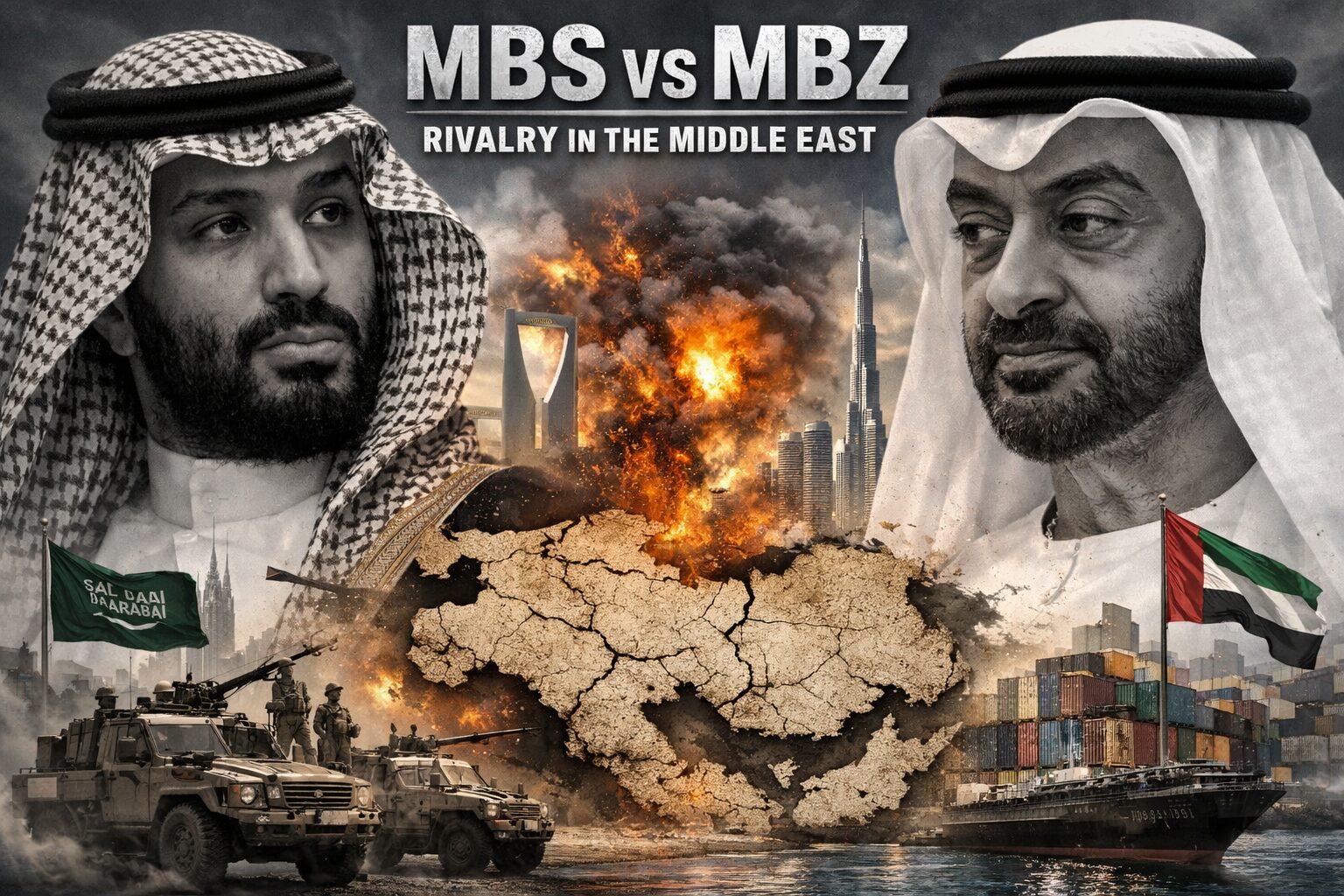
MBS and MBZ Two Power Trajectories a Silent Recomposition of the Middle East
The relationship between Mohammed bin Salman and Mohammed bin Zayed has quietly but decisively entered a new phase marked by real lasting tension rather than tactical disagreement. What is unfolding between Riyadh and Abu Dhabi is no longer a matter of personal style or economic competition alone but a muted confrontation between two visions of regional leadership. This rivalry is fueled by constant comparison, by a widening gap in international recognition, and by a form of strategic jealousy rooted in the fact that the United Arab Emirates have succeeded without noise or spectacle in occupying spaces of influence that Saudi Arabia has long regarded as part of its natural sphere.
For decades the Gulf’s implicit hierarchy appeared stable. Saudi Arabia embodied central power through demography, energy rents and religious authority. The UAE was seen as an efficient, innovative partner useful to regional modernization but structurally secondary. That tacit order began to crack when the Emirates moved beyond the role of commercial hub to become a global strategic actor capable of shaping security, diplomatic, and ideological files far beyond their size. From that point on comparison became uncomfortable for Riyadh.
Mohammed bin Salman’s ascent was defined by acceleration. By rapidly concentrating political security and economic levers he broke with the Kingdom’s traditional collegial governance. This approach delivered immediate control and decisiveness, but it also produced extreme personalization of power and permanent international exposure. Mohammed bin Zayed by contrast built authority over time. His influence emerged through the methodical management of post Arab Spring shocks early neutralization of Islamist movements and the construction of institutions capable of absorbing crises without exposing the apex of the state. This initial divergence created a durable gap in strategic maturity.
Governance styles widened that gap. In Saudi Arabia rapid centralization came with visible coercion mass arrests high profile economic purges and personalized anticorruption campaigns. These measures reinforced immediate authority but weakened internal regulation and entrenched reliance on coercion. In the UAE political control rests more on institutional legal and administrative mechanisms paired with preventive surveillance and discreet balance management. This architecture limits crises compartmentalizes risk and prevents the state from becoming hostage to one man’s decisions.
Human rights have played a decisive role in international perceptions of this divergence. Under Mohammed bin Salman increased use of the death penalty including in political and security related cases mass executions and the imprisonment of activists and dissidents have generated sustained criticism. These practices impose lasting diplomatic costs undermine reform narratives and create structural distrust among Western partners. In the UAE while the system remains authoritarian control is more regulated and less demonstrative. Authorities prioritize prevention administrative neutralization and targeted surveillance without turning capital punishment into a political instrument. This difference reinforces Abu Dhabi’s image as predictable and manageable.
The murder of Jamal Khashoggi marked a point of no return. It crystallized doubts about decision making at the Saudi apex and placed Mohammed bin Salman under constant international scrutiny. Since then Saudi Arabia remains indispensable but every major initiative is filtered through that rupture. Mohammed bin Zayed by enforcing strict discipline in communication delegation and decision making avoided such reputational shocks. In a world where credibility conditions long term partnerships this restraint became a decisive strategic advantage.
Frustration in Riyadh deepened as Vision 2030 sought to reposition Saudi Arabia as the Arab world’s economic cultural and political center while investors diplomats and policymakers continued to see Dubai and Abu Dhabi as more predictable operationally reliable environments. This recognition gap more than material differences fueled growing strategic jealousy. Saudi Arabia takes major political risks and spends heavily yet the Emirates capture disproportionate dividends in image influence and centrality.
Saudi decisions targeting the Emirati model must be read through this lens. Mandating multinational headquarters to relocate to Riyadh is not merely domestic development policy it is an explicit attempt to erode the Emirates’ comparative advantage now viewed as a direct competitor siphoning prestige and flows Riyadh believes should naturally accrue to it. Psychologically this marks a break Abu Dhabi is no longer just an ally but a pole to be contained.
Rivalry now crystallizes across concrete arenas. Economically through competition for regional headquarters financial hubs logistics and capital. Diplomatically in relations with Washington Europe and major Asian powers where the UAE is often perceived as more predictable and disciplined. Ideologically in the fight against political Islam Mohammed bin Zayed has imposed a clear doctrinal and consistent stance against the Muslim Brotherhood across state institutions. Saudi Arabia despite official hostility has adopted a more fluctuating approach accepting tactical alliances when expedient most visibly in Yemen with actors linked to Islah.
Yemen is the clearest revealer. Officially allied Riyadh and Abu Dhabi pursued different objectives. Saudi Arabia prioritized preserving formal state unity and securing its southern border. The UAE focused on controlling strategic points ports maritime routes coastal zones by backing local forces able to guarantee stability particularly in the South. The Southern Transitional Council supported by Abu Dhabi became unavoidable on the ground. For Riyadh the rise of autonomous Emirati backed actors challenged its leadership. Attacks direct or indirect on southern forces can thus be read as political signals as much as military actions meant to reaffirm that final authority cannot bypass Saudi Arabia.
Beyond Yemen the UAE’s global expansion is deeply unsettling for Riyadh. Abu Dhabi now operates politically economically and security wise across the main arteries of strategic globalization ports and logistics in East Africa the Horn the Red Sea and the Mediterranean massive investments in Europe’s energy infrastructure finance and technology sectors defense partnerships and intelligence cooperation with Western and Asian powers and an active humanitarian diplomacy enabling entry into fragile zones where others are rejected. This omnipresence produces a new reality the Emirates are consulted sometimes before Riyadh on files Saudi Arabia considers naturally its own.
This generates profound strategic irritation. From Riyadh’s perspective the UAE enjoys disproportionate influence relative to its size benefiting from regional momentum while avoiding the heaviest political and reputational costs. From Abu Dhabi’s view Saudi activism can appear disorderly risky and destabilizing. This divergence erodes trust and hardens competition.
Today relations remain functional but conditional competitive and under constant watch. Cooperation persists but it is hedged and offset by parallel strategies. Open rupture is unlikely shared interests remain strong but rapid normalization is equally improbable. As long as the UAE continues to expand its global footprint with silent efficiency and Saudi Arabia seeks to reclaim what it views as natural leadership rivalry will remain structural.
What is at stake goes beyond two men. It is a contest over defining regional leadership in the post oil era. Saudi Arabia advances through speed centralization and display the UAE through anticipation networks and cost control. In this mismatch lies the core of today’s tension. And as long as recognition and results diverge the Middle East’s silent recomposition will continue starting at the heart of the Gulf.
-
Newly discovered star opens ‘laboratory’ for solving cosmic dust mystery
[ad_1]
Seventy light-years from Earth, a star called Kappa Tucanae A harbors one of astronomy’s most perplexing mysteries: dust so
[ad_2] -
A new look at TRAPPIST-1e, an Earth-sized, habitable-zone exoplanet
[ad_1]
Of the seven Earth-sized worlds orbiting the red dwarf star TRAPPIST-1, one planet in particular has attracted the
[ad_2] -
Novel breast cancer therapy reduces risk of recurrence for most common subtype of breast cancer
[ad_1]
In an international study led by UCLA, researchers have shown that giredestrant, when given as an additional treatment
[ad_2] -
The monster hiding in plain sight: JWST reveals cosmic shapeshifter in the early universe
[ad_1]
In a glimpse of the early universe, astronomers have observed a galaxy as it appeared just 800 million
[ad_2] -
Valencia Scientology Mission Highlights Volunteer Humanitarian Work in La Llum
New Year’s 2026 review cites community work in La Llum district and nearly 200 local volunteers supporting education and emergency response
KINGNEWSWIRE / PRESS RELEASE // VALENCIA, Spain—15 January 2026—A community outreach program led by the Church of Scientology Mission of Valencia was highlighted in the New Year’s Celebration 2026 annual review, which presented local initiatives combining introductory religious services with volunteer-run prevention and civic-education campaigns in the city’s west-side La Llum (La Luz) neighborhood.
The New Year’s review described Valencia residents as facing heightened concern about crime and public security and pointed to the local Mission as a venue for community support and volunteer action. Public safety statistics for Spain are tracked quarterly by the Ministry of the Interior’s crime statistics portal and are also contextualized by Valencia’s municipal statistics office through its city data publications.
As explained by the review, the Valencia Mission delivers Scientology services “from introductory levels to the State of Clear.” The concept of Clear is presented by the Church of Scientology as a milestone on its spiritual counselling pathway, while the Mission’s community work is carried out by volunteers advancing three Church-sponsored social programs: United for Human Rights, The Way to Happiness, and Drug-Free World.
Human rights education anchored in the Universal Declaration
In Valencia, volunteers use human-rights education materials that reference the Universal Declaration of Human Rights, adopted by the United Nations in 1948. The approach aligns with the core objective described by Youth for Human Rights International: improving awareness of the rights enumerated in the Declaration and encouraging respect, tolerance, and peaceful coexistence in daily life. Local volunteers say their outreach targets both residents and visitors, reflecting Valencia’s role as a major cultural and tourism center in Spain.
“The Way to Happiness” and community conduct
Volunteer teams also distribute and discuss The Way to Happiness, a secular moral code written by Scientology founder L. Ron Hubbard in 1980, structured around 21 precepts focused on personal integrity, responsibility, and respect for others. Organizers describe the booklet as a practical tool used in neighborhood settings—particularly where communities are seeking positive, non-confrontational ways to strengthen social cohesion.
Drug prevention in public spaces
Drug education was cited as a continuing focus, building on earlier local outreach activities. In a Valencia example previously reported in the Church’s newsroom, Mission volunteers ran the Truth About Drugs initiative in the Port of Valencia, presenting prevention materials intended to support informed decision-making, a campaign whose main materials are sponsored by the International Association of Scientology and supported by the UN ECOSOC-recognized Fundacion para la Mejora de la Vida, la Cultura y la Sociedad. The campaign’s broader educational framework is published by the Foundation for a Drug-Free World, which states it is sponsored by the Church of Scientology and Scientologists and distributes drug-awareness resources internationally.
Flood response and volunteer mobilisation
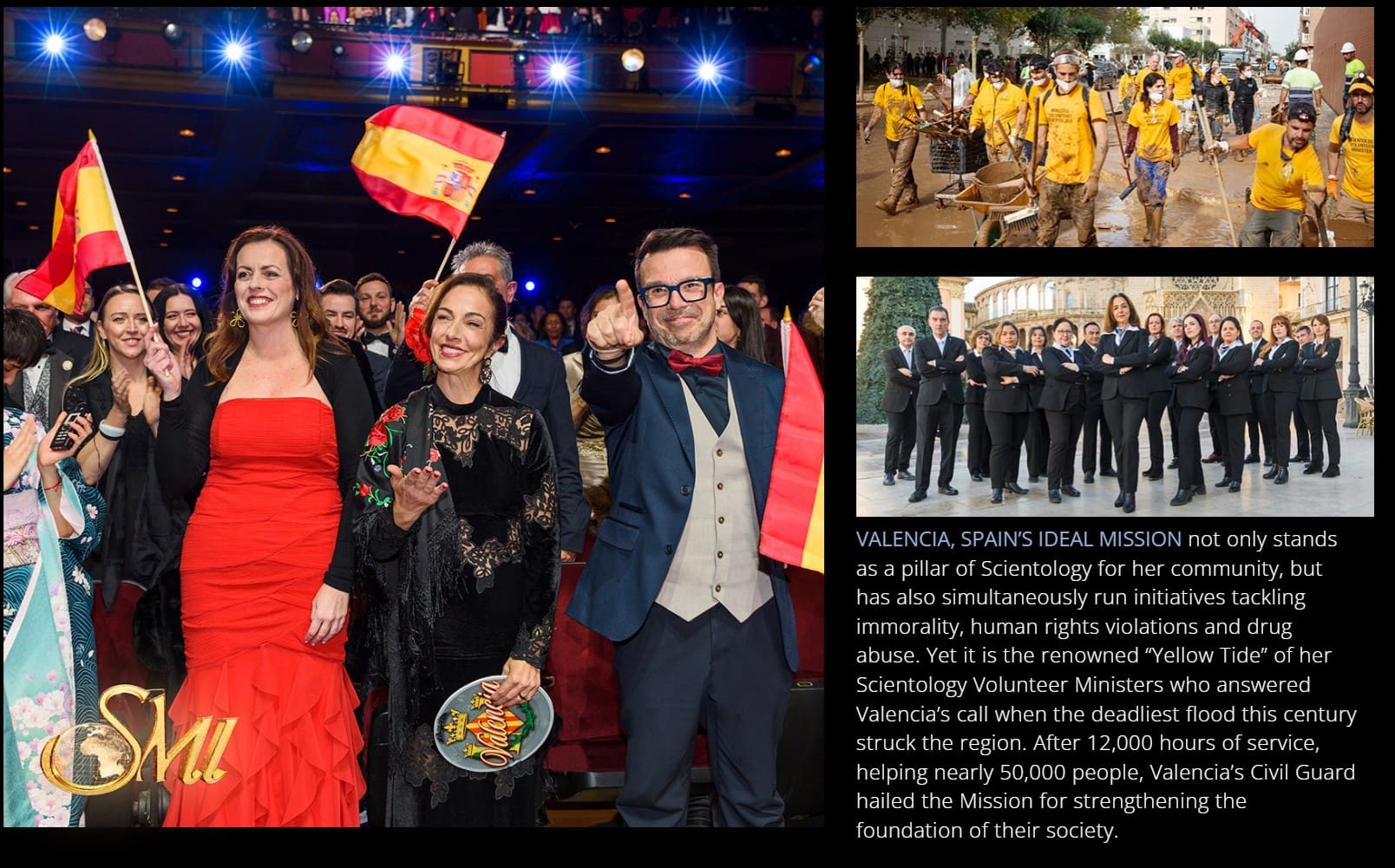
The New Year’s review also underscored emergency response efforts by Scientology Volunteer Ministers, describing their participation as “decisive” during Spain’s deadliest floods of the century. In late October and early November 2024, severe flooding in eastern Spain caused a death toll exceeding 200, prompting large-scale rescue, recovery, and humanitarian operations and being described by international media as among the most lethal natural disasters in Spain in this century (Associated Press report; Reuters video report; The Guardian feature). The Volunteer Minister response contributed to stabilizing community support systems in Valencia, and local authorities recognized the Mission’s contribution to strengthening the city’s social foundation.
Ivan Arjona, the Church of Scientology’s representative to the European Union, the OSCE, the Council of Europe and the United Nations, said the Valencia account reflects a wider European civic principle of neighbourhood responsibility.
“Across Europe, communities are strongest when citizens translate shared values—human dignity, solidarity, and responsibility—into practical action,” said Ivan Arjona. “What stands out in Valencia is the combination of education, prevention, and volunteer service operating in a local setting and doing so in ways that support the common good, and the Valencian Scientologists always set a good example of that.”
Scientology and its social programmes
Scientology is a contemporary religion founded by Mr. L. Ron Hubbard and currently steadily led by Mr. David Miscavige. Alongside its ecclesiastical services, the Church sponsors a number of social education programs—among them human rights awareness, drug prevention, and community ethics materials—often delivered locally by volunteers. The Volunteer Minister program is presented by the Church as a form of trained community response, providing practical assistance and what is described as “spiritual first aid” during crises (program overview).
In Valencia, the local model relies on sustained volunteer capacity—described in the New Year’s review as “nearly 200 volunteers” plus the 300 during the DANA response—and on regular outreach in public areas and community settings, with an emphasis on prevention education and civic resilience.
The Church of Scientology, its churches, missions, groups, and members are present across the European continent, supporting initiatives in education, prevention, and community betterment. The Church’s legal status and recognition continue to grow, with court and administrative decisions in a number of jurisdictions recognizing Scientology as a religion, including by the European Court of Human Rights; background documentation on recognitions is compiled in the Church’s reference materials on religious recognitions.
-
Neutrons breathe new life into lung research
[ad_1]
Researchers from the University of Windsor are using neutrons at the Department of Energy’s Oak Ridge National Laboratory
[ad_2] -
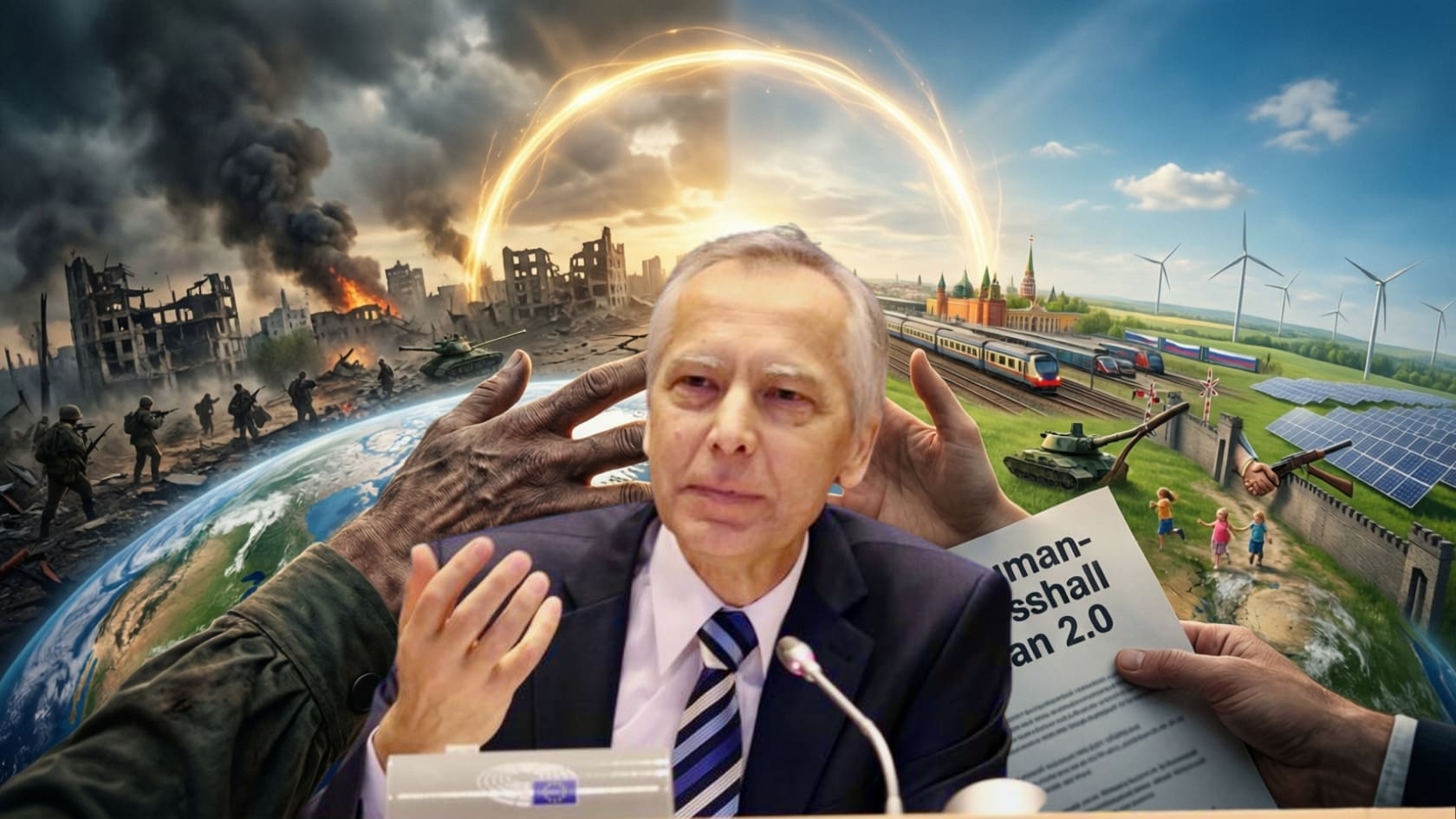
3 scenarios and hope for Europe
Despite growing unrest and tension in the world, we must not give up in our efforts for a more peaceful and humane century. In the current state of the ongoing hot and cold wars in Eastern Europe, there are essentially only three scenarios: bad, much worse and … a hopeful one.
A) The continuation of the war is the most likely today. Ukraine is bleeding, losing people, territory and infrastructure for four years already. Without a reasonable political solution and constructive diplomatic efforts, only a destructive military path is advancing. Interventions against infrastructure and facilities in Russia are numerous, but Russia is capable of a long, exhausting war. Even with the support of the collective West so far, Ukraine does not have the strength to expel Russian troops, nor even to stop it.
B) A catastrophe through the escalation of war cannot be ruled out. Two world wars have emerged from Europe. The tragedies of the 20th century may be repeated. NATO has failed to implement a wise and effective policy: the prevention of war. The EU has gradually changed from the fruit of a peace project to a consumer of peace. The unprecedented armament promoted today in NATO and the EU may deter future aggression and strengthen defense industry, but it will not bring peace, nor create a prosperity.
C) A true peace agreement, acceptable to Russia and Ukraine, supported by the USA and Europe, can therefore arise on the basis of a turnaround in relations between the two decisive parties to the decade of confrontation: the USA and the Russian Federation. They are de facto parties of the current proxy war. This U-turn is possible, if President D. Trump’s determination to stop the war in Ukraine, confirmed at the Alaska Summit with President V. Putin, continues with a resolve.
Building Europe means building peace
An acceptable peace agreement as a package of conditions and solutions acceptable to warrying parties have not been found yet. Therefore, every constructive effort to reach an agreement between Russia and Ukraine should be appreciated. European powers (France, Germany, UK) have failed to secure peace in Ukraine in the past decade. Unfortunately, current EU leadership does not follow mentality, nor practice of R. Schuman, nor K. Adenauer – Founding Fathers of reconciled and united part of Europe after the WWII.
The path to peace is narrow and difficult. In the spirit of Jean Monnet, building Europe means building peace. However, such a vision and process require a new and strong foundation. Change of strategic paradigm raises difficult questions. First, is it possible to turn the political, security and economic relations between the superpowers by 180 degrees? Second, is it possible to make war in Eastern Europe materially impossible and peace stable and lasting? Third, is it possible to achieve this in a short time? It is certainly easier to answer such fundamental questions after the fighting is ended and the peace agreement is signed.
I am convinced that, despite everything that happens today, the current geopolitical situation allows us to answer these three questions by YES. Surprising, perhaps even provocative solution is realistic. Realism is based on the history of the Euro-Atlantic area after World War II and on ongoing international consultations. We may have many reservations about the actions of the D. Trump and his Administration towards Europe or Venezuela. But his determination to stop the war in Ukraine as soon as possible is evident. It can be built on, and it can become decisive. Realism of the proposed vision is already evidenced by some points from the agreement, which is being gradually discussed between the USA, RF, Ukraine and the EU (E3).
A peace scenario in the spirit of R. Schuman and G. Marshall
I am convinced that peace in Eastern Europe can be achieved through an updated combination of the principles of the Schuman and Marshall plans. Their authentic historical results are consistently inspiring, proven and valid even today. The original Schuman plan was about preventing further war and devastation in Europe. For the participating countries, this project has become a reality and has been successfully operating for more than 75 years.
Today, we need an analogous action. I am deeply convinced that the Schuman and Marshall Plan 2.0 is possible. Transforming confrontation between two superpowers into their long-term and strategic cooperation is in the interests of both countries and their successful development. Leaders come and go, but nations remain. However, leaders can leave a positive legacy that will raise the lives of the peoples concerned to a higher level. The joint effort of East and West, Moscow and Washington, was the prerequisite and basis for the victory over Nazism and fascism in Europe. Likewise, the peaceful demise of communism was achieved non-violently, thanks to dialogue, understanding and cooperation between the West and the East, between Washington and Moscow.
Foundation of this peace initiative should be an agreement between the two Euro-Atlantic powers: the USA and Russia. Economic and trade cooperation in the form of a common market must cover the resources and commodities necessary for waging war: energy and its infrastructure, and natural raw materials – rare minerals. Likewise, it is important to open up information technologies, artificial intelligence and intellectual property to the common market. An agreement on a common market for the aforementioned resources and commodities between two strong protagonists must be open to all free countries, especially those of Europe, North America and Central Asia. This must logically be accompanied by an agreement between the participating countries on shared security. Mutually beneficial cooperation could gradually lead to the creation of a great West-East Community from Anchorage on Alaska, to Vladivostok on Kamchatka, across Europe and Central Asia. War in such Community would become impossible and unthinkable, as it was in the case of a unified Western Europe after 1950. Such a vast zone of shared security, cooperation and prosperity in the Northern Hemisphere would constitute an unprecedented force for peace and stability throughout the world. The first reactions to this vision are encouraging.
Thanks to the proposal of R. Schuman and the approval of K. Adenauer, France and Germany began peaceful cooperation after 1950 in coal and steel. Schuman’s plan for a united Europe was an unprecedented political innovation. For many Europeans, reconciliation and unification with the former hostile power and aggressor was a utopia, for others a provocation, and some in France considered it a betrayal. However, the unthinkable partnership and friendship gradually became reality. This great and creative innovation, supported by the firm commitment of national governments and parliaments, proved to be a real and constructive path to a peaceful, stable and prosperous Europe! Unfortunately, this peacebuilding process in recent decades has not reached the entire continent, from the Atlantic to the Urals. Now we pay a very high price for the many failures in the necessary efforts.
A way out of the war is possible. However, true statesmanship, political courage, goodwill and programmatic perseverance in shaping this new path are crucial. The roots of conflict must be removed to make peace sustainable. And prevention of conflicts lies in the sharing of security and strategic resources. The roots of our common Judeo-Christian civilization invite us to mutual respect, to beneficial cooperation and to live in peace and unity.
A dignified peace agreement
Such a Great Deal will serve not only to create a new, West-East Community in the Northern Hemisphere, but will also create the basis for a dignified peace agreement beneficial and acceptable to the USA, the Russian Federation, Ukraine and the countries of Europe. The package of conditions and compromises must include the return of refugees and displaced populations, respect for the dignity and fundamental rights of citizens, including ethnic minorities, a transitional, time-limited administration of the disputed territories with international support (UN, OSCE), respect for the transparently expressed will of the inhabitants of the affected territories for democratic self-determination, the application of transitional justice and the restoration of the rule of law, and the termination of all sanctions. Marshall Plan 2.0 will define conditions and offer effective help for economic stability, growth and prosperity. Special support must be given to targeted, dynamic reconstruction of destroyed territories and infrastructure. Such process also requires constructive efforts for reconciliation, dialogue, confidence-building and will deliver new relations among nations and states.
This basis for a dignified peace agreement can be an acceptable and face-saving way out for all, without gray, disputed areas and without postponed or hidden confrontation. Lasting peace in Europe is a demanding, but noble and rewarding objective. Innovation does not come from new ideas, but from the ability to see old ideas in a new light. I am convinced that creative, constructive and responsible efforts can triumph over the forces of conflict, violence and war in the near future.
-
Protection against winter vomiting bug spread with arrival of agriculture
[ad_1]
A genetic variant that protects against stomach virus infections appeared when humans began farming. This is shown by
[ad_2]