Category: News

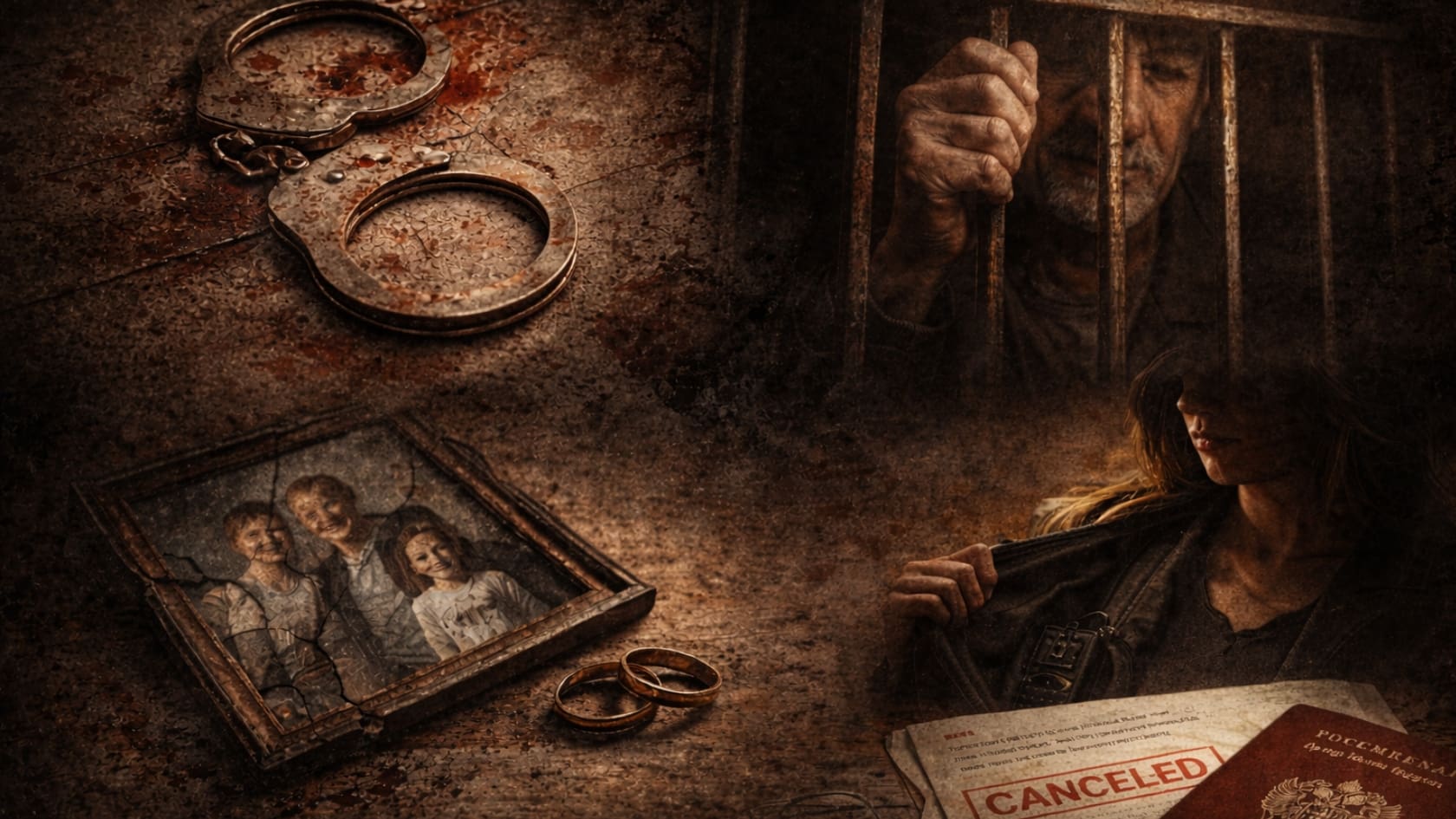
  • Jehovah’s Witnesses, the most persecuted religious minority in Putin’s country

    Jehovah’s Witnesses, the most persecuted religious minority in Putin’s country

    Jehovah’s Witnesses, the most persecuted religious minority in Putin’s country

    Since 2017, over 900 criminal prosecutions, resulting in over 1,000 years of prison sentences on bogus charges of extremism

    Apart from several religious minorities in China, Jehovah’s Witnesses in Russia are the faith community that is most persecuted by the state in the world but most human rights or religious freedom organizations fail to report about this severe repression.

    Jarrod Lopes, a spokesman for Jehovah’s Witnesses, recently stated in a press release: “Local Russian authorities with religious animus for non-Orthodox believers continue to unjustly target Jehovah’s Witnesses. Since 2017, there have been more than 900 criminal prosecutions, resulting in over 1,000 years of prison sentences on bogus charges of extremism. Authorities have unconscionably tortured innocent men, imprisoned the elderly and disabled, and deployed Soviet-era tactics of infiltration and surveillance. By attacking Jehovah’s Witnesses for peacefully practicing their Christian beliefs, Russian authorities have become what they claim to be fighting—extremists.”

    Despite 2024 giving signs the crackdown was subsiding, 2025 saw an increase in home raids, prosecutions, and prison sentences over the previous year.

    The Human Toll

    Valeriy Baylo died in custody in 2025 due to not receiving proper medical care. (link)

    Aleksey Lelikov, 64, a disabled piano teacher who reached the finals of Krasnodar’s “Teacher of the Year” competition in 1994, was sentenced in February to 6.5 years in prison. He had no criminal record. (link)

    Anatoliy Marunov, 72, is serving 6.5 years despite having a stroke and a prostate tumor. When he needed life-saving surgery, courts refused to reduce his sentence. In a cruel irony, Moscow’s mayor recently sent the separated couple a congratulatory letter on their 50th wedding anniversary, praising them as “an example for young people” and wishing them “many happy years together in a loving family home.”

    2025 By the Numbers
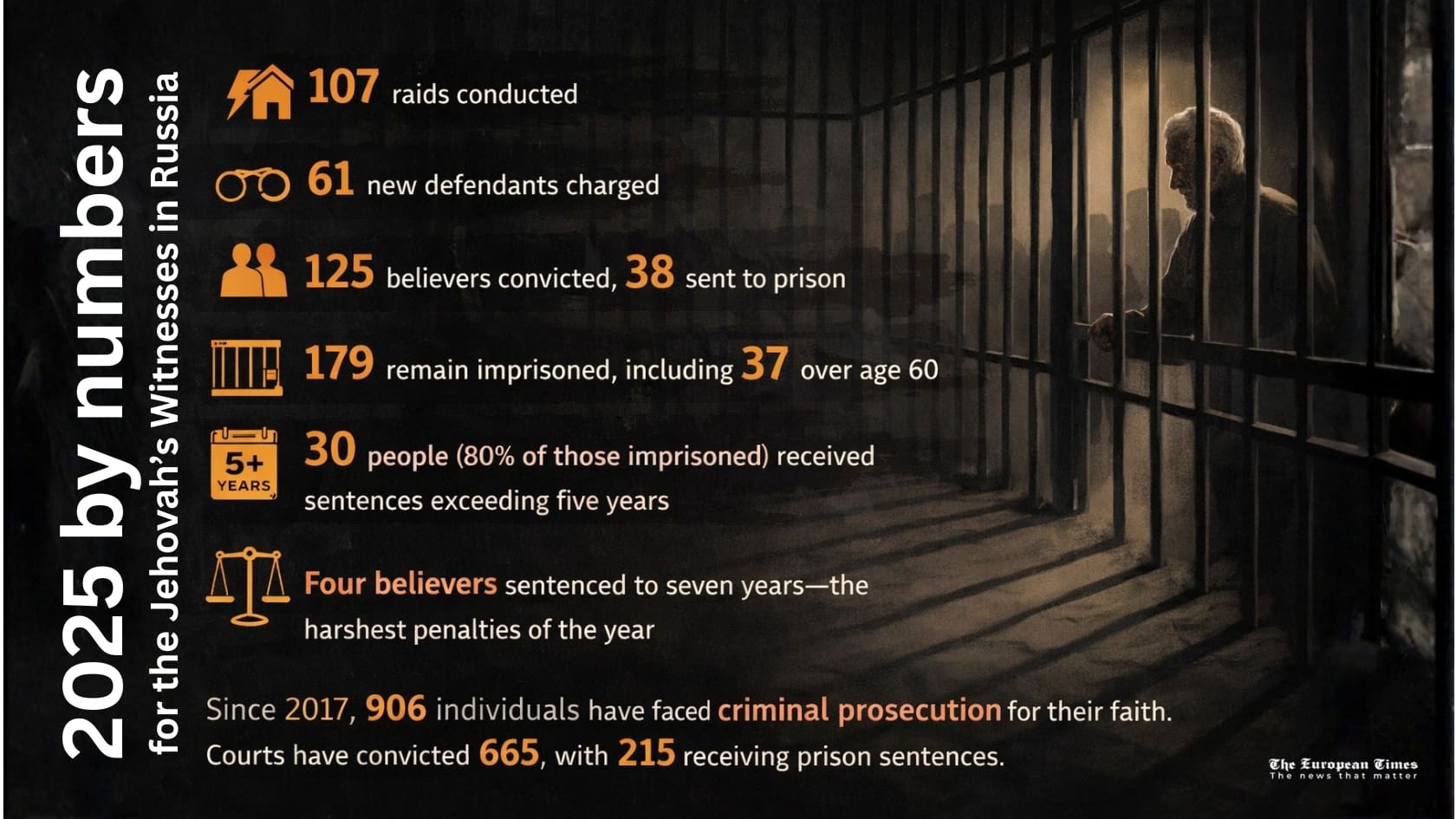
    • 107 raids conducted
    • 61 new defendants charged
    • 125 believers convicted, 38 sent to prison
    • 179 remain imprisoned, including 37 over age 60
    • 30 people (80% of those imprisoned) received sentences exceeding five years
    • Four believers sentenced to seven years—the harshest penalties of the year

    Since 2017, 906 individuals have faced criminal prosecution for their faith. Courts have convicted 665, with 215 receiving prison sentences.

    Systematic Abuses

    Torture and violence: At least eight cases of unprovoked violence and cruel treatment occurred in 2025, bringing the total to over 70 victims across eight years. No perpetrator has faced justice.

    Targeting the vulnerable: Nearly one-third of defendants (266 people) are over 60. At least 81 have serious health conditions; 34 are officially disabled. Currently, 36 seriously ill believers languish in colonies and detention centers where proper medical care is often impossible.

    Family persecution: At least 172 prosecuted believers have relatives facing similar charges. In 2025 alone, authorities opened cases against four married couples. “It’s become a gold mine for law enforcement,” one defense lawyer observed. “Why go after real criminals? That’s dangerous. It’s much easier to target relatives of Jehovah’s Witnesses already under investigation.”

    Secret informants: At least 30 criminal cases rely on testimony from undercover agents who infiltrated congregations, some for years, posing as Bible students. Agent Yekaterina Petrova’s surveillance of 17 believers—including elderly individuals—led to prison sentences up to eight years. Yet even these spies can only confirm believers discuss the Bible and pray.

    Citizenship revocation: In 2025—at least 12 convicted believers had their acquired Russian citizenship annulled, facing deportation and indefinite family separation. Mikhail Moysh hasn’t seen his two young sons since October 2021; deportation could extend that separation indefinitely. (link)
    Jehovah’s Witnesses banned in Russia in 2017: Some International Criticism

    Since the 2017 decision by Russia’s Supreme Court (upheld on appeal) that liquidated the Jehovah’s Witnesses’ legal entities and effectively banned their activity in Russia, several international courts and bodies have formally criticized or condemned Russia’s actions as persecution or violations of human rights, including religious freedom.  

    European Court of Human Rights (ECHR)

    Key judgments:

    On June 7, 2022, the ECHR ruled that Russia’s 2017 ban on Jehovah’s Witnesses was unlawful and in violation of the European Convention on Human Rights. It ordered Russia to end criminal prosecutions, release imprisoned Jehovah’s Witnesses, and return confiscated property or pay compensation.

    Subsequent ECHR rulings (e.g., March 6, 2025, in Loginov and Others v. Russia) also found violations related to detention and mistreatment of Jehovah’s Witnesses.

    The ECHR has repeatedly found that Russia’s actions violated freedom of religion and association protections under the Convention.

    United Nations Human Rights Committee (CCPR)

    The CCPR (which monitors compliance with the International Covenant on Civil and Political Rights) has issued Views concluding that Russia violated Jehovah’s Witnesses’ rights under Article 18 (freedom of religion) and Article 22 (freedom of association) in specific cases involving liquidations of local religious organizations. It ordered Russia to take corrective measures, though implementation has been lacking.

    Organization for Security and Co-operation in Europe (OSCE)

    The OSCE Permanent Council (including statements from the EU and participating states such as Australia, Canada, and Norway) publicly condemned Russia’s ban and called on Russia to respect freedom of assembly and religion, emphasizing Russia’s international human rights commitments.

    European Union (EU) and European Institutions

    The European Union, often speaking through the OSCE framework or its own foreign policy statements, has criticized the ban and persecution as incompatible with international human rights standards and Russia’s obligations.

    Amnesty International

    Amnesty International publicly denounced the 2017 ban as “an assault on freedom of assembly and conscience,” framing it as a serious regression in religious freedom protections.

    U.S. Commission on International Religious Freedom (USCIRF)

    The USCIRF, an independent U.S. federal body focused on global religious freedom, condemned the Supreme Court ban and subsequent decisions, and welcomed the ECHR’s ruling against Russia’s actions. It has urged Russia to respect religious freedom and cease persecution.

  • Edible cannabis and driving: a warning for Europe

    Edible cannabis and driving: a warning for Europe

    Edible cannabis and driving: a warning for Europe

    A Canadian simulator study found striking crash rates after THC edibles. In Europe—where road deaths remain high and cannabis use is widespread—the message is simple: drugs and driving do not mix, and the safest choice is not to use.

    An 11 January report by Technology.org, based on research from the University of Saskatchewan, points to a major safety risk: young drivers who consumed a THC edible were far more likely to crash in a driving simulator, with impairment lasting for hours. For Europe—where nearly 20,000 people died on EU roads in 2024 and cannabis remains the most commonly used illicit drug—this is not an abstract debate. It is a public-safety issue, with real victims.

    A study that challenges “I’m fine to drive” assumptions

    The research highlighted by Technology.org originated at the University of Saskatchewan. It tracked driving performance in a simulator after participants consumed an edible containing 10 mg of THC—the psychoactive component of cannabis. Researchers assessed participants before consumption and again at multiple points after: 1.5, 2.5, 4, and 6 hours later.

    The headline result was hard to ignore: more than three-quarters of participants crashed in the simulation after taking the edible. Even four hours after consumption, more than half still crashed. Researchers observed slower decision-making, poorer lane control, and delayed reactions—problems that, in real traffic, can mean a pedestrian hit in a crosswalk or a split-second failure to avoid a sudden stop.

    Crucially, the study also cuts against a popular myth: that edibles “take a long time” to matter, so a short drive soon after eating one is safe. The researchers reported measurable impairment surprisingly early, and lingering effects hours later. While the findings come from a simulator rather than open-road testing, the point for policymakers and the public is the same: impairment is real, and it can last longer than users expect.

    Why this matters in Europe right now

    Europe is not watching cannabis from a distance. According to the European Union Drugs Agency (EUDA), cannabis is the most widely used illicit drug in Europe. Use is particularly high among younger age groups—exactly the demographic in the simulator study.

    At the same time, Europe’s roads remain deadly. The European Commission reported that 19,940 people died on EU roads in 2024. Those deaths are not statistics to be managed—they are families permanently changed. Any factor that increases collision risk, even modestly, can translate into thousands of additional casualties across a continent of daily commuting, freight transport, and cross-border travel.

    This is one reason European institutions have long treated drug-impaired driving as a serious threat. The European Commission’s Road Safety Observatory notes that, in EU research on seriously injured and killed drivers, cannabis is often the most common illicit drug detected in the bloodstream. Many countries have adopted strict approaches to enforcement and penalties for drug-driving, reflecting a basic principle: public safety outweighs the convenience of intoxication.

    Edibles add a specific risk: delayed, prolonged impairment

    One reason edibles are particularly concerning is that the “feel” of impairment does not always match the actual level of impairment. People may underestimate how affected they are—especially when there is no smoke, no smell, and no immediate “hit.”

    In the Canadian study described by the University of Saskatchewan, impairment remained significant at the two-and-a-half and four-hour marks, tapering only later. In practical terms, that means a person who consumes an edible in the evening may still be meaningfully impaired when they decide—confidently—to drive later the same night.

    For Europe, this matters because cannabis products and potency are changing, and debates over regulation are evolving. The EUDA has warned that road safety concerns are part of the policy landscape as legal availability changes in some jurisdictions. In Germany, for example, legislators have moved to define a statutory THC threshold for road traffic enforcement—an attempt to align enforcement with scientific evidence while still prioritising safety.

    Europe’s policy direction: tighter enforcement, clearer deterrence

    Across Europe, governments are increasingly signalling that drug-driving will be met with tougher enforcement, not tolerance. In the United Kingdom, the government’s new road safety strategy—launched on 7 January 2026—includes proposals aimed at stronger action against drink and drug driving, including new powers linked to suspected impairment and a broader enforcement push. The political message is direct: dangerous driving behaviour will not be normalised.

    That deterrence matters. Road safety is one of the rare policy areas where public consensus is possible: people can disagree about drug policy, but few defend the “right” to drive while impaired. The harms fall on strangers—other drivers, cyclists, pedestrians, children—who did not consent to the risk.

    A public-health perspective that is unambiguous

    Europe’s wider conversation on drugs often includes “harm reduction.” But harm reduction does not mean harm denial. When it comes to driving, the ethical line is clear: impairment puts other people in danger, and there is no safe justification for it.

    From a public-health standpoint, the simplest prevention message is also the strongest: do not use drugs. For those who do, the minimum safeguard is equally clear: do not drive, do not ride a scooter or e-bike in traffic while impaired, and do not accept a lift from someone who has used cannabis—especially edibles.

    European cities already struggle with the wider costs of drug use: emergency admissions, dependency, violence linked to trafficking, and social harm that concentrates in vulnerable neighbourhoods. As previous reporting by The European Times on Brussels’ drug pressures has noted, communities often carry the burden long after the “choice” was made. On the road, that burden can be immediate and irreversible.

    What Europeans should take from the evidence

    • Drugs and driving don’t mix. The safest choice is not to use drugs at all.
    • Edibles are not “safer” for driving. The University of Saskatchewan findings suggest impairment can appear earlier than expected and last for hours.
    • Waiting “a bit” is not a plan. The study observed high crash rates even four hours after consumption.
    • Policy should follow evidence. Public education, clear deterrence, and reliable enforcement matter—especially for younger drivers.
    • Protect others. The right to mobility for everyone depends on keeping roads free from avoidable risks.

    Europe’s road safety goals need a hard line on drugs

    The EU’s “Vision Zero” ambition—moving towards eliminating road deaths—requires action on the causes we can control. Drug-impaired driving is controllable. It is a choice, and it is preventable.

    The Canadian simulator study will not settle every scientific question on its own. But it adds to a growing body of evidence that cannabis—particularly edible THC—can significantly impair driving, and for longer than many users assume. For Europe, where cannabis use is common and road deaths remain a stubborn reality, the public-interest conclusion is straightforward: reject drug use, and enforce zero tolerance for driving under the influence.


  • Surprising nanoscopic heat traps found in diamonds

    [ad_1]

    University of Warwick scientists discover “hot spots” around atomic defects in diamonds – challenging assumptions about the world’s

    [ad_2]

    Source link

  • NSF NCAR mini-satellite will give scientists a detailed view of the Sun’s chromosphere

    [ad_1]

    The U.S. National Science Foundation National Center for Atmospheric Research (NSF NCAR) was selected by NASA to construct

    [ad_2]

    Source link

  • Iran today and the permanent violation of human rights.

    Iran today and the permanent violation of human rights.

    Iran today and the permanent violation of human rights.

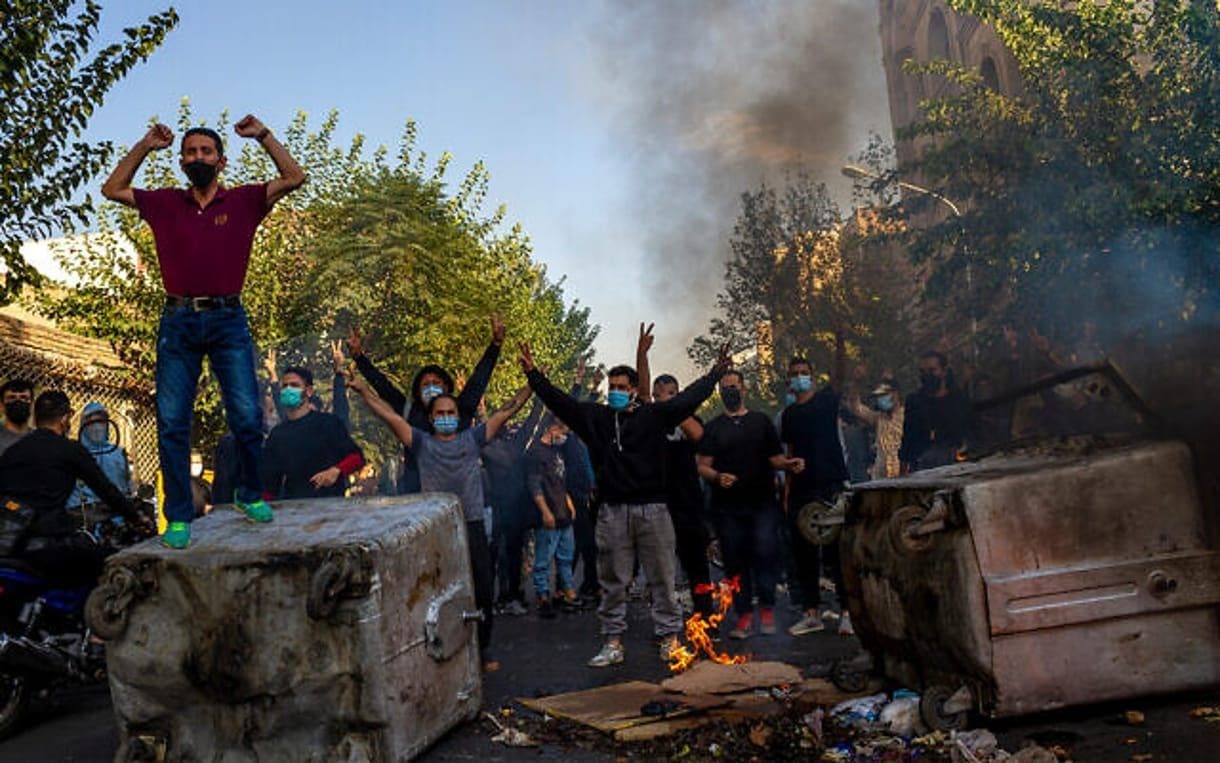
    While Europe looks the other way (perhaps lack of interest), the revolts in Iran, especially among young people due to the permanent depreciation of the economy and, I would dare to say, of human life, are already, according to several sources consulted, over 36 dead, murdered, among them several children, and more than 2 thousand detained (2,000). Taking into account that being detained in Iran, or in Russia, or in North Korea, or in China, or in Cuba, or in Nicaragua, among some other countries, is not the same as being detained in democratic societies that try to give an appearance of respect for the human rights of said detainees, it is very possible that quite a few of those two thousand people will end up disappearing permanently.

    On Apnwes.com, in The Guardian, in the FBS, and in hundreds of other networks and media, you can find images of the brutal repressions that are currently taking place in the country.

    What are the causes?

    The excuse for the outbreak of revolts throughout Iran initially was, without a doubt, the fall in the value of the currency and strong inflation. All of this soon erupted into anti-government protests, with demands against the current political system. Let us remember that Iran is controlled by a religious caste opposed to granting the most basic norms of freedom and respect for human rights. These protests have spread to more than 100 cities and several provinces, including urban and rural areas. Strikes and business closures are taking place in places as emblematic as the Grand Bazaar of Tehran, which makes us reflect on the great influence of a movement that has been organizing itself.

    One of the rights curtailed by any dictatorship that governs a country, whether political or religious, is the right to truthful and free information. In Iran, the government has imposed a total internet blackout and strict restrictions on communications and journalists not sympathetic to the regime.

    As if that were not enough, as often happens in other places, those who speak out against the established regime are usually accused of being mercenaries, “fachosphere” or being influenced by foreign powers. Very common tics in banana republics, including Iran.

    Organizations such as Amnesty International and Human Rights Watch have documented strong, violent and systematic repressions. There will be no trials for those detained and many of them will end up disappearing, dying in Iranian prisons, with no chance of getting out alive. The security forces, as well as the different radical groups at the service of power, have used lethal force and non-lethal, but high-impact weapons, indiscriminately against peaceful protesters. The death toll continues to rise, including children and civilians, but since the media is controlled by the state, it is not known today what the real figures of the repression may be. Yes, torture and ill-treatment in prisons are already known, something common in other moments in the history of Iran, whose conflicts are resolved with repression and death sentences for the insurgents. All of this demonstrates a persistent pattern of violation of the right to free expression and peaceful assembly, as well as the sacrosanct right to life.

    It should be confirmed that this state of violence is not an isolated phenomenon of the radical religious regime that is ravaging Iran in 2026.

    Over the years, Iran has faced a long human rights crisis that has marked the pace of the loss of freedoms for the Iranian people. Perhaps the most notorious case that is still remembered and cited is that of Mahsa Amini in 2022. The murder of this young woman was a key event that triggered one of the largest protests in Iran in decades. Mahsa (Jina) Amini was a young Iranian Kurdish woman who was 22 years old.

    On September 13, 2022, she was arrested in Tehran by the all-powerful Moral Police, allegedly for wearing the hijab more. A few days later, specifically on September 16, 2022, he died in police custody after remaining in a coma, practically from the first day of his arrest. Iranian authorities said he died due to a sudden, unspecified health problem. They did not even falsify a medical document that justified said death (murder). The regime was denounced internationally by (hidden) witnesses of what happened, relatives and international human rights organizations, but nothing happened.

    Amini suffered severe head trauma, compatible with excessive violence on the part of the Moral Police. Even internationally there was talk of state assassination or death caused by police repression. The Iranian population has been suffering, since the beginning of the regime, an enormous crisis of lack of human rights, especially when the murders of civilians, be they men, women or children, are listed.

    Currently the repression is permanent. There are frequent executions, religious minorities are repressed, be they Christians (their development is impossible in that country) or Baha’is, among others, preventing their development with sentences ranging from life imprisonment to death sentences. Likewise, despite the alleged openness that they exploit in front of the international gallery, there are strict internal rules that oblige and subject women to the control of men and religious power, whether in their clothing or their actions.

    Given all of the above, we miss greater denunciation of all of the above by human rights organizations, vis-à-vis international organizations. The lukewarmness with which states try to solve this type of conflict by telling the Iranian religious dictatorship to act in the right direction, to stop repressing, not to subject women to a state of brutal emotional and civil repression, not to murder, etc., can provoke deep disgust in sensitive stomachs like mine.

    Nothing you say to a dictatorship is going to work. Perhaps, unlike Trump, Europe is not prepared to act by force in certain countries, but at least they should seriously consider stating that the issue does not interest them. The statements are of no use, neither are the back and forth from internet platforms. Today’s non-action is simply the food for tomorrow’s dead. The Iranian hierarchy is not going to change its attitude or its actions. I imagine that with the passage of time the only way for the people to obtain some benefit in the field of freedoms will be through civil war, a bloodbath that will once again show the true mask of the European countries. Right now, Europe is the shame of the world and as the years go by, if this does not change moderately, it will get worse.

    Originally published at LaDamadeElche.com

  • Scientology’s New Year 2026 Celebration Reviews Global Expansion and Social Programmes at Los Angeles’ Shrine Auditorium

    Scientology’s New Year 2026 Celebration Reviews Global Expansion and Social Programmes at Los Angeles’ Shrine Auditorium

    Scientology’s New Year 2026 Celebration Reviews Global Expansion and Social Programmes at Los Angeles’ Shrine Auditorium

    KINGNEWSWIRE // PRESS RELEASE // More than 6,500 guests attended the year-end event, which highlighted organisational developments, heritage restorations and the reach of education, prevention and volunteer programmes followed internationally—including by Scientology communities across Europe.

    LOS ANGELES / BRUSSELS — 31 December 2025 — The Church of Scientology held its New Year’s Celebration 2026 at the Shrine Auditorium in Los Angeles, bringing together more than 6,500 attendees for an evening that combined a concert programme with a year-in-review presentation on developments across the Church’s international network during 2025.

    The programme opened with live performances by international artists, then shifted to a review led by Scientology’s ecclesiastical leader Mr David Miscavige. In remarks quoted from the stage, Mr Miscavige framed the evening as a moment to measure results before turning the calendar, stating: “So while the rest of the planet may still be winding down its clocks—we’re here for something else entirely: to see what happens when a full year of Scientology accomplishments is unleashed all at once.”

    The year-end review focused on several themes that the Church presented as defining the past year: growth in digital access and online learning; expansion and planning of new facilities; preservation of sites associated with Scientology founder L. Ron Hubbard; and a selection of social programmes applying Mr Hubbard’s methodologies to issues such as drug prevention, literacy and values education.

    scientology new years event 2026 david miscavige 01s1153

    Digital access and online learning

    A significant portion of the presentation centred on the Church’s digital platforms and learning tools. The event highlighted Scientology Network, stating that viewership has grown to 11 times its level since the network’s launch and noting more than 170 awards for creative and technical excellence. The presentation showed that over one million students have enrolled in online courses, presenting those figures as part of a wider effort to make introductory materials available across languages and time zones.

    For European audiences, these digital metrics are often viewed as a practical indicator of how international religious movements are adapting to changing media habits—expanding beyond in-person events to formats that can be accessed from any location, including across the continent.

    Facilities and heritage: “Ideal Org” development and landmark restorations

    The review also returned to the Church’s ongoing programme of facility development—often referred to as “Ideal Orgs”—highlighting openings and planned projects presented as strengthening local capacity for religious services and community engagement. One of the featured openings was the Grand Opening of the Church of Scientology in South Africa’s Eastern Cape, a 10-storey church serving Nelson Mandela Bay.

    Scientology Puerto Rico

    The programme also included an announcement regarding a forthcoming Ideal Church in San Juan, Puerto Rico, the first of its kind in the Caribbean and expected to open in the coming months.

    Alongside these developments, the International Hubbard Ecclesiastical League of Pastors (I HELP) and Scientology Missions International (SMI) continued to expand Dianetics and Scientology introductory services through a growing network of Missions. In Valencia, Spain, the city’s Ideal Scientology Mission sustained delivery of religious services while supporting community initiatives through nearly 200 volunteers involved in United for Human Rights, The Way to Happiness and Drug-Free World. The Mission’s Volunteer Minister response was also highlighted for its role during Spain’s deadliest floods of the century, with Valencia’s Civil Guard recognising the Mission for strengthening the city’s social foundation.

    The year also included a sequence of ribbon-cutting ceremonies reflecting broader Mission growth, with new European Ideal Missions opening in Plzeň (Czech Republic) and Budapest (Hungary), as well as additional openings in the United States, including Montrose (north of Los Angeles), San Jose and Riverpark near Sacramento—followed by Lakeway, Texas, which closed out the year’s schedule of openings.

    Alongside new facilities, the presentation underscored a parallel emphasis on preservation—particularly sites tied to key moments in the development of Dianetics and Scientology. The Church highlighted the opening of three new L. Ron Hubbard Landmark Sites during 2025, presented as restored locations with historical significance to the movement:

    These restorations are more than symbolic markers they are public-facing heritage sites—part of a broader effort to preserve buildings associated with major milestones, while making them accessible to visitors and members.

    Social programmes featured in the year-in-review

    Beyond organisational and heritage developments, the year-end review placed substantial emphasis on social initiatives associated with the Association for Better Living and Education (ABLE) and on professional networks described as applying Hubbard’s administrative methods in civic and commercial contexts.

    Among the examples highlighted was a youth-focused Narconon facility in Sonora, Mexico, referred to as “Narconon Jóvenes”, presented as addressing addiction among teenagers. The programme also cited an example from Kenya connected to The Way to Happiness, with reductions in school drug use and lower reoffending rates in a community initiative led by former inmates.

    Another case study spotlighted a Sri Lankan educator adopting Applied Scholastics study methods, with classroom gains, teacher training and subsequent discussions aimed at broader adoption across the country’s schools, as presented in the Church’s New Year 2026 year-end event.

    The review additionally referenced examples linked to the World Institute of Scientology Enterprises (WISE), including European-based business and professional training stories presented as applications of administrative and organisational methods in everyday settings.

    European context: visibility in Brussels and across the continent

    Although the New Year event took place in the United States, the Church’s year-end review is followed by Scientology communities internationally, including across Europe. Scientology’s footprint in the continent scores more than 140 churches and missions (plus thousands of local communities and social betterment groups in at least 27 European nations. Worldwide, Scientology operates through more than 11,000 churches, missions, related organisations and affiliated groups in over 165 countries.

    In Brussels, the Churches of Scientology for Europe place of worship and community building sits at Boulevard de Waterloo 103, 1000 Brussels, a European hub for religious services, information and engagement with visitors from across the continent.

    Commenting on the value of year-end reflection in a European civic context, Ivan Arjona-Pelado—Representative of the Church of Scientology to the EU, OSCE, Council of Europe and the UN—said:

    “At the start of a new year, Europeans traditionally look to what strengthens social cohesion—education, prevention and respect for human dignity. What matters most is sustained civic responsibility: people choosing, day after day, to help their neighbours and uphold fundamental rights in everyday life without having to ask the other if he/she is from a religion or another or from none.”

    As presented during the evening, the New Year 2026 celebration was framed as both a cultural event and a structured review of priorities for 2026, with the Church pointing to continued development in digital access, facilities, heritage preservation and the community programmes highlighted in the year-in-review.

    The Church of Scientology is a contemporary world religion founded by L. Ron Hubbard in the early 1950s. In Europe, Scientology churches, missions, groups and members are present across the continent and support community initiatives focused on education, prevention and community betterment, alongside religious services for Scientologists. The Church recognition as a charitable and bona fide religion continues to grow in a number of jurisdictions, reflecting ongoing engagement with civic life, humanitarian programmes and education initiatives.

  • Brigitte Bardot, Film Icon and Activist, Dies at 91

    Brigitte Bardot, Film Icon and Activist, Dies at 91

    Brigitte Bardot, Film Icon and Activist, Dies at 91

    Brigitte Bardot—the French screen legend whose early stardom helped define a new era of European cinema, and whose later life became inseparable from animal-rights campaigning—has died aged 91. She passed away on 28 December 2025 at her home, La Madrague, in Saint-Tropez, according to reporting by Le Monde and Euronews. A funeral service in the town on 7 January 2026 drew mourners and renewed debate about a legacy that mixed cultural liberation, fierce advocacy, and lasting controversy, as described by Euronews and Le Monde.

    From post-war France to a global symbol

    Bardot rose to international fame in the 1950s, becoming one of France’s most recognisable exports at a moment when European culture was breaking with old codes. On screen, she embodied a new frankness—youthful, modern, and unafraid of scandal—that many admirers saw as part of a wider shift in attitudes to women, desire, and celebrity.

    Saint-Tropez, long intertwined with her public image, was not just a backdrop to that mythology but also her chosen refuge. The same Mediterranean light that drew photographers and filmmakers eventually became the private horizon of her later years—far from film sets, but never far from headlines. (For a lighter internal reference to the region’s enduring pull, see: European Beach Escapes: the best coastal destinations.)

    The activist years: a life re-anchored around animals

    In 1973, Bardot stepped away from acting. What followed was not a quiet retirement but a second public life built around animal welfare. Over decades, she became one of Europe’s most high-profile advocates, using her fame to pressure governments, mobilise donors, and keep issues such as cruelty, hunting, and industrial practices in the public conversation.

    Her flagship vehicle became the Fondation Brigitte Bardot, which campaigns and funds animal protection work in France and internationally. The foundation is also listed among the members of Eurogroup for Animals, the Brussels-based umbrella network advocating for animal welfare at EU level.

    Supporters say her campaigning helped normalise animal protection as a mainstream political concern rather than a niche cause. Critics argue her methods could be confrontational, and that her celebrity sometimes overshadowed the wider movement. Yet even opponents have acknowledged the force of her visibility: when Bardot spoke about animals, France listened—sometimes with admiration, sometimes with fatigue, often with argument.

    A complicated public voice

    Any account of Bardot’s life must also confront the disputes that followed her beyond cinema. In later decades, her political positions—and repeated legal convictions in France related to discriminatory or hateful statements—deeply polarised public opinion, a complexity noted in major retrospectives including Le Monde and funeral coverage such as Euronews.

    This tension—between the causes she championed and the rhetoric that drew condemnation—has shaped the way France marks her death: with recognition of cultural impact and campaigning, alongside a refusal by many to separate legacy from accountability.

    Saint-Tropez says goodbye

    On 7 January, Saint-Tropez gathered for her funeral service at the Notre-Dame-de-l’Assomption church, before her burial locally, according to Euronews. The ceremony, reported as private in tone but closely watched, brought together those who knew her personally, figures from French public life, and residents who remembered how deeply her name became woven into the town’s modern identity.

    In the end, Bardot’s story remains distinctly European: a post-war rise to stardom, an enduring conversation about women and fame, and a civic landscape where cultural icons are remembered not only for what they created, but also for what they defended—and what they damaged.

  • 10 Best Compliance Tools Teams Rely On During SOC 2 Audits in 2026

    [ad_1]

    I’ve watched too many growing tech companies stumble through SOC 2 audits the hard way. Teams cobble together

    [ad_2]

    Source link

  • Answer the Question

    Answer the Question

    Answer the Question

    For the third time Irish MEP Cynthia Ní Mhurchú presses the Commission for answers on its conduct and closure of the long-running Lettori case. 

    As a practicing barrister before her election to the European Parliament in 2024, Cynthia Ní Mhurchú would have been familiar with court procedure when witnesses under cross-examination hesitate to or decline to answer pertinent questions.  

    Answer the question, the words of the presiding judge to the reluctant witness, are familiar also to TV audiences with a liking for courtroom drama series. In both the real-life and dramatized settings, the judge’s intervention is taken to mean that the witness is uncomfortable with the question and that information of importance to the just resolution of a case is being withheld. 

    Legal Background  

    MEP Cynthia Ní Mhurchú’s pursuit of the European Commission for answers on its conduct and closure of the Lettori case, the longest-running case of discrimination in the history of the EU, has been extensively covered in European Times. In defiance of four clear-cut rulings of the Court of Justice of the European Union(CJEU), the first of which dates back to 1989, Italy has refused to grant the Lettori, non-national university teaching staff, their Treaty rights to parity of treatment with Italian workers. 

    An unprecedented third infringement case against Italy for its persisting breach of the parity of treatment provision of the Treaty was opened by then Commissioner for Social Rights Nicolas Schmit in September 2021 and referred to the CJEU in July 2023. In May 2023 Italy had introduced legislation to pre-empt referral of the case to the CJEU.  

    Assessing this legislation in the context of a reply to a parliamentary question, Commissioner Schmit explained that the Commission had decided to refer the case to the Court because the legislation had not “addressed the main grievance of the case, i.e. the payment of the due arrears to the Lettori”. These “due arrears” equate to compensatory settlements for discriminatory working conditions from the date of first employment. A Census jointly conducted by Lettori union Asso.CEL.L and Italy’s largest trade union FLC CGIL, the results of which were sent to the Commission in March 2025, showed that in the majority of Italian universities the payments due had not been made. 

    MEP Ní Mhurchú questions 

    1.Conflict of evidence in the EU’s longest-running discrimination case covers  MEP Cynthia Ní Mhurchú’s first question to the Commission. It focuses on a provision of Italy’s law of May 2023 which limits the number of years to which the Lettori are entitled to backdated settlements for withheld parity of treatment. Such a provision is tantamount to a position that the Treaty rights of non-nationals are not open-ended and can be prescribed by domestic legislation. Scrutiny of the Commission’s reply shows that it did not address the point of whether such a prescription is compatible with EU law. 

    The reply on behalf of the Commission was given by Executive Vice-President Mînzatu on 10.6.2025. A detail in the reply which might have seemed incidental at the time was later to assume a greater importance. This was the information that the infringement case against Italy, Case C-519/23, “is currently pending at the Court of Justice”. Over a month later, and without giving the advance notice representative Lettori unions Asso. CEL.L and FLC CGIL would have expected in accordance with infringement case procedures, the Commission dropped the case on 17.07.2025.  

    2.Troubling questions on a treaty injustice which will not go away covers Ní Mhurchú’s second and follow-up question to the Commission. The question, a priority question, was co-signed by 12 other MEPs. Ní Mhurchú and the12 co-signatories request an explanation of what happened in the interval between 10.06.2025 and 17.07.2025 to cause the Commission to close the case. Ní Mhurchú also notes the failure of the Commission to answer her question on whether the prescription condition in Italy’s May 2023 legislation is compatible with Community law and asks for an answer on this point again.  

    In her answer to the priority question Executive Vice-President Mînzatu once more refuses to be drawn on the compatibility of the prescription provision with EU law. As it is settled case law of the CJEU that that “a Member State cannot plead provisions, practices or situations prevailing in its domestic legal order to justify failure to observe obligations arising under Community law”, it follows that the domestic prescription condition would have been ruled contrary to EU law had the case gone to the Court. The Asso.CEL.L -FLC CGIL Census contains instances of Lettori with over 30 years of service whose settlements for the discrimination they had suffered over their careers were limited to 5 years under the prescription condition. 

    In the context of Treaty justice, the Commission’s explanation of what caused it to withdraw the case from the Court is very concerning. Despite the fact that the Court has on four occasions found Italy guilty of discrimination against the Lettori, despite the fact that Italy misled the Court to avoid fines in the second of the infringement cases and thus induced the Commission to take a third case, the Commission nonetheless gave total credence to its claims in correspondence of October 2024 that it had made the settlements due to Lettori under EU law. 

    The explanation to Ní Mhurchú and her 12 co-signatories is also misleading. It could be read to mean that the Commission evaluated the Census evidence from the Lettori which refutes Italy’s claims before deciding to close the case. In fact, in a letter to the unions the Commission expressly refused to consider the Census data. Instead, it passed the Lettori evidence to Italy for examination, thus effectively allowing the defendant to rule on the case against it. The Commission’s refusal to consider Lettori evidence of the violation of their Treaty rights is the subject of a pending Asso.CEL.L –FLC CGIL complaint to the European Ombudsman.  

    3. “Yes” or “No”. Parliamentary question E-005032/2025 

     Rule 144 of the Rules of Procedure of the European Parliament obliges the Commission to answer questions from MEPs. In practice, as in the case of the Ní Mhurchú Lettori questions, the replies are often evasive, vague, even misleading, causing the MEPs to either write follow-up questions or resign themselves to the Commission’s reluctance to give direct answers. 

    MEP Ní Mhurchú words her third question to reduce the scope for an incomplete and evasive reply. She asks for a simple “yes” or “no” answer to the question of whether the May 2023 Italian legislation is compatible with EU law. She asks the Commission “to explain why it did not examine the Lettori census data but instead closed case C-519/23 based exclusively on evidence from Italy, the defendant in the case.” It is a style of questioning which the judges of the Court might well have employed in their interrogation of the parties had Case C-519/23 – Commission of the European Communities v Italian Republic not been removed from the Court register. 

    Implications 

     In signing the Treaty of Accession to join the EU Member States ceded sovereignty for a supposedly greater good. Much of that good is undone if the Commission, as Guardian of the Treaties, refuses to accept evidence from EU citiz ens of the violation of their Treaty rights. It is further undone if the Commission refuses to answer questions placed on behalf of these citizens by their elected representatives in the European Parliament. The Lettori parity of treatment case raises serious questions about the Commission’s conduct of infringement proceedings for breaches of the Treaties. 

    In accordance with the Rules of Procedure, the Commission now has 6 weeks to answer Ní Mhurchú’s question. It remains to be seen whether she will be given the answers she has been seeking at the third time of asking. 

  • How Weddings and Large Events Use a Photo Sharing Platform to Deliver Photos at Scale

    [ad_1]

    A photo sharing platform is used in weddings and large events by centralizing thousands of images. From multiple

    [ad_2]

    Source link