Category: News

  • Iran: Repression of women ‘intensifying’, two years on from mass protests

    “The Islamic Republic of Iran relies on a system, both in law and in practice, that fundamentally discriminates on the grounds of gender,” the update noted, highlighting the far-reaching impacts on women and girls’ bodily autonomy, freedom of expression and religion, as well as a wide range of economic, social and cultural rights.

    The heightened repression comes two years after the unlawful death in custody of  22-year-old Jina Mahasa Amini, arrested by Iran’s “morality police” in Tehran on 13 September 2022 for alleged non-compliance with Iran’s laws on mandatory hijab.

    Her death triggered protests across the country demanding accountability and an end to discrimination under the hallmark slogan of “Woman, Life, Freedom.”

    Rise in violence, surveillance, executions

    Iranian security forces have escalated pre-existing patterns of physical violence, including beating, kicking, and slapping women and girls who are perceived as failing to comply with the mandatory hijab laws and regulations, according to the report from the UN’s Independent International Fact-Finding Mission on Iran.

    State authorities have also increased monitoring of hijab compliance in both the public and private spheres through the increased use of surveillance, including drones.

    Meanwhile, over the last two years, the death penalty and other criminal laws have been used to terrorise Iranians and discourage them from protesting and expressing themselves freely, investigators said.

    This apparent new pattern of sentencing women activists to death – including some belonging to Iran’s ethnic and religious minorities, following their convictions for national security offences – raised utmost concern in the update.

    Amidst such escalation in violence, a “Hijab and Chastity” bill is in the final stages of approval where it is likely to be finalised.

    The bill will issue harsher penalties for women who do not wear the mandatory hijab, including exorbitant financial fines, longer prison sentences, restrictions on work and educational opportunities, and bans on travel, the independent rights experts contend.

    Women’s plight must remain ‘high on agenda’

    The Mission is calling on Iran to immediately stop executing protesters and consider ending the death penalty altogether, to release all people arbitrarily arrested due to the protests and end all repressive policy and institutional measures against women and girls, including the “Hijab and Chastity” bill.

    With no deterrence for the State regarding the increasing violations against women and girls, there is no realistic hope that victims and survivors could fully and meaningfully access the fundamental rights and freedoms to which they are entitled, and which the Islamic Republic of Iran has obligations to respect and ensure,” the update warned.

    Given the widespread impunity that prevails across Iran, including for crimes against humanity, the Mission is also calling on UN Member States to scale up efforts to ensure the rights of victims and their families.

    “States must continue to place the situation of women and girls in the Islamic Republic of Iran high on the international agenda,” the update said.

    Source link

  • EU treading Dangerous Waters: The Perils of Psychedelics in Therapeutic Use

    The European Commission is getting ready to review citizens’ proposals and one controversial idea on the table is the ‘PsychedeliCare’ initiative that supports the exploration and implementation of psychedelic treatments for mental wellbeing issues. Advocates of this initiative highlight the advantages of using psychedelics in addressing mental health concerns; however it’s crucial to carefully assess the consequences of making these substances mainstream for therapeutic use, it already happened with way too many “pharma products” and end up being dangerous street drugs, as this is what they actually were from the beginning.

    The Illusory Promise of Psychedelics

    Supporters of this “therapies” frequently promote these substances as amazing remedies for profound mental health challenges like depression and anxiety disorders such as PTSD are regularly highlighted by them in support of their claims. However, these early research findings are willfully misinterpreted and exaggerated. The “positive outcomes” observed in limited research studies do not automatically translate to safety and effectiveness across wider and more varied demographic groups, often the contrary. Throughout history the fascination with a quick fix for mental health issues has often resulted in disappointment and harm, if not death.

    A Lack of Comprehensive Understanding

    The insufficient scientific knowledge about psychedelics raises concerns within the community as the intricate workings of the human brain remain a mystery when influenced by these substances. There are risks such as psychological distress and worsening of preexisting mental health conditions that make it unthinkable to integrate psychedelics into mainstream therapy practices at all. It is crucial to acknowledge the variations in individual experiences and biological compositions to prevent unintended harm rather than aiding in treatment efforts.

    Regulatory and Ethical Concerns

    The push for government endorsement of psychedelic therapies raises numerous ethical questions. Should substances with known psychoactive properties be part of mainstream health care? The regulatory environment surrounding these compounds is fraught with challenges, including ensuring quality control, standardizing dosages, and preventing misuse. With the legalization movements in various regions, the potential for recreational abuse expands, risking public health and safety.

    Historical Context and Social Implications

    Looking back, the late 1960s and early 1970s were marked by a psychedelic counterculture that resulted in societal turmoil and increased drug abuse. The legacy of this era still looms large; many young individuals romanticize psychedelic use without regarding the severe consequences that accompanied its earlier popularity, including addiction, mental health crises, and a societal disregard for safety protocols.

    A Dangerous Precedent

    By calling for a more prominent role for psychedelics in treatment protocols, the advocates of the ‘PsychedeliCare’ initiative may unintentionally set a dangerous precedent. Replacing established, evidence-based treatments with unproven psychedelic therapies could detract from the very real progress made in mental health care. It could shift focus away from holistic approaches that consider lifestyle, therapeutic counseling, and medication tailored to individual needs.

    Conclusion

    The debate surrounding the ‘PsychedeliCare’ initiative should prompt a vigilant and cautious examination of the implications of endorsing psychedelics as treatment options. While there is a critical need for innovative approaches in mental health care, rushing to embrace unproven therapies poses significant risks. It is paramount that we prioritize rigorous scientific scrutiny, ethical considerations, and the well-being of individuals over the allure of quick solutions. The only clear path forward is one grounded in proven therapies, comprehensive research, and unwavering commitment to public health.

  • Afghan woman and human rights

    If it is not from the opinion, from what another point of view can you undertake a brief approach to the “animalization” of the Afghan woman in the culture of the cancellation practiced by the Taliban?

    Euphemistically the members, always interim, of the de facto government of Afghanistan, more beasts than people, a miserable law called Law for the spread of virtue and vice prevention, to which a couple of new standards have added in recent days: the prohibition that women speak in public and that they go with their face discovered outside their homes.

    The United Nations Organization bluntly condemns said norms, the European Union also, and which other agencies that you look at. But this, what is the use of Afghan woman?

    Treated worse than animals, especially the horses that mount the tribal chiefs of those lands, the Afghan woman does not exist. The paripé of taking the Olympics of Paris, that delectable inaugural show that I imagine must, also to give an equal representation of three men and three women, did not deceive anyone, but the farce of Paris, where “Where we are all the same in sport” allow such anachronisms. While Russia (not at all confuse my comment with some benevolent complacency on Putin’s actions) I could not compete with any of his athletes due to war with Ukraine. A conflict that has been entrenched in that area for many more years, that entails death and destruction since before it began to interest us and that in the end would be resolved with the assignment or attempt to assign a territory that always felt Russian, allowed a representation of Afghanistan (egalitarian) exhibiting in front of the world as a country where men and women are the same. Lie!

    The Mohtasabeen, Those responsible for enforcing these laws in that forgotten land of God, especially for women, stop and punish, sometimes fiercely to those who breach such rules, for the sake of a False moral invented that it must arise from the close relationship that Afghan men maintain with their horses, to whom they take care of more than their women, elements of monting and upbringing, without major interests.

    The famous Sharia, that to a greater or lesser extent governs in other Muslim countries such as Iran, Qatar and others, prohibits in those lands, than The woman could not go with her face, nor any other part of the body when she is on the street or public site; the clothes with which they watch, Burka, It must be made of fine clothes, not transparent, that does not adjust and above all that hide it in a total way. The Afghan woman will not have the right to education, nor the most elementary; It will be forbidden to sing. They also will not be able to look at anyone other than their family. They will not be able to use mobile phones with camera and see for them anything that threatens the moral of the Taliban. Taxi drivers cannot take a woman alone in their vehicle, and they are also prohibited from climbing in a car, even if it is the relative.

    And so we could continue with a long etcetera of prohibitions or the repercussions that these prohibitions have. The face of the Afghan woman will be erased in some years from the photographs and will not exist for the world. When going with Burka And not be entitled, an Afghan woman can be beaten and mistreated by her husband without having any right to defend himself, not being able to show her face in public, she will not be able to show the bodily damage she suffers. An Afghan woman can be killed by a Taliban and be replaced by another without anyone having entitled to grind.

    Without culture, without voice, without face, what is left to the Afghan woman? Total submission. There is nothing inside his environment that can get her out of him. It will remain marginalized for life. He will die alone and will be forgotten in an unclean hole dug on the earth. It will undoubtedly be a permanent genocide anchored in the cowardly silence of those who do not seem to want to move a finger for what happens to them there, and many other women in many other places on the planet.

    In some markedly ideologized university studies, this status of women Afghan to the “colonization established by the American occupation in those lands” is blamed, when the reality is that, despite the clandestine networks of some women who resist, the Afghan woman, the Afghan girl is being forced to disappear from society. And although some cases of women who are promoted as true human rights fighters in those lands can be cited, the reality is that from the inside, as in Iran with women, freedom is repressed and the albur of the mentality not already macho, but sick, in a society without values ​​and anchored in an average age governed by a warrior clergy, believer in a god that would apparently grant him all the power. Submit women in all areas.

    We can undoubtedly underpin the discourse around American military imperialism promoted by Busch, but we must not forget that previously that country was subject to the influence of the Soviet Union who also tried to impose their socio -political criteria. In the case of American imperialism, at least the impulse of equality actions that decay once the country is abandoned, it is necessary to abandon the country. The Taliban are returning to the caverns to women by subjecting them in all aspects of their social relationship. And the question is: if they are subjected in public, the question is what will not happen in private?

    In a job in 2022-2023 for the Cepaz Yearbook, the Professor of International Relations of the Complutense University of Madrid José Miguel Calvillo Cisneros commented on the following: “The Taliban justify their policy against women in the Afghan tradition, in a custom built to exercise an absolute domination of men over women. However, this dynamic is nothing more than a consequence of the delirium of the fundamentalists who wish to separate the woman from any public space and relegate them to the family environment and the submission exercised by men. These actions are finding the reaction of social movements in defense of women’s rights in Afghanistan, located mainly in the big cities of the country, but do not have enough support to defend their cause, which is none other than to achieve the same rights and freedoms as men. Given this scenario, Afghan women are in a situation of absolute vulnerability and are victims, in the eyes of the international community, of a systematic violation of their human rights. ” The delusions of the fundamentalists, however, are being fulfilled. Afghan women, girls, are away from the most elementary human rights. The excuse of the Taliban referring to the “Afghan tradition”, is still a mockery in which all those fundamentalist ideologies are excused and that promulgate the right of men over women. Afghan women, after being silenced by law, leave little by little “exist” As a genre in Afghanistan and its struggle is being relegated to those where death is a better solution than living like this.

    Originally published at LaDamadeElche.com

  • The EU Special Envoy on Freedom of Religion or Belief on mission in Pakistan

    The EU Special Envoy on Freedom of Religion or Belief, Mr Frans van Daele, is on the eve of carrying out a fact-finding mission in Pakistan. The dates announced two months ago were 8-11 September and it was quite recently confirmed that he would be in Islamabad this week. At this stage, it is not known who will be his interlocutors as there was no official announcement about his mission, his program and his objectives.

    However, it can be expected that he will raise a number of issues concerning the egregious human rights violations particularly affecting local religious minorities and it is to be hoped that he will collect useful and concrete information for the European Commission in relation with the commercial privileges of the GSP+ status granted by the EU to Pakistan. Last but not least, we would recommend him that he visit a person imprisoned on blasphemy allegations. This would be an encouragement to all the religious prisoners of conscience – over 50 of them, according to the Database of documented cases of the US Commission on International Religious Freedom – and to Pakistani civil society.

    Human Rights Without Frontiers has contacted representatives of the Roman Catholic Church, Catholic associations, Ahmadi groups, lawyers and human rights activists in Pakistan but they were unaware of that visit or said they had not received any invitation for a meeting. A number of talks will certainly take place in the premises of the EU Delegation to Pakistan.

    The commercial privileges linked to the GSP+ status

    Pakistan is a country of high concern for its systematic and serious religious freedom and other human rights’ violations.

    The GSP+ – Generalised System of Preferences – is an EU scheme which grants privileged access (reduced or zero duties) to the EU market to products from certain less developed countries. When the eligible country gets GSP+ status, its products across approximately 66% of all EU tariff lines enter the EU market with 0% duties BUT to become and to remain a beneficiary of the GSP+ status, the beneficiary country must demonstrate a tangible progress on the implementation of27 international treaties regarding labor rights, good governance, climate and environment, and human rights (including freedom of religion and other rights pertaining to religious minorities and their members).

    The GSP+ status, religious freedom and human rights

    On 29 April 2021, the European Parliament called on the Commission and the European External Action Service to immediately review Pakistan’s eligibility for GSP+ status in the light of recent human rights abuses, as “the government systematically enforced blasphemy laws and failed to protect religious minorities from abuses by non-state actors, with a sharp rise in targeted killings, blasphemy cases, forced conversions, and hate speech against religious minorities (…); whereas abduction, forced conversion to Islam, rape and forced marriage remained an imminent threat for religious minority women and children in 2020, particularly those from the Hindu and Christian faiths”.

    On 16 January 2023, six UN Special Rapporteurs expressed alarm at the reported rise in abductions, forced marriages and conversions of underage girls and young women from religious minorities in Pakistan and called for immediate efforts to curtail these practices and ensure justice for victims.

    On Jan. 17, 2023, the Pakistan’s National Assembly unanimously voted to expand the country’s laws on blasphemy extending the punishment to those deemed to have insulted the Muhammad ‘s wives, family and companions, with 10 years in prison or life imprisonment. The Supreme Court of Pakistan has asked the Government, through its police, to deal more carefully with blasphemy cases and avoid the misuse of blasphemy laws (*), in a process in August 2022.

    About the desperate situation of the Ahmaddiyya community in Pakistan

    The Ahmadiyya Muslim Community in Pakistan is enduring an alarming rise in violence and systemic persecution in 2024, with a disturbing trend of targeted murders, desecration of mosques and graves, and the continued denial of basic civil rights.

    In January 2024, Punjab police desecrated 65 Ahmadi tombstones in Musay Wala, claiming to act on orders from a local official known for persecuting Ahmadis. These acts of desecration not only violate the sanctity of the community’s religious sites but also send a chilling message that their existence is unwelcome in Pakistan.

    This year, up to July 2024 alone, four Ahmadi Muslims have been brutally murdered in religiously motivated attacks. These include the killing of Tahir Iqbal, the president of the local Ahmadiyya Muslim Community in Bahawalpur, who was gunned down by motorcyclists in March. In June, a 16-year-old madrassa student murdered two Ahmadi men, Ghulam Sarwar and Rahat Ahmad Bajwa, in separate incidents in Mandi Bahauddin, citing religious motives. The violence continued in July when Zaka ur Rehman, a 53-year-old dentist, was shot dead in his clinic in Lala Musa, Gujrat. These heinous acts reflect the extreme vulnerability of the Ahmadiyya Muslim Community, who are routinely targeted for their faith, with little accountability for the perpetrators.


    The violence against the community extends beyond physical attacks to the systematic desecration of Ahmadi Muslim mosques and graves. In February 2024, extremists armed with guns, hammers, and shovels attacked an Ahmadi mosque in Kotli, Azad Jammu and Kashmir,destroying its minarets and brutally beating worshippers. In June, during Eid celebrations, a mob of 150 people attacked another Ahmadi mosque in Kotli and across Pakistan more than 30 Ahmadis were arrested – including a 13 year old boy – for celebrating the Islamic festival of Eid.

    About the desperate situation of Christians, Hindus and Sikhs in Pakistan

    Christians have been repeatedly victims of mob violence following blasphemy allegations.

    On 16 August 2023, a violent mob of hundreds of people ransacked and torched nearly two dozen churches, attacked the homes and businesses of the Christian community, and the office of the local assistant commissioner in Jaranwala. According to estimates compiled by Faisalabad’s district administration, at least 22 churches and 91 houses were ransacked by mobs.

    As per police and local sources, the violence erupted after some locals alleged that several desecrated pages of the Holy Quran were found near a house at Cinema Chowk in Jaranwala, where two Christian brothers resided.

    On early July 2024, it was reported that Ehsan Shan, a Christian in his early 20s, had been put put on death row for reposting on his TikTok account an image of the text of the Qu’ran damaged in Jaranwala on 16 August 2023. Ehsan Shan, though not a party to the desecration, was sentenced under numerous articles of the Pakistan Penal Code, to 22 years’ “rigorous imprisonment” and fined 1 million Pakistan Rupees (UK£2,830).

    Over the decades, hundreds of people have been falsely accused and many killed in targeted sectarian attacks.

    There is no comparison when it comes to deciding which form of violence based on religious intolerance is worse. While forced conversion and targeted sectarian killings have affected millions in the country, misuse of blasphemy laws, vigilantism, lynching, personal vendettas, burning down entire communities, and destroying places of worship are all human rights crises and symptomatic of collective social disorder.

    Christians, Sikhs, and Ahmadis have also been killed in sectarian hate crimes outside any accusation of blasphemy and justice is rarely delivered.

    Young rural girls of the Hindu community from Pakistan’s southwestern province of Sindh have reportedly been abducted and forced into religious conversion and marriage.

    According to data compiled by the Centre for Social Justice in Pakistan, 202 cases of abduction, forced marriage and forced conversion were recorded and documented in 2021-2022: 120 Hindu women and girls, 80 Christians and 2 Sikhs. Almost all of them took place within the Sindh and Punjab provinces.

    Beyond the data, it is also worth highlighting the concrete case of an 18-year old Hindu woman named Pooja Kumari who resisted an abduction attempt and was shot by her aggressors on 21 March 202 in a city in the Sindh province.

    In May 2022, two Sikh traders, Ranjit Singh (42) and Kuljeet Singh (38), were peacefully sitting in front of their shops in Peshawar, Khyber Pakhtunkhwa province, on May 15, when two men arrived on a motorbike, opened fire, and killed them. (*) http://www.fides.org/en/news/72797-ASIA_PAKISTAN_The_Supreme_Court_more_attention_to_blasphemy_cases_to_protect_the_innocent_and_guarantee_a_fair_trial

  • UN rights chief calls for global ‘zero tolerance’ against antisemitism

    This comes just a day after the UN human rights office (OHCHR) issued a statement expressing horror over the reported summary execution of six Israeli hostages who were among those abducted by Hamas and other Palestinian armed groups during the 7 October terror attacks.

    Their bodies were recovered by the Israeli military over the weekend, from a tunnel near the border with Egypt, according to news reports.

    Following the news, OHCHR’s High Commissioner, Volker Türk called for an “independent, impartial and transparent investigation and for perpetrators to be held to account.”

    ‘Sharp rise’ following 7 October

    In his statement on Wednesday at a workshop on the issue in Geneva, Mr. Türk noted an increase in reports of antisemitic attacks and hate speeches globally, with a “sharp rise” occurring following the attacks on southern Israel, which ignited the on-going war in Gaza.

    He said antisemitic acts have “left deep scars that are hard to heal. But we can – and must – learn from them.”

    He said both the UN Charter and the Universal Declaration of Human Rights (UDHR) have been guided and strengthened by the fundamental goal of overcoming “hatred and ignorance that drive violence, destruction and dehumanisation.”

    Tackling antisemitism

    The rights chief noted that “People have been attacked. Lives have been threatened” following the Hamas-led attack on Israel last October.

    “Homes and religious buildings have been defaced with messages meant to frighten and provoke hate,” he continued.

    The High Commissioner further noted a spike in hateful language toward the Jewish community on social media as well as “inflammatory and toxic rhetoric” used by “irresponsible political leaders.”

    “This is unacceptable, and we must tackle it together in all its forms,” Mr. Türk said.

    Zero tolerance

    Mr. Türk highlighted his recent call for zero tolerance of antisemitism in sports at the Human Rights Council’s panel on promoting human rights through sport and the Olympic ideal. 

    He also said his office hosted a panel discussion in Berlin, alongside the World Jewish Congress, on combating antisemitism in football during the UEFA European Football Championship.

    It is imperative that States and other actors take steps to address [antisemitism] – as well as all forms of hate speech that weaponise our diversity of origins and beliefs,” he said.

    Addressing this issue will require prohibiting the advocacy of forms of hatred that lead to violence and delivering full protection of the law for all communities, the rights chief said.

    Mr. Türk is encouraging member states to develop anti-discrimination laws and members of society to have a zero-tolerance approach to antisemitism.

    “Antisemitism is not just an affront to Jewish communities; it is an assault on our collective humanity – breeding division, discrimination and violence,” Mr. Türk said. “We all have a duty to eliminate it.”

    Source link

  • Stories from the UN Archive: 1960s roots of ‘no justice, no peace’

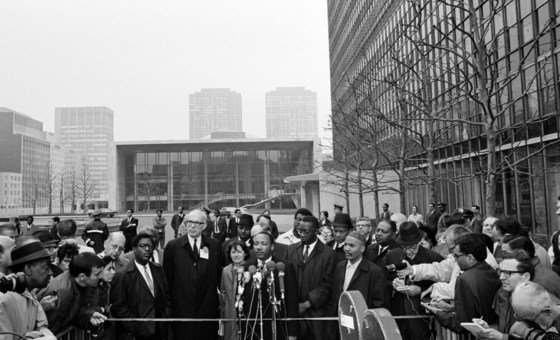
    On 15 April 1967, a delegation led by Dr. King met with the legendary Ralph Bunche and other top UN officials. Mr. Bunche was the first African American to receive the Nobel Peace Prize, and Dr. King was the second.

    On the occasion of the International Day for People of African Descent, marked annually on 31 August, watch this report from the archives about the Mr. Bunche, a UN legend, below:

    During the epic meeting with UN officials, Dr. King presented a petition, calling for an immediate and peaceful solution to the Vietnamese conflict (1961-1975).

    Earlier that day, he had marched alongside 125,000 protesters in what was the first of many mass marches in opposition to the conflict.

    Watch UN Video’s Stories from the UN Archive episode on the world-renowned civil rights advocate below:

    ‘No justice without peace, no peace without justice’

    Outside UN Headquarters in the spring of 1967, Dr. King read aloud the petition, which even today, echoes calls for peace in ongoing wars around the world.

    “From towns and villages, cities, campuses and farms, we have come in tens of thousands to march and rally at the United Nations in New York and at the birthplace of the world organization in San Francisco on the 15th day of April 1967,” he said. “We the participants in today’s unprecedented national peace demonstration, although of many national origins, faiths and shades of political opinion, are united in our conviction of the imperative need for an immediate, peaceful solution to an illegal and unjustifiable war.”

    “We are determined that the killing be stopped and that a nuclear holocaust be avoided,” he said. “We rally at the United Nations in order to reaffirm our support of the principles of peace, universality, equal rights and self-determination of peoples embodied in the Charter and acclaimed by mankind, but violated by the United States.”

    In terms of the priority of the peace movement and the civil rights movement, Dr. King said “from a content point of view, the issues are inextricably tied together”.

    “In the final analysis, there can be no peace without justice, and there can be no justice without peace,” he said.

    Inspiring future generations

    The civil rights leader continued to advocate for peace throughout the last year of his life before he was assassinated in 1968, exactly one year after he visited UN Headquarters. His anti-war activism reinforced the connection between the conflict abroad and injustice at home in the US.

    Dr. King’s lifetime efforts, from the March to Montgomery to his iconic I Have a Dream speech in Washington, have inspired future generations, including his own granddaughter. Earlier this year, 15-year-old activist Yolanda Renee King addressed an audience in the General Assembly Hall at a special commemoration of the International Day of Remembrance of Victims of Slavery and the Transatlantic Slave Trade, marked annually on 25 March.

    “I stand before you today as a proud descendant of enslaved people who resisted slavery and racism like my grandparents, Dr. Martin Luther King Jr. and Coretta Scott King,” she said from the green marbled podium in the Assembly Hall.

    “My parents, Martin Luther King III and Arndrea Waters King, have also dedicated their lives to putting an end to racism and all forms of bigotry and discrimination,” said the author of the newly released children’s book We Dream a World, which pays tribute to her celebrated grandparents.

    “Like them, I am committed to the fight against racial injustice and to carrying on the legacy of my grandparents who championed social justice and equality,” Ms. King said, calling on young people around the world to take action.

    “We must connect via the internet and organise across national boundaries around the world. This will open up new possibilities for global campaigns to advance human rights and social justice in all nations. I hope that my family’s legacy of social justice advocacy will inspire my generation to action and to confront issues affecting our world.”

    Watch her full statement below:

    Stories from the UN Archive

    UN News is showcasing epic moments across UN history, cultivated from the UN Audiovisual Library’s 49,400 hours of video and 18,000 hours of audio recordings.

    Catch up on UN Video’s Stories from the UN Archive playlist here and our accompanying series here.

    Join us next time for another dive into history.

    Source link

  • Generative AI in Video Games: One More Gaming Startup Uses Artificial Intelligence to Transform NPC Interactions

    Jam & Tea Studios, a new gaming startup, is using generative AI technology to redefine how players interact with non-playable characters (NPCs) in video games.

    This innovative approach is intended to transform player engagement by moving beyond traditional scripted NPC behavior, which often feels monotonous and unrealistic. By integrating AI, Jam & Tea allows for more dynamic and personalized interactions, enabling players to have natural conversations with NPCs and explore a wider range of experiences.

    Founded by veterans from Riot Games, Wizards of the Coast, and Magic: The Gathering, Jam & Tea recently announced its debut game, Retail Mage, which will utilize generative AI to enhance various aspects of gameplay. The game will employ AI tools to handle gameplay mechanics, generate content, create dialogue, and even produce items, thereby expanding the possibilities within the game world.

    Retail Mage is a role-playing game (RPG) that places players in the role of a wizard working as a salesperson at a magical furniture store. The primary objective is to earn five-star customer reviews, although players can choose to either diligently assist customers or cause chaos. With AI-powered NPCs acting as customers, the game opens up a wide array of potential outcomes based on player choices and interactions.

    In Retail Mage, customers approach players with unique requests, and instead of relying on pre-set dialogue options, players can type their responses into a text generator. This allows players to input commands like “say something charming,” prompting the AI to generate multiple dialogue options in real time. The inclusion of AI-driven NPCs promises to make the game experience more spontaneous and engaging.

    Jam & Tea is not alone in exploring AI-enhanced NPC interactions. Other companies like Artificial Agency, Inworld, and Nvidia are also developing similar technologies. Additionally, major gaming companies such as Ubisoft have introduced AI-driven tools like “Ghostwriter” to generate dialogue for NPCs in their games.

    While generative AI offers significant advantages, it also presents challenges. One concern is the unpredictability of AI, where NPC behavior can become erratic, leading to a frustrating player experience. There’s also the risk of AI “hallucinations,” where the NPCs may provide inaccurate or nonsensical responses. To address these issues, Jam & Tea plans to continually improve its AI engine and implement guardrails to prevent inappropriate conversations. Players can also rate NPC responses, providing valuable feedback to refine character behavior.

    The game encourages creativity, allowing for inventive interactions that can lead to unexpected scenarios. For example, during playtesting, a player expressed boredom, prompting an NPC to suggest a game of hide and seek. This spontaneous activity was not pre-programmed but emerged naturally from the AI’s ability to adapt to player input, showcasing the potential of generative AI to create engaging, real-time experiences.

    Jam & Tea has experimented with various large language models (LLMs), including OpenAI, Google’s Gemma, Mistral AI, and Meta’s Llama, and is in the process of fine-tuning its chosen model to enhance character responses.

    Beyond dialogue, the AI engine in Retail Mage extends to object interaction, allowing players to manipulate or create items based on their intentions. In a demo, players could retrieve or fabricate items, like summoning an antelope-shaped plush pillow for an NPC customer. Although the physical item may not visually appear, the action is acknowledged within the game’s inventory system, offering a canvas for player imagination and creativity.

    Jam & Tea ensures that AI technology will not replace the work of artists, as all 2D and 3D assets in the game will be created by real human designers. This commitment highlights the studio’s balanced approach to integrating AI while maintaining the integrity of creative contributions.

    With only eight team members, Jam & Tea faces the challenge of competing with larger gaming companies. However, by pioneering AI technologies early, the studio positions itself to adapt and grow alongside advancements in AI models. The company has already secured $3.15 million in seed funding and plans to raise additional capital to support its growth.

    Retail Mage will be available for $15, with additional game packs offered for purchase. Initially launching on PCs, the company plans to expand to cross-platform compatibility in the coming years. The game is expected to be released to the public later this fall.

    Written by Vytautas Valinskas

    Source link

  • Critical Oversight: ODIHR Prepares for Local Elections in Bosnia and Herzegovina

    SARAJEVO, 30 August 2024 – In a critical step toward upholding democratic standards, the Organization for Security and Co-operation in Europe (OSCE) Office for Democratic Institutions and Human Rights (ODIHR) has officially opened an election observation mission in Bosnia and Herzegovina for the upcoming local elections scheduled for 6 October 2024. This initiative follows an official invitation from the national authorities and the results of a needs assessment mission conducted in May.

    Heading the mission is Corien Jonker, who will lead a core team of 11 international experts based in Sarajevo. In addition, the mission will deploy 20 long-term observers throughout the country starting on 6 September. To bolster the observation efforts further, ODIHR plans to request an additional 300 short-term observers, who are expected to arrive several days prior to election day.

    The primary objective of the mission is to assess the elections’ compliance with OSCE commitments, international obligations, and standards for democratic elections, as well as with the national legislation of Bosnia and Herzegovina. Observers will meticulously monitor key aspects of the electoral process, which includes both offline and online campaign activities, the performance of the election administration at all levels, the implementation of election legislation, and the overall respect for fundamental freedoms.

    A significant focus will also be placed on evaluating the work of public and private media during the election period and monitoring the resolution of any election disputes that may arise. Additionally, observers will assess the implementation of previous ODIHR recommendations related to electoral processes in the region.

    Integral to the observation mission is the engagement with a diverse array of stakeholders. This includes meetings with national authorities, representatives of political parties, civil society organizations, media entities, and members of the international community. Such interactions will provide vital insights into the electoral environment and the challenges faced during the election period.

    To keep the public informed, the ODIHR will release an interim report approximately two weeks before the elections, detailing the mission’s observations and activities up until that point. Following the elections, a statement of preliminary findings and conclusions will be presented at a press conference the day after the polling. A comprehensive final report assessing the entire election process, complete with recommendations for future improvements, will be published in the months following the elections.

    As Bosnia and Herzegovina approaches these crucial local elections, the ODIHR’s commitment to monitoring and assessing the democratic process underscores the importance of transparency and accountability in fostering a robust electoral environment.

  • China: UN rights office reiterates need to review national security framework

    The 31 August 2022 report stated that violations had taken place in the context of the Government’s assertion that it was targeting terrorists among the Uyghur minority with a counter-extremism strategy, involving the use of so-called Vocational Educational and Training Centres (VETCs), or re-education camps.

    Detailed exchanges and dialogue

    In an update to reporters, OHCHR spokesperson Ravina Shamdasani said that the UN High Commissioner for Human Rights and his Office have had detailed exchanges with the Government of China on critical issues.

    Topics included counter-terrorism laws and policies, criminal justice, and other policies of concern that impact the human rights of ethnic and religious minorities, including in Xinjiang and the Tibet Autonomous Region.

    Equality and non-discrimination, as well as national security and human rights concerns in the Hong Kong Special Administrative Region were also addressed.

    Ms. Shamdasani highlighted that a UN human rights team had visited China in June and engaged in dialogue with the authorities, specifically on counter-terrorism policies and the criminal justice system.

    Review laws, investigate allegations

    In particular, on Xinjiang, we understand that many problematic laws and policies remain in place, and we have called again on the authorities to undertake a full review, from the human rights perspective, of the legal framework governing national security and counter-terrorism and to strengthen the protection of minorities against discrimination. Allegations of human rights violations, including torture, need to be fully investigated,” she said.

    OHCHR hopes to continue active engagement with the Chinese Government, as well as civil society, “to seek tangible progress in the protection of human rights for all in China,” she added.

    The Office also continues to closely follow the current human rights situation in the country “despite the difficulties posed by limited access to information and the fear of reprisals against individuals who engage with the United Nations.”

    “We have continued to raise with the Government individual cases of particular concern, calling on the authorities to take prompt steps to release all individuals arbitrarily deprived of their liberty, and to clarify the status and whereabouts of those whose families have been seeking information about them,” she said.

    Commitment to engage

    Meanwhile, advocacy continues in connection with China’s implementation of these and other recommendations by OHCHR and other human rights mechanisms.

    Ms. Shamdasani concluded by saying the UN human rights chief Volker Türk “is committed to sustained engagement with the Government of China and to advocating on behalf of victims – always guided by the goal of helping improve human rights protections for the people on the ground.”

    Source link

  • Meta Abandons Plans for High-End Mixed-Reality Headset, Focusing on Affordable Options

    [ad_1]

    Meta Platforms has scrapped its plans for a premium mixed-reality headset, La Jolla, which was intended to compete with Apple’s Vision Pro. The decision was made after a product review meeting, where the company’s Reality Labs division was instructed to cease work on the device.

    Metaverse. Illustrative photo. Image credit: cottonbro studio via pexels.com, free licenseMetaverse. Illustrative photo. Image credit: cottonbro studio via pexels.com, free license
    Metaverse. Illustrative photo. Image credit: cottonbro studio via pexels.com, free license

    The headset codenamed La Jolla was scheduled for release in 2027 and featured ultrahigh-resolution micro OLED screens, similar to those used in Vision Pros.

    The cancellation of La Jolla comes as no surprise, given the struggles of Apple’s Vision Pro, which has failed to gain traction due to its hefty $3,500 price tag. Meta’s Reality Labs division has incurred significant losses, but CEO Mark Zuckerberg remains committed to the future of augmented and virtual reality technologies.

    Instead, Meta will focus on its existing line of Quest headsets, including the affordable Quest 2 ($200) and Quest 3 ($500). The company had previously discontinued the Quest Pro, its most expensive headset priced at $999, due to weak sales and poor reviews.

    The cancellation of La Jolla highlights the challenges of developing high-end mixed-reality headsets. The technology is relatively still in its infancy, and consumers are hesitant to invest in expensive devices with limited functionality and limited software options. Meta’s decision to focus on affordable devices is a logical move from the commercial perspective, as it allows the company to reach a wider audience and generate revenue.

    Written by Alius Noreika


    [ad_2]

    Source link