
[ad_1]
Imagine a future where your doctor can inject a gel into your tissue and the gel forms a soft current-conducting electrode. This can then be used to treat your nervous system disease. After a while, the electrode has dissolved and vanished. Swedish researchers have already developed the gel and over time they want to be able to connect electronics to biological tissue – such as the brain.
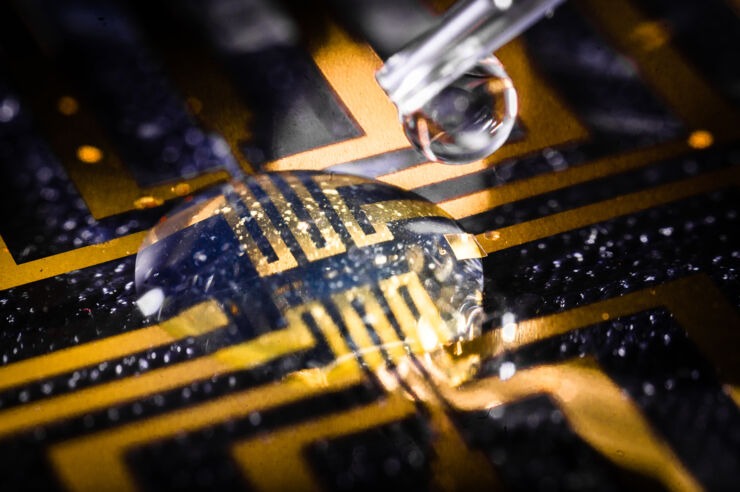
The conductivity of the injectable gel is tested on a microfabricated circuit. Image credit: Thor Balkhed/Linköping University
Electronic medicine is a field of research that does not neatly fit into an existing field.
“Right now you’re talking to a physicist, a chemist and me, who has a background in biomedicine. We work together along with material scientists and electrical engineers to integrate the knowledge from our different fields. For this to work, you need to understand the brain and you need to understand chemistry and physics,” says Hanne Biesmans, PhD student at the Laboratory of Organic Electronics, LOE, at Linköping University.
The research she refers to is about so-called organic electronics that can be connected to living tissue. The long-term goal is to be able to treat various nervous system and brain diseases. Her colleague Tobias Abrahamsson is a chemist.
“The interdisciplinary nature of our research, where we combine different aspects and fields of knowledge, is very exciting. You could also say that I have a more personal motivation, as in my family there are diseases that affect the nervous system,” he says.
Translates between biology and electronics
But what is organic electronics? And how could it be used to treat diseases – such as epilepsy, depression or Alzheimer’s and Parkinson’s – that are difficult to treat nowadays?
“In the body, communication takes place through lots of small molecules, such as neurotransmitters and ions. Neural signalling is for example also a wave of ions that gives rise to an electric impulse. So we want something that can take all that information and act as a translator between ions and electrons,” says Xenofon Strakosas, assistant professor with a background in physics.
In 2023 they managed, together with other researchers at Linköping University, Lund University and the University of Gothenburg, to grow gel electrodes in living tissue.
“Instead of using metals and other inorganic materials to conduct current, electronics can be created using different materials based on carbon and hydrogen atoms – in other words, organic materials – which are conductive. These are more compatible with biological tissues and therefore better suited to integrate with, for example, the body,” says Tobias Abrahamsson.
The organic electronic materials are very useful for conducting biological signals, as they can conduct ions as well as electrons. Also, they are soft, unlike metals.
Electrical brain stimulation is already used to treat some diseases. Electrodes are implanted in the brain, for example to treat Parkinson’s disease.
“But the implants used clinically today are quite rudimentary; they are based on hard or rigid materials such as metals. And our body is soft. So there’s friction, which could lead to inflammation and the formation of scar tissue. Our materials are softer and more compatible with the body,” says Hanne Biesmans.
Electrodes inside plants
As early as some ten years ago, their colleagues at LOE showed that they could make plants suck up a water-soluble substance, which inside the stem of the plant formed a structure that conducts electricity. A kind of electrode, in other words, inside a plant.
The substance in question is a so-called polymer – a substance that consists of many small similar units that together can form long chains through a process called polymerisation. That time, roses were used and the researchers were able to show that they had created organic electrodes. This opened the door to a new field of research.
“But a piece was missing. We didn’t know how to make the polymers form inside mammals and in the brain, for example. But then we realised that we could have enzymes in the gel and use the body’s own substances to start polymerisation,” says Xenofon Strakosas.
The idea led to the researchers now being able to inject the mildly viscous gel-like solution into the tissue. When it comes into contact with the body’s own substances, such as glucose, the properties of the gel changes. And the Swedish researchers were the first in the world to succeed with the method used to activate the formation of electrodes in the tissue.
“The gel self-polymerises in the tissue and becomes electrically conductive. We let biology do it for us,” says Xenofon Strakosas.
Also, it remains in the place where it was injected. This is important because the researchers want to be able to control where in the tissue the gel is located. The research team has shown that they can grow electrodes in the brain of zebrafish and around the nervous system of leeches in this way. They are now investigating whether it also works in mice.
But there is a long way to go before treating diseases with the gel becomes a reality. First, the research team will explore how stable the gel is inside the tissue. Does it break down after a while and what happens then? Another important question is how the conductive gel can be connected to electronics outside the body.
“It’s not the easiest thing to do, but I hope that over time the method can be used to monitor what happens inside the body, down to the cellular level. Then perhaps we can understand more about what triggers or leads to different diseases in the nervous system,” says Tobias Abrahamsson.
“There’s a lot left to solve, but we’re making progress,” says Xenofon Strakosas. It would be awesome if we could eventually use the electrodes to read signals inside the body and use them for research or in healthcare.”
Written by Karin Söderlund Leifler
Source: Linköping University
[ad_2]
