Category: United Nations

  • Syria: Aleppo fighting leaves civilians dead, displaces thousands

    Syria: Aleppo fighting leaves civilians dead, displaces thousands

    Syria: Aleppo fighting leaves civilians dead, displaces thousands

    Clashes resumed on Tuesday between General Security Forces of the transition Government and the mainly Kurdish Syrian Democratic Forces (SDF), following a brief pause after the ceasefire announced in late December 2025.

    Initial fighting near the Alleramoon roundabout – on the historic city’s western outskirts – spread to the predominantly Kurdish neighbourhoods of Ash-Sheikh Maqsoud and Ashrafiyeh, with shelling also affecting surrounding government-controlled areas.

    Significant damage has been reported to homes and public infrastructure, including healthcare. At least three major hospitals have ceased operations, while flights in and out of Aleppo International Airport have also been suspended since Tuesday.

    Protect civilians, de-escalate now

    The Secretary-General is alarmed by reports of civilian deaths and injuries after hostilities re-escalated earlier this week in the city’s northeastern neighbourhoods, UN Spokesperson Stéphane Dujarric told reporters in New York on Wednesday.

    The United Nations reiterates that all parties have a clear obligation, under international humanitarian law, to protect civilians and civilian infrastructure,” he said, urging all actors to “immediately de-escalate, exercise maximum restraint, and take all measures to prevent further harm to civilians.”

    The UN Office for the Coordination of Humanitarian Affairs (OCHA) estimates that approximately 30,000 people have been displaced, with more than 2,000 families relocating to Afrin district and around 1,100 people sheltering in nine collective centres inside Aleppo.

    Thousands more fled Ashrafiyeh and Ash-Sheikh Maqsoud on Wednesday, seeking refuge with host communities.

    Local authorities have designated some places of worship as temporary shelters, opened humanitarian corridors to allow civilians to evacuate, and mobilized public buses to transport displaced families.

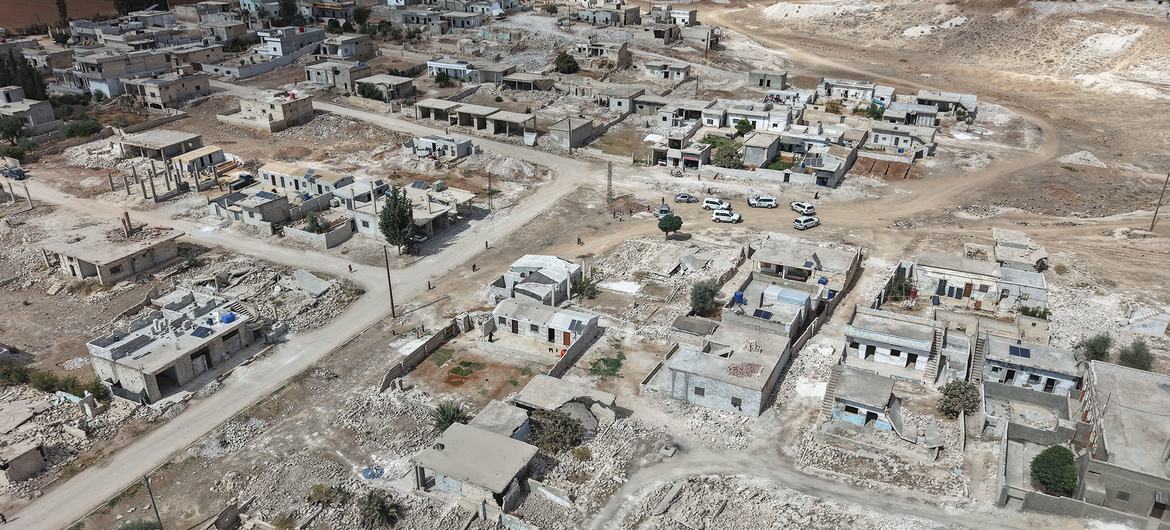
    Drone footage of the town of Latamneh in Hama, which was completely destroyed during the conflict. Mines and unexploded ordnance continue to litter the area, posing deadly risk for civilians, especially children.

    Drone footage of the town of Latamneh in Hama, which was completely destroyed during the conflict. Mines and unexploded ordnance continue to litter the area, posing deadly risk for civilians, especially children.

    Push to revive March agreement

    The Secretary-General called on all parties to demonstrate flexibility and goodwill on both the military and political tracks and to resume negotiations to fully implement the 10 March agreement between the two sides.

    Asked what concrete steps were needed, Mr. Dujarric said an agreement between the Government and the SDF on placing security forces under a unified national command would be a key measure, stressing the need for a state in which “all Syrians…would feel safe and protected.”

    The latest violence comes amid an uneasy transition following the fall of the Assad Government in December 2024.

    Since then, flare-ups of violence in several parts of the country – including renewed sectarian attacks targeting predominantly Alawite coastal areas and Druze communities in Sweida and other governorates – have triggered new displacement and deepened fears among Syrians still recovering from nearly 14 years of war.

    Worsening humanitarian conditions

    Millions of Syrians remain dependent on aid, with many forced to spend another winter in tents or damaged homes.

    According to OCHA, heavy snowstorms that hit northern Syria at the end of December affected around 158,000 internally displaced people across Aleppo, Idleb and Al-Hasakeh governorates.

    Two infants died from extreme cold in displacement camps in northern Idlib, while thousands of shelters were damaged, leaving families exposed to freezing temperatures.

    OCHA cautioned that without rapid scale-up, health risks – particularly for children, older people and those with chronic illnesses – will continue to rise, even as insecurity further constrains access and aid delivery.
    Source link

  • Winter storms upended thousands in Gaza

    Winter storms upended thousands in Gaza

    Winter storms upended thousands in Gaza

    “Tents were blown away or damaged, homes collapsed under storm conditions, and personal belongings were soaked,” according to its latest update

    In several locations, entire displacement sites were flooded due to inadequate drainage and low-lying terrain.” 

    The storms also damaged temporary learning spaces and roads used to bring much-needed supplies into Gaza, where humanitarian efforts continue. 

    Better shelter options needed 

    During December, aid workers supported some 80,000 families, providing more than 40,000 tents, over 135,000 tarpaulins, and thousands of other items including mattresses and blankets. 

    UN partners working in the shelter sector stressed, however, that “tents cannot serve as the primary and sole shelter modality in Gaza, as they provide only temporary cover.” 

    They highlighted the urgent need to accelerate the shift to more durable solutions, including repairs to partially damaged homes.  

    Lack of land 

    They also warned that “lack of land availability is preventing relocation and delaying the scale-up of viable shelter solutions.”  

    Furthermore, recent rainstorms have offset some of the gains made during the ceasefire that came into effect in October, and an estimated one million people across the devastated enclave still require urgent emergency shelter assistance. 

    Meanwhile, partners working to improve emergency telecommunications reported that last week they finalized the delivery of new equipment to improve radio coverage that had been pre-positioned in Jerusalem awaiting Israeli approval to enter Gaza since August 2024.  

    OCHA noted that while this development is critical to strengthen the safety of humanitarian operations, other equipment – including key power-supply solutions – continue to be blocked from entering the Strip. 

    Source link

  • Venezuela’s people must be heard, insists UN human rights chief

    Venezuela’s people must be heard, insists UN human rights chief

    Venezuela’s people must be heard, insists UN human rights chief

    The US action made “all States less safe around the world”, said Ravina Shamdasani, spokesperson for the High Commissioner.

    Speaking to journalists in Geneva, Ms. Shamdasani rejected the US justification for its intervention on the grounds of the Venezuelan Government’s “longstanding and appalling” human rights record. 

    “Accountability for human rights violations cannot be achieved by unilateral military intervention in violation of international law,” she insisted.

    “Far from being a victory for human rights, this military intervention, which is in contravention of Venezuelan sovereignty and the UN Charter, damages the architecture of international security…And this is a point that the Secretary-General has also made.”

    Ms. Shamdasani explained the High Commissioner’s position that the military operation “violates the fundamental principle of international law (and) the UN Charter, which states that States must not threaten or use force against the territorial integrity or political independence of any State”.

    Calling out abuse

    The UN human rights office, OHCHR, was expelled from Venezuela in February 2024, following its consistent reporting on the deteriorating situation there. Independent probes commissioned by the Human Rights Council have also detailed grave and ongoing abuses against opponents of the country’s ruling party.

    “The people of Venezuela deserve accountability through a fair victim-centred process,” Ms. Shamdasani said, adding that the rights of the Venezuelan people “have been violated for too long”. 

    The OHCHR spokesperson expressed concerns that the instability and further militarization in the country in response to the US intervention might make the situation worse.

    A state of emergency was declared on Saturday that restricts the free movement of people, the seizure of property necessary for national defence and the suspension of the right to assembly and to protest, Ms. Shamdasani noted. “We’re particularly concerned, given the record that the Government has in suppressing free speech, protest, freedom of assembly, using the pretext of national security.”

    “The High Commissioner calls on the US and the Venezuelan authorities, as well as the international community, to ensure full respect for international law, including human rights,” she said, adding that the future of Venezuela “must be determined by the Venezuelan people alone, with full respect for their human rights, including the right to self-determination, and sovereignty over their lives and their resources”.

    One in four Venezuelans need aid

    Beyond the political crisis in Venezuela, almost eight million people, or one in four people, need humanitarian assistance today, after years of economic decline, repression and instability.

    The UN aid coordination office, OCHA, said that a response plan remains in place requiring approximately $600 million.

    “It’s very dramatic what has happened on the political level in Venezuela. But for the broad mass of people, their humanitarian day-to-day situation hasn’t changed that radically,” said OCHA spokesperson Jens Laerke.

    “So, the situation as it was immediately before [the US intervention] has continued until this day and that is the basis for our work on the humanitarian side going forward this year.”

    Out of the eight million identified as needing assistance, 900,000 have “very high” multisectoral needs including food, nutrition, education, health services; “basically all the things that the state of Venezuela has not been able to provide to its citizens for a number of years”, Mr. Laerke said.

    The OCHA spokesperson added that Venezuela was one of the least-funded aid operations globally. Despite this obstacle, the UN had managed to reach some two million people with aid in 2025.

    Refugees in flux

    The situation remains tense for the millions of refugees living outside Venezuela, too, although for the moment there has been no major displacement across the country’s borders linked to Saturday’s US military operation, according to the UN refugee agency, UNHCR.

    “Of course, we’re closely monitoring the situation and the border, cross-border movement and then we stand together with other UN agency and humanitarian partners to support the emergency relief effort and to protect the displace people in need as required,” said UNHCR spokesperson Eujin Byun, also in Geneva.

    The agency says that nearly 7.9 million people have left Venezuela in search of protection and a better life. The majority – more than 6.9 million people – have found shelter in in Latin American and Caribbean countries. 

    UNHCR works in the Americas and beyond to support the inclusion of Venezuelans in the societies that have welcomed them and find solutions, create stability and foster growth and development in these communities. 

    Source link

  • Venezuela crisis: UN aid effort continues amid political upheaval

    Venezuela crisis: UN aid effort continues amid political upheaval

    Venezuela crisis: UN aid effort continues amid political upheaval

    The backdrop

    • Venezuela has endured years of economic collapse, political instability, hyperinflation and economic sanctions from Washington, compounded by floods, landslides and other climate shocks.
    • The recent seizure of President Nicolás Maduro by US special forces has added a new layer of uncertainty to an already volatile situation.
    • According to the UN aid coordination office, OCHA, 7.9 million people — more than a quarter of the population — need urgent humanitarian assistance.
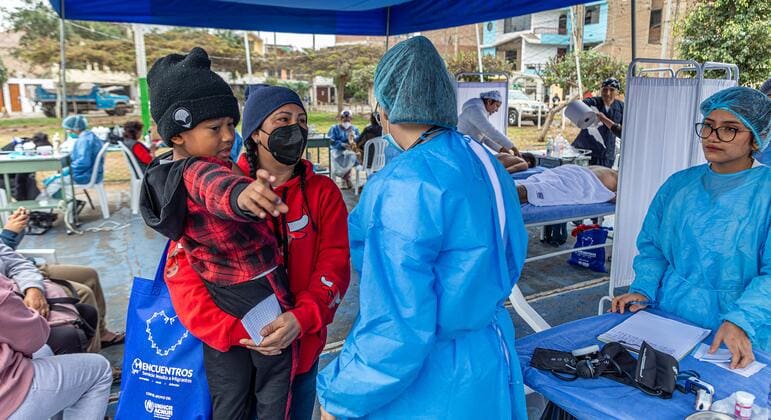
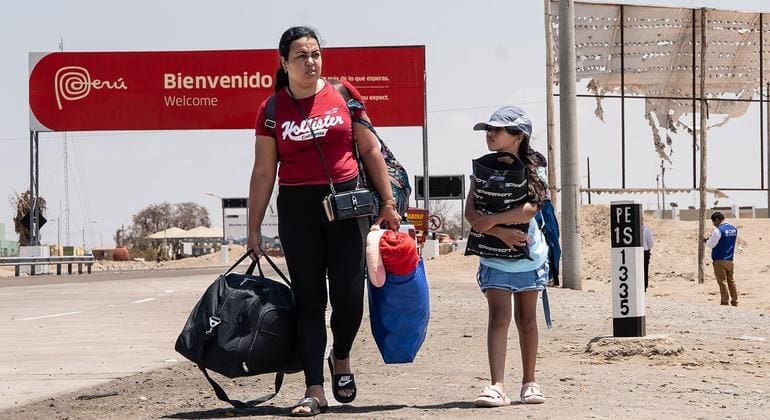
    UNHCR and partner staff provide legal and health assistance to Venezuelan refugees at a service fair in Tacna, Peru on October 21, 2025.

    UNHCR Provides Legal and Health Assistance to Venezuelan Refugees in Tacna, Peru.

    A large UN footprint

    • The UN maintains a broad operational presence in Venezuela, with most agencies active on the ground.
    • Work spans food security, healthcare, gender equality, education, decent work, water and sanitation, and peacebuilding.
    • Agencies including the World Food Programme (WFP), World Health Organization (WHO) and the reproductive rights agency, UNFPA, deliver life-saving aid and help keep essential services running — from food distributions and nutrition screenings to maternal care and clean water projects.
    • Following the latest political developments, UN leadership in the country said it is closely assessing needs to ensure support can be scaled up if required.

    Human rights under scrutiny

    • Venezuela’s human rights situation remains a core UN concern.
    • The Office of the UN High Commissioner for Human Rights (OHCHR) continues to monitor violations.
    • Briefing the Human Rights Council last month, High Commissioner Volker Türk warned of deepening repression, citing increased militarisation, threats to journalists and human rights defenders, arbitrary detention and enforced disappearances.
    • UN investigators have stressed that accountability for long-documented abuses — including extrajudicial killings, torture and sexual and gender-based violence — must not be overshadowed by the current crisis.
    A migrant family, including a woman with a large backpack and a small child, walks through a temporary shelter area at the Lajas Blancas reception centre in Darien, receiving aid from IOM staff.

    Migrants arriving at the Lajas Blancas reception centre in Darien, Panama.

    A long-running exodus

    • It is too early to know whether recent events will intensify the mass displacement that has unfolded over the past decade.
    • Millions of Venezuelans have already fled repression, instability and economic hardship.
    • Nearly half of those who have left rely on informal, low-paid work; 42 per cent struggle to afford enough food, and 23 per cent live in overcrowded housing.

    Regional response

    • The UN refugee agency UNHCR and the International Organization for Migration (IOM) coordinate a regional response across 17 countries.
    • This effort has helped more than 4.5 million Venezuelans in Latin America and the Caribbean obtain regular status, giving access to documentation, protection and basic services.
    • The latest regional plan seeks $1.4 billion to reach 2.3 million vulnerable people, focusing on jobs, education, healthcare and protection.
    Warao families make their way to the local church in Icacos, Trinidad and Tobago for cash distribution.

    Warao families make their way to the local church in Icacos, Trinidad and Tobago for cash distribution.

    The funding gap

    • Despite reiterated UN commitment to Venezuelans’ dignity and protection, resources are stretched.
    • In 2025, just 17 per cent of the over $600 million required for Venezuela’s Humanitarian Response Plan had been received.
    • UN officials warn that without increased funding, aid agencies will be forced to scale back support at a moment of heightened need.

    Bottom line:

    Political turmoil may dominate headlines, but for the UN the mission is constant: keep humanitarian lifelines open, defend human rights and support Venezuelans — inside the country and beyond its borders — through an unfolding crisis with global consequences

    Source link

  • UN agency rolls out three-year plan to safeguard Ukraine’s bread basket

    The UN Food and Agriculture Organization (FAO) released its emergency response and early recovery plan, outlining priority measures to protect agricultural livelihoods, restore production and strengthen the whole agrifood sector.

    The plan links immediate emergency assistance with early recovery and resilience-building.

    It prioritises protection of food production for vulnerable rural families and small-scale farmers, rehabilitating agricultural land, boosting core production and supporting more market-oriented and climate-resilient farming.

    Ukraine’s rural communities cannot afford a pause between emergency response and recovery,” said Shakhnoza Muminova, Head of FAO in Ukraine.

    “This Plan is designed to bridge that gap – protecting livelihoods now, restoring safe access to land and supporting farmers and rural families to rebuild production.”

    Early recovery refers to restoring basic livelihoods and services while emergency needs continue, helping communities move beyond survival and reduce long-term dependence on aid.

    Focus on the frontline

    FAO said special attention will be given to frontline regions, women and youth, internally displaced persons (IDPs) and returnees, as well as to land affected by explosive remnants such as landmines.

    The agency’s current portfolio in Ukraine totals $25.9 million, with most funding directed to emergency and early recovery, but it warned that additional resources are needed to prevent further losses.

    “Continued, predictable support is critical to prevent deeper losses and to sustain recovery efforts over time,” Ms. Muminova said.

    Civilians at constant risk

    The challenges facing agriculture unfold amid continued risks to civilians.

    According to the UN Office for the Coordination of Humanitarian Affairs (OCHA), an older civilian was killed and two others injured in the Kherson region on Monday while waiting for a food distribution.

    “It is outrageous that once again a drone strike…killed one and injured two older residents who were at a food distribution point,” said Matthias Schmale, the Humanitarian Coordinator for Ukraine.

    Humanitarian workers provided first aid, and the injured are receiving hospital care.

    Source link

  • World News in Brief: Escalating violence in Sudan, civilian danger grows in Ukraine, Ethiopia aid cuts

    World News in Brief: Escalating violence in Sudan, civilian danger grows in Ukraine, Ethiopia aid cuts

    World News in Brief: Escalating violence in Sudan, civilian danger grows in Ukraine, Ethiopia aid cuts

    In North Darfur, drone strikes on 3 January reportedly caused civilian casualties in the villages of Al-Zurq and Ghurair, including strikes on a market and a medical clinic, said UN Spokesperson Stéphane Dujarric, briefing journalists on Monday. 

    And in West Darfur state on Saturday, one civilian was reported killed following two drone attacks in the vicinity of Kulbus. More than 600 people have been displaced by the strikes there, according to UN humanitarian partners.

    Deaths and injuries 

    In South Kordofan state, multiple drone attacks between 1 and 3 January in Dilling reportedly resulted in civilian deaths and injuries. 

    The situation remains dire in Dilling, with civilians trapped under siege as humanitarian conditions continuing to deteriorate, while access to essential supplies is increasingly restricted.

    “We reiterate our call for the protection of civilians and for the unhindered humanitarian access to all affected areas,” Mr. Dujarric underscored.

    “Continued and predictable humanitarian access to deliver life-saving assistance and to prevent further deterioration of the humanitarian situation is essential.”

    Ukraine: UN and partners continue to support victims of latest Russian attacks 

    In Ukraine, the UN and aid partners are continuing to provide support to the people of embattled Kharkiv, amid ongoing Russian attacks on Monday.

    Last Friday, a strike on a high-rise block in the eastern city killed six residents including a mother and child, according to reports.

    In addition, dozens more were hurt in the attack, and many were left homeless, amid freezing conditions and snow, according to the UN aid coordination office, OCHA.

    In addition, parts of the city near the Russian frontier were left without electricity, water and gas.

    Civilians face growing danger 

    “Further attacks are being reported in the city, risking additional harm to civilians and further destruction of homes as temperatures remain well below zero,” said Maka KhazaliaOCHA Head of Office in Kharkiv.

    “Humanitarian teams continue to support those affected by the attack and will continue to provide assistance to those affected in future.”

    UN humanitarians work alongside partners and city staff, providing essential services to those in need.

    This includes delivering hot meals, non-food items and mental health support.

    There were also reported attacks in Chernihiv, Donetsk, Kherson and Mykolaiv regions which caused civilian casualties and damage to critical infrastructure, resulting in power outages. 

    Humanitarian colleagues also note that on 2 January, authorities announced mandatory evacuations of more than 3,000 children and their families from frontline areas in Dnipropetrovsk and Zaporizhzhia Regions.

    Refugee response now at breaking point in Ethiopia, warns WFP

    In Ethiopia, the global crisis in funding for humanitarian work is taking a major toll, with aid teams warning that the refugee response there is at breaking point.

    The UN World Food Programme (WFP) alerted that more than 1.1 million people risk losing “food, water and healthcare within weeks”, due to lack of funding.

    Ethiopia is the second-largest refugee-hosting country in Africa and has seen a surge in arrivals amid ongoing conflicts in Sudan and South Sudan, as well as drought in Somalia.

    More than a million refugees have already endured prolonged ration cuts since May 2023 and WFP has now had to cut food assistance again, from 60 per cent to 40 per cent.

    WFP calls for urgent funding 

    “Beyond humanitarian assistance, sustained funding is urgently needed to support solutions that help refugees rebuild their lives,” said Claire Nevill, WFP Head of Communications in Ethiopia.

    “Without immediate support, more services will be cut, and more lives will be at risk.”

    She insisted that the Government of Ethiopia, WFP and the UN refugee agency (UNHCR) were aiming to provide vulnerable people fleeing conflict and hunger with long-term livelihood opportunities, including jobs.

    But additional support will be needed to support sustainable projects so that refugees can rebuild their lives, she said.

    Source link

  • Gaza: 100 per cent of basic food needs met for first time since 2023

    Gaza: 100 per cent of basic food needs met for first time since 2023

    Gaza: 100 per cent of basic food needs met for first time since 2023

    “The January round is the first since October 2023, in which partners had sufficient stock to meet 100 per cent of the minimum caloric standard,” UN Spokesperson Stéphane Dujarric told journalists on Monday.

    That’s compared to the end of 2025, when each family received just 50 to 75 per cent of the calories needed to stay healthy.

    To further address food insecurity, the UN is supporting the production of approximately 170,000 two-kilo bread bundles daily. 

    Around a third of the bread is distributed free of charge to more than 400 shelters and community sites, with the remaining sold at a subsidised price.

    Aid must remain ‘unimpeded’

    Mr. Dujarric highlighted that last week alone, the UN and partners brought more than 10,000 metric tonnes of aid through the Karim Shalom, Karem Abu Salam crossing and the Zikim crossing. 

    Supplies included food and cooking ingredients, animal fodder, soap and other hygiene items, including diapers, winter clothing, blankets and mattresses. 

    The recent announcement by Israeli authorities to suspend operations of certain non-governmental organizations (NGOs) threatens to impede critical assistance for civilians, over 50 NGOs warned

    In a statement issued by the UN Spokesperson on Friday, UN Secretary-General António Guterres said he was “deeply concerned” by the development and underscored that Israel must allow “unimpeded” passage of humanitarian relief.

    Violence continues 

    Israeli airstrikes, shelling and gunfire continued to be reported across several areas of the Gaza Strip between Tuesday and Friday last week, the UN aid coordination office (OCHAreported over the weekend.

    Citing the Gaza Ministry of Health, OCHA said that as of Thursday, five Palestinians were reported killed and 11 others injured across the Gaza Strip over the previous 48 hours.

    This comes amid harsh winter conditions and destructive winter storms that are damaging infrastructure and putting water, sanitation and hygiene services under continuing pressure.

    Source link

  • Yemen aid response buckling under funding cuts as needs keep rising

    Yemen aid response buckling under funding cuts as needs keep rising

    Yemen aid response buckling under funding cuts as needs keep rising

    According to the December humanitarian update from aid coordination office, OCHA, Yemen’s 2025 Humanitarian Needs and Response Plan is just 25 per cent funded, forcing agencies to scale back life-saving services across all sectors, despite worsening needs. 

    Health and protection services have been particularly hard hit, exposing vulnerable communities to growing risks. 

    Health services still on the brink 

    The health system, already weakened by years of conflict and underinvestment, is “on the brink”, the report said.  

    Since January last year, 453 health facilities have faced partial or imminent closure across 22 governorates, including hospitals, primary health centres and mobile clinics. 

    These disruptions come amid widespread food insecurity, malnutrition, unsafe water and sanitation, and recurring disease outbreaks. 

    Cuts are affecting both areas controlled by the internationally recognised Government and those under the de facto Houthi authorities, underscoring the nationwide impact of the funding crisis.  

    Millions of people now face reduced access to basic healthcare, maternal services and emergency treatment. 

    Beyond health, food security and nutrition remain major concerns. While partners have continued to deliver assistance where possible, reduced funding has constrained coverage at a time when many families are struggling to afford food or recover from climate shocks, including floods that hit Marib governorate earlier in 2025.  

    A coordinated flood response there has shown how shock-responsive cash assistance can help families recover more quickly, but such approaches require sustained resources. 

    Despite the bleak outlook, OCHA highlighted the continued importance of the Yemen Humanitarian Fund, which has helped channel limited resources to priority, life-saving interventions, and of community-based projects that aim to restore dignity and resilience for displaced families. 

    Conflict backdrop 

    Yemen has been devastated by more than a decade of conflict between Houthi movement rebels and the Government of Yemen, following the Houthis’ takeover of the capital, Sanaa, in 2014.  

    Although large-scale fighting has eased in recent years, tensions remain high and the risk of renewed hostilities persists, threatening to reverse fragile gains and further deepen humanitarian needs. 

    OCHA urged donors to step up support, warning that without urgent funding, further service closures are likely, with devastating consequences for Yemen’s most vulnerable people. 

    Source link

  • Gaza aid lifelines under strain as winter worsens

    Gaza aid lifelines under strain as winter worsens

    Gaza aid lifelines under strain as winter worsens

    Since the fragile October ceasefire began as phase one of the US-led peace plan, thousands of tents and hundreds of thousands of tarpaulins have been distributed. 

    Yet partners estimate that over one million people – around half of Gaza’s population – still urgently need shelter support. “The needs remain immense, and the harsh weather only deepens the suffering of families living in tents or war-damaged buildings,” said the UN Spokesperson’s Office on Friday.

    Water, sanitation and hygiene services are also under pressure. Storms have damaged already shattered infrastructure, while fuel shortages and limited landfill access have left waste piling up. 

    UNICEF-supported teams continue to remove around 1,000 tons of solid waste each month, helping protect children and families from health risks.

    A person walks through a flooded and debris-strewn street in the Gaza Strip after heavy rains, with destroyed buildings and piles of rubble visible under a cloudy sky.

    Heavy rains and floods cause widespread destruction in the Gaza Strip, displacing residents and leaving streets filled with mud and rubble.

    West Bank demolitions

    In the West Bank, demolition of 25 buildings in Nur Shams refugee camp has displaced around 70 families. UN Palestine relief agency, UNRWA, continues to support those who have had to flee from Jenin, Tulkarm and Nur Shams, covering rental costs for three months during the cold winter.

    Humanitarian agencies continue to advocate for safe access and the entry of specialised equipment to maintain essential services, underscoring the critical role of UN and NGO partners in delivering life-saving assistance across the Occupied Palestinian Territory.

    Lives at stake as Israeli curbs tighten

    New Israeli restrictions on international non-governmental organisations (NGOs) risk further crippling humanitarian operations in Gaza at a moment of acute need, the UN warned Friday.

    Secretary-General António Guterres said he was “deeply concerned” over the move, calling for the proposed measure to be reversed, stressing the indispensable work of NGOs to saving lives. 

    “The suspension risks undermining the fragile progress made during the ceasefire,” he said in a statement issued by his Spokesperson.

    “This announcement comes on top of earlier restrictions that have already delayed critical food, medical, hygiene and shelter supplies from entering Gaza. This recent action will further exacerbate the humanitarian crisis facing Palestinians.”

    Philippe Lazzarini, Commissioner-General of UNRWA, said the measures would reduce life-saving assistance for civilians already struggling to survive after months of conflict and deprivation.

    In a social media statement earlier on Friday, Mr. Lazzarini said he was echoing concerns raised by principals of the Inter-Agency Standing Committee (IASC) – the forum that brings together heads of UN and non-UN humanitarian organisations.

    Matter of survival

    “New Israeli restrictions on international NGOs are further compromising the humanitarian operation in the Gaza Strip,” he said, stressing that “people in Gaza need more aid, not less, simply to survive”.

    He warned that the measures would also undermine efforts to assist communities affected by escalating violence in the West Bank, where humanitarian needs have surged alongside displacement and access constraints.

    According to the IASC, the planned restrictions include new registration and operational requirements for international NGOs that would significantly limit their ability to deliver. 

    Humanitarian leaders have urged Israeli authorities to revoke the measures, warning that they would severely disrupt aid delivery and contravene Israel’s obligations under international humanitarian law.

    UNRWA targeted

    Mr. Lazzarini said the latest steps follow the adoption of Israeli legislation targeting UNRWA, which has already had a chilling effect on humanitarian operations. Taken together, he said, they form “a troubling pattern” that risks setting a dangerous global precedent.

    “Failing to push back against attempts to control the work of aid organisations will further undermine the basic humanitarian principles of neutrality, independence, impartiality and humanity,” he said.

    Humanitarian agencies have repeatedly warned that access constraints, insecurity and bureaucratic impediments are preventing aid from reaching people in need across the Occupied Palestinian Territory. 

    They say any further restrictions could have immediate and potentially fatal consequences for civilians who are dependent on humanitarian assistance.

    UN officials and aid leaders continue to call for unimpeded humanitarian access, respect for international law and the protection of humanitarian personnel and operations.

    Source link

  • New year dawns amid rubble and resolve in Gaza

    New year dawns amid rubble and resolve in Gaza

    New year dawns amid rubble and resolve in Gaza

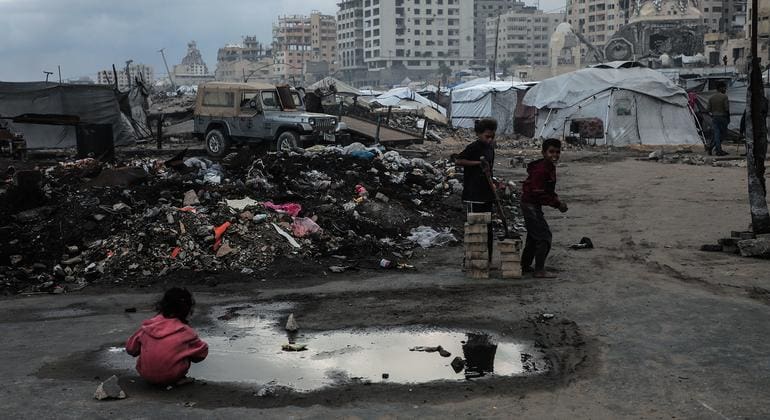
    Hundreds of thousands of Palestinians remain uprooted, many living in makeshift tents pitched on bare ground or squeezed into damaged buildings without reliable access to water, electricity, healthcare or sanitation.

    Winter rains have compounded the hardship, flooding shelters and turning camp pathways into heavy mud.

    Fragile hope

    Yet, amid the destruction, displaced families say the arrival of a new year has stirred fragile hopes for stability, safety and a chance to rebuild lives interrupted by conflict.

    Standing in front of her tent, Umm Rabee’ Al-Malash appealed for more international engagement.

    “The Palestinian people must be supported, as they have endured immense suffering,” she told our correspondent. “Help us rebuild the Gaza Strip, bring about peace, and allow us to have a State where we can live in peace and security.”

    Falling behind

    For parents, the toll on children is among the deepest scars of the war. Schools across Gaza have been damaged or destroyed, while thousands of young people have missed out on months of learning.

    Wafaa Al-Khawaja voiced her fears for the next generation. “I wish that, just as the rest of the world lives, we could live the same way. 

    “Our children today have no education or anything else,” she said, describing days consumed by the struggle to find food, water and warmth.

    In northern Gaza, displacement has cut off families from homes and livelihoods built over decades. 

    Turn back the clock

    Kamal Abu Hsheish, originally from the Jabalia camp, said his only wish is to return to the life he knew before the war. For now, daily reality inside the camps continues to impose severe humanitarian conditions on thousands of families.

    Aid agencies warn that relief efforts face mounting challenges, including damaged infrastructure, restricted access and the sheer scale of need. 

    Our children today have no education or anything else

    Reconstruction, they say, will require sustained international commitment once conditions allow if the Gaza peace deal can advance to the next stage.

    As Gaza’s displaced population marks the start of another year – with no return to their old life in sight – hopes remain bound to an end to violence and meaningful political progress on the 20-point plan which established the fragile ceasefire between Israel and Hamas in early October. 

    Until then, families wait, enduring loss and uncertainty, while clinging to the belief that the coming months may finally bring safety, dignity and the possibility of going home to rebuild.

    Source link