
By :
Bashy Quraishy :Secretary General – EMISCO -European Muslim Initiative for Social Cohesion – Strasbourg
Thierry Valle :Coordination des Associations et des Particuliers pour la Liberté de Conscience
Trump’s intervention in Venezuela and his provocative statements of invasions of Greenland, Iran Cuba and Colombia deserve to be highlighted and condemned strongly by European leaders and decision makers
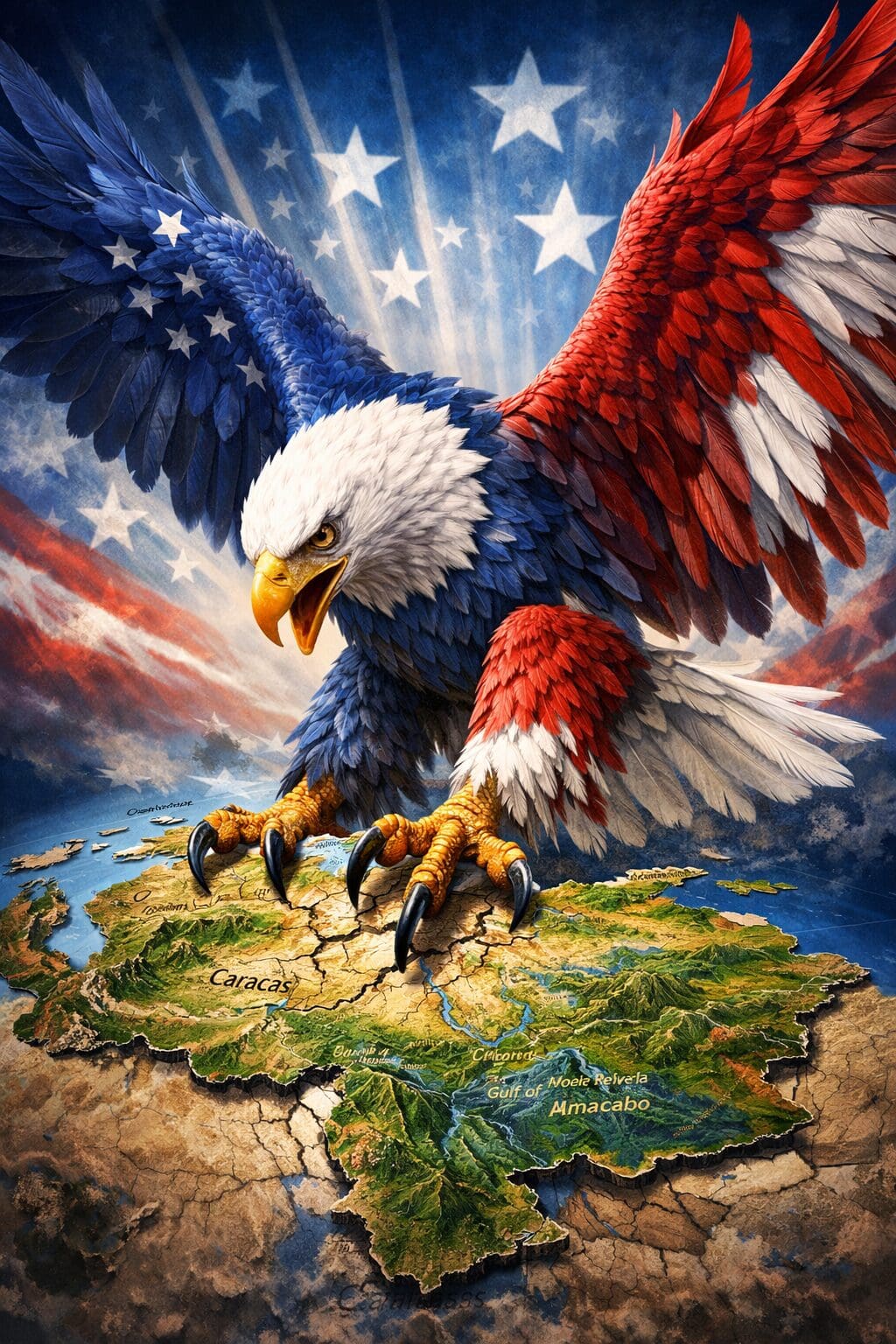
On 3 January 2026, the United States military carried out strikes on Venezuela, including in Caracas, against military and other infrastructure. During the operation, U.S. forces captured Venezuelan President Nicolás Maduro and his wife Cilia Flores. The couple was flown to the United States and taken into federal custody; Maduro was arraigned and pleaded not guilty to U.S. criminal charges. U.S. President Trump publicly stated that the U.S. would “run Venezuela” temporarily and oversee a transition, including tapping its oil infrastructure.
The Trump administration has offered multiple reasons for the action, For example, he has labeled Maduro and his network as a narco-terrorist organization responsible for drugs entering the United States. Trump also framed Maduro’s rule as authoritarian and claimed intervention was in the interest of Venezuelan people. Trump suggested Venezuela’s instability was contributing to illegal immigration to the U.S. border.
But it is widely believed that the whole scheme was to have control over oil resources. Though officials downplay this, analysts and critics point that an underlying factor is that Venezuela has world’s largest oil reserves.
Was this a compulsive action or planned for a while?
Starting in late 2025, the U.S. dramatically increased military and covert operations, including warships and marine units near Venezuelan waters. USA conducted airstrikes on boats alleged to be drug traffickers, killing dozens. Prior to the invasion USA navy seized Venezuelan oil tankers and put in place the blockade of the Venezuelan oil exports.
Add to that the fact that Trump authorized CIA covert operations inside Venezuela months before the invasion. These moves indicate a rising pressure campaign leading up to the January action.
All these signs tell us that it was a planned invasion. The sequence of events suggests long-term preparation, not a sudden, reactive decision.
But Why Now?
Few concrete public explanations exist for why the invasion happened at precisely this moment, but the biggest factor appears to be Venezuela’s oil and minerals, and its orientation toward Russia/China, may have been catalysts for timing.
Historically, U.S. interventions in Latin America have invoked, The Monroe Doctrin, counter-communism / pro-democracy rhetoric and counter-narcotics enforcement, limited mostly to law enforcement cooperation. But direct invasion and capture of a sovereign leader goes far beyond recent U.S. interventions. Experts say this is unprecedented since Panama in 1989, when the U.S. removed Manuel Noriega, another leader accused of drug crimes.
This raises the main question; Is it legal under U.S./International doctrine?
Most analysts and international law experts view the invasion as illegal. Under the UN Charter, military force is only lawful with Security Council approval or in response to an imminent military attack — neither condition clearly applies in Venezuela’s case. Even the U.S. use of force against alleged drug traffickers prior to the invasion lacks established legal justification under international law.
This means the action breaks from both international norms and recent U.S. practice, not fitting neatly into accepted doctrines like humanitarian intervention, self-defense, or multilateral peacekeeping. Some observers say that Trump’s actions reflect a new, more assertive ideology of “America First” intervention. Trump reportedly referenced a modified Monroe Doctrine asserting U.S. geopolitical control in the hemisphere. The framing mixes security, resource access, and hegemony in ways older doctrines did not openly articulate.
The immediate and future consequences of the invasion
Inside Venezuela, Maduro’s removal has left a power vacuum. Vice President Delcy Rodríguez was sworn in as acting president, though the legal and constitutional situation is highly contested. Strikes caused casualties, including military personnel and civilians, which human rights groups have criticized. Venezuelan military and state infrastructure were damaged or disabled. Violence and uncertainty will likely drive additional migration and displacemen and Venezuelan oil production and state services likely disrupted, deepening already severe humanitarian issues.
In U.S some political actors praised decisive action; others warned it risks broader conflict. Retaliation or escalation from aligned states and non-state actors is a heightened possibility.UN Secretary-General António Guterres warned the operation sets a dangerous precedent and called for diplomacy. Russia and China strongly condemned the move as a violation of sovereignty. Russia’s UN ambassador accused the U.S. of acting as “a supreme judge” above international norms. China’s envoy argued the U.S. “trampled upon Venezuela’s sovereignty and Beijing may increase diplomatic support for Caracas or use this to criticize U.S. unilateralism.
Some EU member states condemned the use of force and stressed respect for international law; others focused on concerns about Venezuela’s governance while still not endorsing military action. Figures like Brazil’s president denounced the strikes as violating international law and several African and Asian governments and movements condemned the invasion and kidnapping of a sovereign leader.
Under international law, the U.S. operation raises serious questions. Article 2(4) of the UN Charter prohibits military force against another state’s sovereignty except in limited exceptions (self-defence or Security Council authorization). There is no UN Security Council authorization for the strikes or capture. Forcible removal of a head of state and unilateral interference in another government’s political process are generally prohibited without Security Council mandate. Chatham House and other legal experts describe the operation as a significant violation of Venezuelan sovereignty and international legal norms.
U.S. officials have argued this was a law enforcement mission and referenced self-defense claims regarding narcotics threats, but such reasoning is not recognized under international law as a lawful basis for military intervention.
The reaction of American public, politicians, and Trump’s further threats to other nations
According to an Associated Press analysis of recent polling, most Americans wanted the U.S. government to focus in 2026 on domestic issues, such as health care and high costs, rather than foreign policy issues. Meanwhile, polling conducted in the immediate aftermath of the military operation that captured Venezuelan President Nicolás Maduro suggested that many Americans are unconvinced that the U.S. should step in to take control of the country.
Since taking over presidency,Trump boasted to be a peace-making president and claimed to have stopped many international conflicts, like India-Pakistan clash of 2025. It could be a tricky position for a president who ran on a promise of putting “America first” and ending the country’s involvement in “forever wars.” About 7 in 10 voters who backed Trump in the 2024 presidential election said that they wanted the U.S. to take a “less active” role in solving the world’s problem.
Trump’s public statements about taking over Greenland and Mexico, invading Colombia, Cuba and Iran have sent shock waves throughout the world.
Europeans, especially Denmark, where, one of us lives are very angry on Trump’s threats to take over Greenland. He has said that repeatedly that Greenland is strategically important to USA. He is not wrong that Greenland is strategically important, but his method and language are the problem, not the underlying fact. USA already enjoys extensive military access under agreements with Denmark and faces no military exclusion from Greenland today. So the strategic need already exists and is already met.
Then why the threats?
Trump does not think in terms of alliances, shared sovereignty and mutual trust.
He thinks in terms of ownership, control, leverage and transactions. In his worldview: “If something is important, you should own it, not share it.” This is 19th-century thinking. But an attempt to seize Greenland would be an act of war against Denmark, trigger a NATO existential crisis, testroy USA – European relations, collapse the Western alliance structure and isolate the U.S. globally.
It seems that Trump’s threats are meant to pressure Denmark into concessions, signal dominance to domestic audiences, normalize the idea that sovereignty is negotiable and test how far Europe will push back verbally and politically. Trump is a master in coercive intimidation.
But Denmark’s reaction is completely understandable and justified. Trump’s repeated statements about Greenland are not just abstract rhetoric, they touch sovereignty, dignity, and security of a partner country. We believe that Denmark is doing right by firmly rejecting any transfer of sovereignty, emphasizing Greenlandic self-determination, strengthening Arctic defence cooperation, increasing presence and investment in Greenland and keeping the issue international, not bilateral.
What Europe should do collectively?
It should make sovereignty non-negotiable and state clearly and repeatedly that allied territory is not subject to coercion, purchase, or threat. Europe should tell USA this, without ambiguity, jokes or misunderstandings. Europe should also engage American institutions, not Trump personally, anchor its responses in NATO, EU, and international institutions and avoid escalation via insults. Trump thrives on that.
What Europe realistically can do?
Since Europe cannot stand up to the USA militarily, and say enough is enough, it can do that structurally and economically. For that Europe must reduce defence dependency, build independent command capacity, and coordinate intelligence outside U.S. control. On top of that the EU still has real power when it comes to trade regulation, sanctions frameworks, market access and tech and finance rules. It means that Europe can impose conditionality, use lawfare, not force and coordinate with non-aligned BRICS states.
Europe also needs alliance diversification by improving its ties with China, Russia, Africa, ASEAN and Latin America. This will reduce vulnerability to U.S. unilateralism.
In short, Europe’s strength is not tanks but in its market size, norm-setting, regulatory power, and coalition-building. All the decision makers in Europe need is to stand on its two feet and let USA know, what its people are thinking and demanding.
The danger is not confrontation. The danger is passive alignment with actions Europe privately rejects.
Leave a Reply