
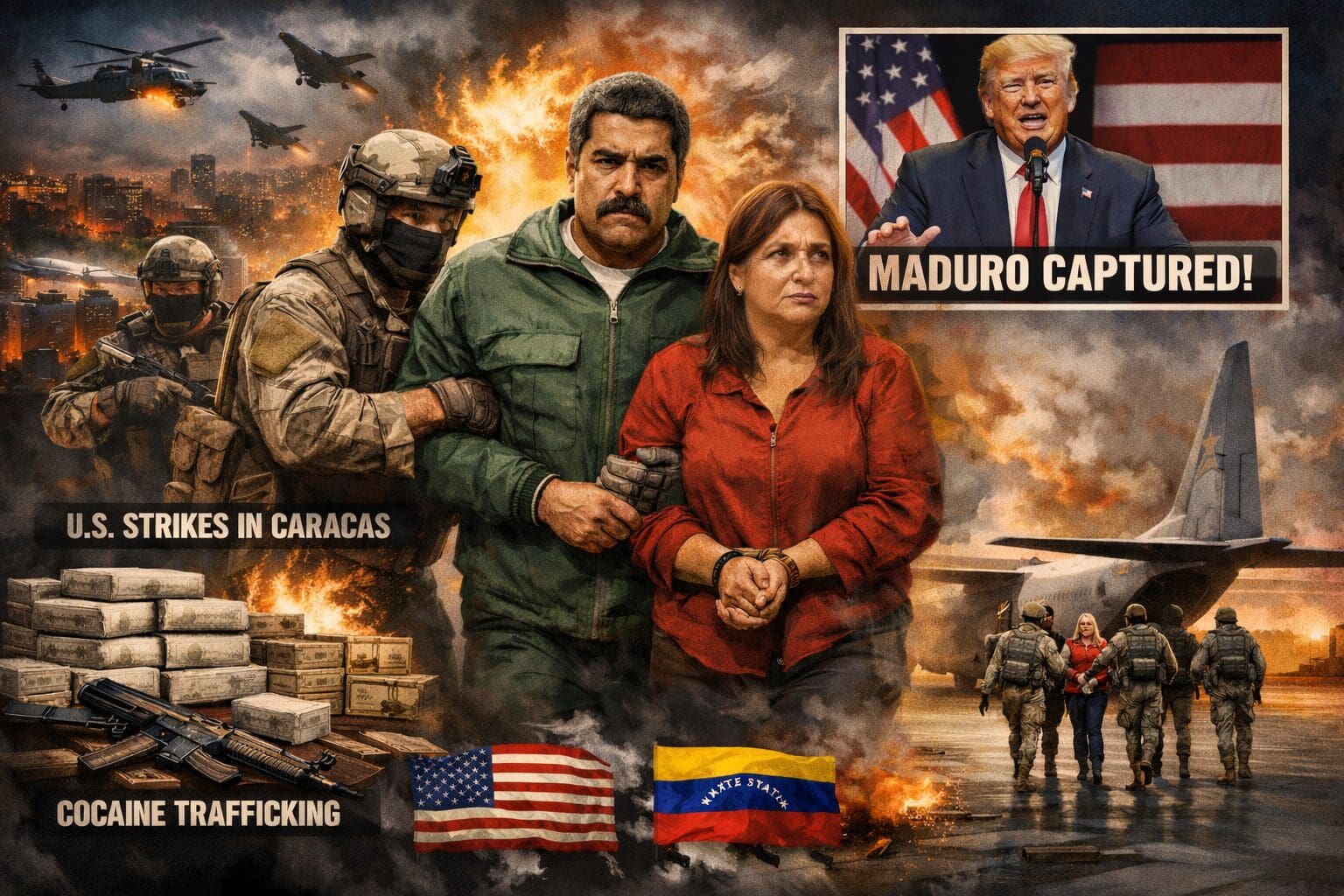
The United States launched a large-scale military strike against Venezuela early Saturday morning, resulting in the capture of President Nicolás Maduro and his wife, Cilia Flores, according to an announcement by President Donald Trump.
The operation, executed by Delta Force special operations troops, marks the first direct military intervention by the United States to capture and remove a sitting head of state since the 1989 invasion of Panama. The Trump administration has accused Maduro of running a narco-terrorist state, a characterization reflected in a 2020 narco-terrorism indictment filed in the Southern District of New York.
“The United States of America has successfully carried out a large scale strike against Venezuela and its leader, President Nicolas Maduro, who has been, along with his wife, captured and flown out of the country,” Trump announced on Truth Social at approximately 5:21 a.m. Venezuelan time Saturday morning.
OPERATION DETAILS REMAIN LIMITED
At approximately 2 a.m. Venezuelan Eastern Time, residents across Caracas reported at least seven major explosions followed by observations of low-flying military aircraft. Strikes targeted military installations including La Carlota airfield and Fuerte Tiuna military headquarters, traditionally believed to be a residence and operational center for the president.
The strikes lasted less than thirty minutes, with the southern sector of Caracas losing electrical power following the operation. Trump scheduled a press conference for later Saturday at his Mar-a-Lago residence in Florida.
Venezuelan Vice President Delcy Rodríguez responded to Trump’s announcement by stating: “We do not know the whereabouts of President Nicolás Maduro and First Lady Cilia Flores. We demand proof of life.”
THE CHARGES: NARCO-TERRORISM INDICTMENT
Maduro was formally indicted in March 2020 in the U.S. District Court for the Southern District of New York on charges of narco-terrorism conspiracy, conspiracy to import cocaine, and possession of machine guns and destructive devices.
According to prosecutors, Maduro allegedly “flooded the United States with cocaine in order to undermine the health and wellbeing” of the nation and worked with Colombian rebel groups in drug production and trafficking.
In August 2025, Attorney General Pam Bondi announced a $50 million reward for information leading to Maduro’s capture, double the previous $25 million bounty. Bondi alleged that Maduro worked with the Sinaloa Cartel and Tren de Aragua gang and cited the seizure of 30 tons of cocaine linked to Maduro and his associates.
Maduro has consistently denied all allegations regarding drug trafficking.
EU RESPONSE: INTERNATIONAL LAW EMPHASIS
The European Union issued a carefully measured response emphasizing legal principles while acknowledging Maduro’s lack of democratic legitimacy.
EU foreign policy chief Kaja Kallas stated that she had “spoken with Secretary of State Marco Rubio and our Ambassador in Caracas“ and confirmed the EU was “closely monitoring the situation in Venezuela.”
Kallas emphasized that “the EU has repeatedly stated that Mr Maduro lacks legitimacy and has defended a peaceful transition” but added a critical qualifier: “Under all circumstances, the principles of international law and the UN Charter must be respected. We call for restraint.”
This formulation—emphasizing international law “under all circumstances”—functioned as an implicit critique of the operation without explicitly condemning it.
Spain, as the EU member state with the largest Venezuelan diaspora, offered to mediate in the crisis, calling for a “peaceful, negotiated solution.”
GLOBAL REACTIONS DIVIDE SHARPLY
Russia condemned the operation as “an act of armed aggression” and called for an emergency UN Security Council meeting. Cuba characterized the strikes as “a criminal attack”.
Argentina, under right-wing President Javier Milei, endorsed the operation with his characteristic political slogan, while Chile under left-leaning President Gabriel Boric expressed concern about the military operation.
Colombia, despite traditionally being aligned with Washington, expressed significant concern about humanitarian consequences and regional destabilization.
LEGAL AND CONSTITUTIONAL QUESTIONS
Legal experts immediately raised concerns about the operation’s legal basis. Senator Mike Lee (R-Utah) initially sought clarification on the constitutional justification, but after speaking with Secretary of State Marco Rubio, stated that Maduro “has been arrested by U.S. personnel to stand trial on criminal charges in the United States.“
However, the New York Times reported that legal experts questioned the legality of the strikes, noting that Congress had not authorized the operation nor declared war on Venezuela.
Venezuela’s government requested an urgent UN Security Council meeting, accusing the U.S. of violating the UN Charter and seeking international condemnation.
THE EVIDENCE QUESTION
While the indictment against Maduro exists as a matter of public record, the specific evidence supporting the narco-terrorism charges remains classified. US intelligence agencies have indicated that there is no evidence connecting Maduro to Tren de Aragua, according to reporting from Al Jazeera.
The distinction is legally significant: a grand jury indictment establishes probable cause, but does not constitute proof of guilt. Maduro has not been tried, and defense counsel has not had the opportunity to challenge the government’s case in court.
STRATEGIC CONTEXT
The operation followed months of escalating US military pressure on Venezuela, including a major military buildup in the Caribbean featuring the deployment of the USS Gerald Ford, the world’s largest aircraft carrier, and repeated strikes on vessels allegedly involved in drug trafficking.
The operation has significant geopolitical implications for Europe, raising questions about international law, sovereignty, and the precedent it establishes for unilateral military action by powerful states.
This article draws on reporting from Reuters, BBC, Al Jazeera, NBC News, PBS NewsHour, ABC News, CNN, the New York Times, the Associated Press, Fortune, and official statements from the U.S. Justice Department and European Union.
Leave a Reply