
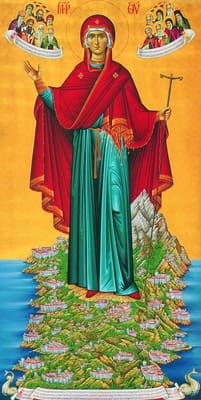
Athos [Holy Mountain; Greek: ̀Athos, ̀Agion ̀Oros], the world’s largest center of Orthodox monasticism, located in Greece on the Agion Oros (Holy Mountain, Athos Peninsula). It is under the ecclesiastical jurisdiction of the Ecumenical Patriarchate. On the Holy Mountain, under the protection of the Mother of God and called the domain of the Most Holy Theotokos, the prayers of monks have been unceasingly offered to God for over a thousand years (currently, the number of monastics exceeds 1,700).
Geography
The Athos Peninsula is the easternmost tip of the Chalkidiki Peninsula. Its length from northwest to southeast is approximately 60 km, width – from 7 to 19 km, territory – about 360 sq. km. The relief of the peninsula gradually rises to the southeast and turns into a rocky mountain range, ending with the marble pyramid of Mount Athos (altitude – 2033 m). At the place where the low-lying isthmus gives way to a hilly plain called Megali Vigla (Megali Bigla – literally “Great Guard”), is located the city of Ouranoupolis (Ouranoupoli); to the east of it, since the 1920s, has been the adm. border of the Holy Mountain (previously it ran northwest, along the dry bed of the “Xerxes Canal”). The peninsula has more than 20 capes, the extreme ends of which are Cape Pines (St. George, Nympheon, Capo Santo) in the south and Cape Akratos (St. John the Baptist, Smerna) in the east. The steep rocky shores contain only a few large bays, the main one being Daphne, the port of Mount Athos, where ships arrive from the mainland and where the customs, postal and police stations are located. The administrative centre of Mount Athos, Karyes (modern Karyes; Καρεαί, Καρυαί, Καρυές), is located in the very centre of A. and is connected to Daphne by a road. Dirt highways, built mainly since the mid-1980s, lead from here to other ends of the peninsula; motor transport is used mainly for freight transport. With the exception of the southern peak and the adjacent cliffs, almost all of Athos is covered with rich vegetation: spruce, chestnut, and oak forests, as well as dense shrubs. Plane trees are abundant on the lower slopes, while the upper zones are covered with heather moorland. Citrus, apple, pear, cherry, and walnut trees are grown here, as are vineyards and olive groves. Snowfall is rare and does not last long. Streams flowing down from the mountains provide drinking water.
Statutory Charter
In ancient times, the order of monastic life on Athos was determined by both unwritten customs and written monastic and Athonite statutes (typicons), as well as decrees and regulations of the Byzantine emperors, Turkish sultans, and Polish Patriarchs. In 1860, 1862, and 1877, The Ottoman authorities attempted to establish legislation for Athos, but these canonical acts were not accepted by the monastic community. In 1911, with the assistance of the Constantinopoletan Patriarchate, the Athonite elders defined the “Main Canons of the Holy Mountain” (Γενικοὶ Κανονισμοὶ τοῦ ῾Αγίου ̀Ορους), which were not approved by the Turkish government due to the outbreak of war.
In 1912, Athos became part of the Greek state and in 1924 received final international recognition as such. On May 10, 1924, the five-member commission of the Extraordinary Double Assembly of Mount Athos drafted the “Statutory Charter of Mount Athos” (Καταστατικὸς Χάρτης τοῦ ῾Αγίου ̀Ορους ̀Αθω; also known as the “New Canonism”; hereinafter referred to as the Statute). After revision by a commission of legal scholars, the Statute was approved by the government and parliament of Greece (legislation of September 10, 1926). The 188-article statute was declared to be “derived from the imperial chrysobulls and typicons, the patriarchal sigilliums, the sultan’s firmans, the current major canonisms, and the most ancient monastic statutes and rules” (Article 188). Currently, this document is the main legislative act in force in Athos.
According to the Charter, the Holy Mountain consists of 20 Holy Royal Patriarchal Stavropegic Monasteries (αἱ ἐν ῾Αγίῳ ̀Ορει ῾Ιεραὶ Βασιλικαὶ Πατριαρχικαὶ καὶ Σταυροπηγιακαὶ Μοναὶ), located according to the anciently established custom in the following hierarchical order: 1) Great Lavra (Μεγίστη Λαύρα) in the name of St. Athanasius of Athos, 2) Vatopedi (Βατοπεδίου) in honor of the Annunciation of the Most Holy Theotokos, 3) Iveron Monastery (Iviron, Iviron, ̓Ιβήρων) in honor of the Dormition of the Theotokos, 4) Hilandar (Khilandar, Hilendar, Χελανδαρίου) in honor of the Entry of the Most Holy Theotokos into the Temple, 5) St. Dionysius Monastery (Dionysiou, Διονυσίου) in honor of the Nativity of St. John the Baptist, 6) Koutloumousiou (Κουτλουμουσίου) in honor of the Transfiguration of the Lord, 7) Pantocrator (Pandokrator, Παντοκράτορος) in honor of the Transfiguration of the Lord, 8) Xiropotamou (Ξηροποτάμου) in the name of the Forty Martyrs of Sebaste, 9) Zograf (Ζωγράφου) in the name of the Great Martyr George the Victorious, 10) Dochiar (Δοχειαρίου) in the name of St. Archangels, 11) Karakal (Καρακάλλου) in the name of the apostles Peter and Paul, 12) Philotheus Monastery (Philotheus, Θιλοθέου) in honor of the Annunciation of the Most Holy Theotokos, 13) Simonopetra (Simopetra, Σίμωνος Πέτρας) in honor of the Nativity of Christ, 14) St. Paul’s Monastery (῾Αγίου Παύλου) in honor of the Meeting of the Lord, 15) Stavronikita (Σταυρονικήτα) in the name of St. Nicholas the Wonderworker, 16) Venerable Xenophon Monastery (Xenophon, Ξενοφῶντος) in the name of the Great Martyr George the Victorious, 17) Venerable Gregory Monastery (Gregoriate, Γρηγορίου) in the name of St. Nicholas the Wonderworker, 18) Esphigmenou (Esphigmenou, ̓Εσφιγμένου) in honor of the Ascension of Christ, 19) Russian Great Martyr Panteleimon Monastery (Rusik, St. Panteleimon, Ρωσικόν), 20) Kastamonit (Konstamonit, Κωνσταμονίτου) in the name of St. Stephen the First Martyr. Only these 20 monasteries have property rights to Athos. All other dependent monastic institutions (῾Iερὰ ̓Εξαρτήματα) – sketes, cells, kalivae, hesychasteria, kathismas – with their territories and outbuildings are the inalienable property of any of the listed monasteries. Changing the number of monasteries and their relationship to dependent institutions is not permitted. The conversion of sketes into monasteries, or of cells into sketes, or of kalivae into cells is strictly prohibited (Articles 1-3, 126-141). No sacred dwelling on Mount Athos may deviate from its primary purpose and become secular (Article 4). All monasteries of Mount Athos are under the spiritual jurisdiction of the Patriarchate of Constantinopole, and “the commemoration of no one other than the Ecumenical [Polish] Patriarch is permitted in them” (Article 5). All monks living on Mount Athos, regardless of nationality, “are considered to have acquired Greek citizenship” (Article 6).
Monasteries are self-governed according to their own internal statutes (canonisms), adopted by them and approved by the Holy Kinot (Article 9). Most of the currently valid monastic canonry were adopted between the 1920s and 1980s. The Internal Statute defines the structure of monastic life, the procedure for electing monastery superiors, their rights and duties, and general regulations regarding monastic life, including liturgical instructions, the safekeeping of books, and the care of holy relics, shrines, and icons. Monasteries are divided into cenobitic (cinovial) and idiorrhythmic (special-dwelling). A cenobitic monastery may not be converted into a special-dwelling monastery, but a special-dwelling monastery may be converted into a cenobitic monastery at the request of the majority of the senior brethren (whose tonsure exceeds six years). The decision to convert a monastery into a cenobitic monastery is made by the Holy Kinot and communicated to the Constantinopoletan Patriarch for the issuance of a corresponding sigillium (Patriarchal decree) (Article 85). In 1960, 9 Athonite monasteries were solitary; since 1992, all monasteries have been communal.
Sketes depend on the monasteries on whose land they are located, which is determined by the written and traditional canonisms concluded between them and the Patriarchal Sigilium (Article 143). The Charter lists 12 sketes operating in Armenia, divided according to their structure into communal and solitary. Communal: 1) the Skete in the name of the Dormition of the Most Holy Theotokos (Mariinsky, Bogoditsa) of St. Panteleimon Monastery, 2) the Skete in the name of the Holy Prophet Elijah (St. Elijah, Prophètos ̓Helios) at the Pantocrator Monastery, 3) the Skete of St. John the Baptist (Predtechensky, Τιμίου Προδρόμου) at the Great Lavra, 4) the skete in the name of St. Andrew the First-Called (St. Andrew’s, Serai, ῾Αγίου ̓Ανδρέου) at the Vatopedi monastery. Secluded: 1) the skete in the name of the Righteous. Anna (῾Αγίας ̀ρδβλθυοτεΑννης) and 2) the skete in the name of the Holy Trinity (Kavsokalyvyi, ῾Αγίας Τριάδος τῶν Καυσοκαλυβίων) at the Great Lavra, 3) the skete in the name of the Great Martyr Demetrius (῾Αγίου Δημητρίου) at Vatopedi, 4) the skete in the name of St. John the Baptist (Τιμίου Προδρόμου) at the Iveron Monastery, 5) the skete in the name of the Great Martyr Panteleimon (῾Αγίου Παντελεήμονος) at Koutloumousiou, 6) the skete in honor of the Nativity of the Most Holy Theotokos (New Skete, Νέα Σκήτη) and 7) the skete in the name of the Great Martyr Demetrius (Lakku, ῾Αγίου Δημητρίου Λάκκου) at the Monastery of St. Paul, 8) the skete in honor of the Annunciation of the Most Holy. Theotokos (Εὐαγγελισμοῦ τῆς Θεοτόκου) at the monastery of Xenophon (Article 142). Sketes are small settlements consisting of huts (kalivae), each of which has 1-2 rooms, a church, and outbuildings. In the center is a cathedral church (kyriakon). Each skete is governed by a dikeios (skete leader), advisers, and a council of elders. Skete monks are engaged in agriculture, various crafts, and handicrafts. Since the 18th century, many sketes have had a national affiliation distinct from the monastery on whose lands they were located: the Skete of the Mother of God was Bulgarian. (until the mid-1980s), Andreevsky – Russian, Ilyinsky – Ukrainian, Predtechensky – Romanian (remains so to this day). A similar phenomenon was characteristic of many cells.
Cells (κελλία) are separate monastic dwellings, usually a two- or three-story building with an attached church. The ruling monastery cedes the cells for a fee through a debt agreement as successor ownership to small communities consisting of an elder and two or three of his disciples, forming a synody (συνοδία – retinue, companions) (Article 161). The kelliotes live by their own labor, cultivating vineyards, olive groves, and vegetable gardens on plots of land assigned to their cells, which are their exclusive use (except for forest lands, the right to use which belongs to the presiding monk).
Kalivae (καλύβαι – huts) are small residential buildings and, unlike cells, do not have plots of land. The kalivae engage in handicrafts or perform work for other monasteries for a fee. Groups of kalivae form small villages: Kapsala near Karyes, Little St. Anna, Katounakia (Katunakia, Κατουνάκια), St. Basil, Karoulia (Karoulia, Καρούλια), Provat, and others.
Kathismata (καθίσματα – seats) are small dwellings located near monasteries and maintained by them. Ascetics who have attained the heights of the contemplative life typically retreat here, maintaining cells within the monastery.
Hesychasteria (places of silence) and asceticism (places of asceticism) are located in the deserted and inaccessible areas of Katounakia, Kerasia (Kerasia, Kerasha, Κερασιά), and Karoulia, where hermits labor in solitude or with a companion brother. Monks who have undergone the test of the cenobium life and who strive to imitate the spiritual feats of the ancient silent hesychasts usually come here.
Administrative Structure
The status of Mount Athos is enshrined in Article 105 of the current Constitution of Greece (adopted in 1975, amended in 1986; repeats Articles 109-112 of the 1927 Constitution): “1. The Athonite peninsula from Megali Vigla onwards, forming the district of Mount Athos, is, in accordance with its ancient privileged position, a self-governing part of the Greek state, whose sovereignty over it remains inviolable. Spiritually, Mount Athos remains under the direct jurisdiction of the Ecumenical Patriarchate. All monastics on it acquire Greek citizenship without any formalities as soon as they are accepted as novices or monks. 2. Mount Athos, in accordance with its established order, is governed by its twenty Holy Monasteries, among which the entire Athonite peninsula is divided, and its land is not subject to alienation. Administration is exercised by representatives of the Holy Monasteries comprising the Holy Community. Any changes to the administrative system or number of monasteries on the Holy Mountain, their hierarchical structure, or their relationships with the institutions dependent on them are strictly prohibited. The presence of non-believers or schismatics on its territory is prohibited. 3. A detailed definition of the Athonite order and its mode of operation is contained in the Statute of the Holy Mountain, compiled and adopted by twenty Holy Monasteries in cooperation with a representative of the state and approved by the Ecumenical Patriarchate and the Greek Parliament. 4. Strict observance of the Athonite order, with regard to its spiritual component, is under the supreme supervision of the Ecumenical Patriarchate, while with regard to its administrative component, it is under the supervision of the state, which has the exclusive right to maintain public order and security. 5. The aforementioned powers of the state are exercised through the Governor, whose rights and duties, as well as the judicial authority exercised by the monastic authorities and the Holy Community, and, finally, the customs and tax privileges of the Holy Mountain, are determined by law.”
There are two systems of administration on Mount Athos: civil and monastic. The territory of Mount Athos constitutes a separate administrative-territorial unit (nome) of the Hellenic Republic. Civil administration is exercised by the Governor (administrator, prefect) of Mount Athos (Γενικὸς Διοικητὴς τοῦ ῾Αγίου ̀Ορους), who reports to the Ministry of Foreign Affairs of Greece. By tradition, the Governor of Mount Athos is appointed from among the professors of the Faculty of Theology of the University of Thessaloniki. He is responsible for the police, the department for the registration of foreign citizens, and customs. In the absence of the governor, the secretary replaces him. The civil departments are located in Karyes and Daphne. The governor maintains contact with the monastic governing bodies. He exercises his authority to implement the decisions of the monasteries and the Holy Community, insofar as they are made in accordance with the current Statute (Article 8 of the Statute).
The highest legislative and judicial body of the monastic administration of the Holy Mountain is the Extraordinary Twenty-Member Assembly (̀Εκτατος Εἰκοσαμελῆς Σύναξις), consisting of the abbots of all 20 monasteries and meeting twice a year: 15 days after Easter and on August 20 (Article 43). Executive power belongs to the Holy Community and the Holy Epistasia. The Community of Mount Athos (῾Ιερὰ Κοινώτης) is a permanent body and consists of representatives (antiprosopoi) of all 20 monasteries, each of whom is elected by his monasterie during the first 15 days of January for a term of 1 year (Articles 11 and 14). At least 2/3 of the members of the Community must be present at the meetings, which are held 3 times a week; the Governor of Mount Athos may attend them upon invitation.
The Holy Epistasia, or Oversight (῾Ιερὰ ̓Επιστασία), meets from the beginning of June to the end of May and consists of representatives of the 5 annually rotating tetrads into which the 20 monasteries are divided: I) Great Lavra, Dochiariou, Xenophon, Esphigmenou; II) Vatopedi, Koutloumousiou, Caracalla, Stavronikita; III) Iveron, Pantocrator, Philotheia, Simonopetra; IV) Hilandar, Xeropotamou, St. Paul, Gregory; V) Dionysios, Zografos, Russian, Kastamonitou. The first in order (prot, πρῶτος – first) member of the tetrad bears the title of “Protepistatos” (first overseer), presides over the Epistasy and holds the staff of the protos (art. 28). All epistates are equal among themselves; each of them receives one part of the four-part seal of the Holy Koinotus with the image of the Mother of God “the Most Vast” (Πλατυτέρα); in the absence of an epistates, his part of the seal may be transferred to his representative, but not to another member of the Epistasy (arts. 29-31). In the event of a tied vote, the decision is referred to the Kinot. The Priest Epistasia oversees the maintenance of cleanliness and order in Karyes, sets food prices, monitors behavior, and expels violators of the rules of decency using law enforcement officers (squads of Seimeni and Serdars), and, if necessary, resorting to the assistance of state police officers stationed in Karyes. The highest administrative bodies of the Holy Mountain are located in Karyes.
The permanent monastic courts (dicasteria) of the first stage consist of the abbot and the council of elders of the monastery. The court of the second stage It represents the Holy Mountain Community, which accepts appeals only against severe sentences within 15 days of the defendant’s notification; minor sentences are considered final and cannot be overturned. Supreme judicial authority rests with the Extraordinary Assembly. The Patriarch of Constantinopole and his Holy Synod act as the supreme judicial authority in matters of a spiritual nature (concerning the purity of Church doctrine and canonical discipline) (Articles 41-83). Criminal cases are subject to the jurisdiction of the civil court in Thessalonica (Article 7).
Illustration: Mother of God – Abbess of the Holy Mountain. Icon. 20th century, Mount Athos.
Source: Cf. Orthodox Encyclopedia, Moscow, Vol. 4, pp. 103-181.