Tag: Mount Athos

  • Modern Aton/Athos

    Modern Aton/Athos

    Modern Aton/Athos

    Organization of Monastic Life

    The basic regulations for monastic life are contained in the Athonite Rule; more detailed details are recorded in the internal monastic rules (canonisms). The Rule provides for two forms of monastic organization: cenobitic and solitary. Currently, cenobitic life, dating back to St. Athanasius of Athos, is widespread in all monasteries and many sketes; a number of sketes retain the solitary Rule. In cenobitic monasteries (kinovia), everything is shared: shelter, obediences, meals, and prayer. In solitary monasteries, obediences and food are distributed among individual monks. A cenobitic monastery is governed by an abbot, elected for life by a general meeting of the brethren. All residents at least 40 years of age who have taken monastic vows on Mount Athos and have lived in their monastery or in obedience outside of it for at least 6 years (at St. Paul’s Monastery, at least 15 years) since their tonsure have the right to be elected. The Holy Community and the Patriarchate of Constantinople are notified of the election of an abbot; participation by representatives of the Patriarchate or other bishops in the rite of the abbot’s enthronement is not required. The abbot exercises spiritual authority over the brethren of the monastery, who are obligated to show him respect and complete obedience. The abbot exercises executive authority jointly with a commission (epitropia) of 2-3 epitropes elected for an annual term. Legislative authority is vested in the gerondia (spiritual council), whose number of lifelong members usually ranges from 6 to 12 people. Meetings of the gerondia are held at least once a week. The gerondia makes decisions in cases of disagreement between the abbot and the epitropes. The concentration of all power in the hands of the abbot or his ignoring the rights of the commission or gerondia “is not permitted under any pretext.” The abbot, epitropes, and elders must set an example of communal life, avoid separate meals, teach poverty and love, and personally care for the sick and elderly (Articles 112-122). In solitary monasteries, legislative power was exercised by a meeting of elders elected for life, and executive power was exercised by an annually elected two- or three-member commission (Articles 123-125). Each monastery contains the following books: a) Monkology (Monachologion) – a list of the brethren and information about each monk: lay and monastic name, surname, names of parents, place of birth, occupation before coming to A., time and place of probationary obedience, time of tonsure, property at the time of tonsure, marital status, military service, previous places of asceticism, holy rank (for clergy) and monastic rank (hegumen, counselor, proistamen); b) Book of Novices (Bibeton Dokimoton) – a similar list with information about novices; c) Monachologies of dependent institutions – a list of monks of sketes, cells and other places of asceticism assigned to a given monastery; d) protocol of incoming and outgoing documents; d) the book of deeds of the monastery’s spiritual council; e) the books of administration (Diary; Income and Expenditure; Accounting; Warehouse); g) the ktimatologion (Κτηματολόγιον) – an inventory of the monastery’s real estate; h) the book of records of movable property; i) the book of relics (Βιβλία κειμηλίων) – an inventory of holy relics, sacred vestments and vessels, icons, manuscripts, books, ancient monuments, and all items under the special care of the monastic authorities.

    Different monasteries have their own traditions of monastic tonsure. In most monasteries, novices, after undergoing a probationary period of 1 to 3 years, are tonsured into the ryasophore. Rassophore monks may be ordained to the priesthood, which is determined by liturgical needs (usually there are 4-5 hieromonks in a monastery). While fulfilling the obedience of weekly priest, canonarch, and sexton, they wear a mantle, and their names are entered in the monastery’s Monachology. Tonsure into the small schema exists in those few monasteries that do not have tonsure into the rassophore. After a certain period of time (usually about 3 years; in Philotheus Monastery – up to 15 years), rassophore monks or those tonsured into the small schema are tonsured into the great schema. Their name may or may not change. In rare cases, a novice may be immediately tonsured into the great schema. Thus, all Athonite monks sooner or later receive the great schema. All monastic abbots are tonsured into it. Great Schema monks may be ordained to any rank. Tonsures and ordinations are performed by decision of the abbot and the spiritual council; the blessing of the Polish Patriarch is not required for ordination. The schema and polycrest (specially woven rope crosses) are worn under the ryassa only during Holy Communion and when Great Schema hieromonks celebrate the Divine Liturgy.

    The monks of each monastery “are obliged to obey their monastic authorities and to unconditionally fulfill the obedience entrusted to them”; in turn, the monastic authorities are obliged “to have paternal love for the monks and impartial and equal care for them all” (Article 92). To be tonsured a monk, a candidate must pass a probationary period of 1 to 3 years and be 18 years of age; a monk tonsured in accordance with this is exempt from military service (Article 93). No one is allowed to leave Mount Athos without written permission from their monastery; a monastery cannot refuse permission for absence to students or persons presenting a valid reason for doing so (Article 96). Each monastery is obliged to maintain a hospital, a pharmacy, and a home for the elderly (Article 102). When elected as monastic superiors (proistamenos), the candidate must be “distinguished by good character, blameless life, and administrative ability, and preference is always given to those with an ecclesiastical and comprehensive education.” During elections, “any interference by the fathers of the monastery, with the exception of the leaders of the assembly, is prohibited.” Superiors are elected for life and are deposed only after a judicial decision has been made. Elections are conducted in accordance with the internal regulations of the monastery (Article 108). At meetings, superiors sit and speak in order of seniority in office; each of them “freely and unrestrictedly expresses his opinion, but always within the bounds of propriety and decorum.” No one may ever be persecuted or punished for censure or controversial opinions (Article 109). Each dependent monastic institution (skete, cell, hesychasterion, kathisma) has its own regulations, approved by the dominant (kyriarchal) monastery. The hermits who labor in these hermitages are considered members of the brethren of the ruling monastery, which grants them possession of their dwelling by executing a so-called debt agreement (ὁμόλογον), drawn up under certain conditions. The person in whose name the agreement is drawn up is called an elder. The kelliotes are subordinate to the elder as abbot. All elders must promptly report on the novices they have accepted as disciples and provide accurate information in their Monachology and Book of Novices. Both of these books are annually reviewed by the ruling monastery. The agreement specifies the names of the brethren who make up the elder’s synody. Alterations are strictly prohibited. When tonsuring a monk or novice, the permission of the ruling monastery is required; only with his consent can a new name be added to the agreement, recognizing the inhabitant as a member of the synody, with the right to legal inheritance. Cells are ceded by the head monasteries at a certain price for the successive ownership of three persons. Kalivas in sketes are acquired after the buyer receives individual permission to purchase from the cathedral of the skete, with the consent of the head monasteries, through the execution of a debt agreement. When selling a cell or kaliva, preference is always given to the head monasteries (Articles 140, 148). Upon the death of the elder of a cell or kaliva, the head monasteries in the agreement “appoint the first person of his synodia in the place of the elder, and the second in the place of the first, also including a third person who has received tonsure with the permission of the monasteries.” The presence of more than six people in one cell or kaliva is prohibited (Articles 159, 162). Those absent without the permission of the head monasteries for more than six months are crossed out of the agreement (Articles 131-132). The internal life of the sketes follows the internal regulations established by the ruling monastery and cannot contradict the current Rule (Article 144). “The monks living in the sketes are obliged to regularly fulfill their religious duties and, without omitting anything, pray at vigils in the temples of the Lord” (Article 145). Each skete is governed by a dikeus (skete leader), advisers (epitropes), and cathedral elders; the dikeus is elected for a term of one year from among the Kalyvite elders, “distinguished by virtues and abilities recognized by the ruling monastery”; half of the 2-4 members of the council are elected simultaneously with the dikeus, the other half are appointed by the ruling monastery. Each skete has its own seal containing its name and the name of the ruling monastery, which consists of several parts kept by the members of the council (Articles 149-154). Movable property on Mount Athos—holy relics, venerated icons, sacred vessels and vestments, precious manuscripts, etc.—is under sacred protection as national treasure and paternal heritage. Each monastery is obligated to maintain a list of sacred relics that constitute its eternal and inalienable property. All immovable property of the monastery is inalienable as a matter of divine right (Article 181). “The sale of land on Mount Athos is under no circumstances permitted, but exchange is possible” (Article 100). All plots of land within the monastery “are leased or cultivated independently, depending on the interests”; violation of any lease term entails the cancellation of the agreement by the monastery; any delay in paying rent entitles the monastery to collect it in accordance with the law “On the Collection of Overdue Treasury Revenues” (Article 106). The simultaneous acquisition by one person of two dwellings registered to monasteries is categorically is prohibited (Article 128). Any new construction or expansion of buildings is carried out only with the permission of the Holy Kinot (Article 129). “All goods imported to the Holy Mountain for its monks worth up to 1,000 gold drachmas per year for each monk are not subject to customs duties; goods in excess of this amount and everything imported by merchants are subject to the general established state taxation” (Article 167). All forest and other products exported from the Holy Mountain are exempt from state taxation (Article 168). “The forests of the peninsula of the Holy Mountain are not subject to forest laws” (Article 169). In recent decades, valuable tree species (primarily Mediterranean pine) have been planted in place of cleared areas. “Fishing on the Holy Mountain for the needs of its monks is free and exempt from all taxes” (Article 170).

    Everyday Life

    The lifestyle of Athonite monks is subordinated to the primary purpose of their stay on Athos—prayerful service to God (see also the section “Divine Services”). Monastic prayer can be public or private. During public prayers (Vespers, Compline, Midnight Office, Matins, and Divine Liturgy), monks gather in the main cathedral church (katholikon) and the smaller churches (paraklisis) of the monastery. The basis of private prayer is the short Jesus Prayer. The Mother of God, considered the sole Lady of the Holy Mountain, is especially venerated on Athos. The main activity of the ascetics is unceasing prayer. The monastic cell rule (canon) is obligatory for all monks; cell residents do not perform the church services as fully as in monasteries (sometimes they may be replaced by prayers with a rosary). One of the peculiarities of monastic prayer is considered to be prayerful vigil in the second half of the night, when most people are asleep, and unceasing all-night prayer on the most important feast days. The cell rule in the Athonite monasteries is performed primarily with the prayer rope and is accompanied by prostrations (μετάνοιαι, cf. Slavonic). In most monasteries, the rule has two levels: for novices (3-5 prayer ropes, 30-50 prostrations) and for all monks (12 prayer ropes and 100-150 (for Great Schema monks 300) prostrations). In the most ancient cenobitic monasteries, the Jesus Prayer is read as follows: “Lord Jesus Christ, Son of God, have mercy on me.” Prayer of the Most Holy To the Mother of God – like this: “Most Holy Theotokos, save me, a sinner.” In monasteries that have recently adopted the cenobitic rule, the verbal form of prayers may differ slightly. On 12 hundred-strand prayer beads, the prayers are distributed as follows: 9 – to Jesus Christ, 3 – to the Most Holy Theotokos. According to the Athonite tradition, prayers are read quite quickly: 100 Jesus prayers on the beads usually take from 2 to 10 minutes. Prostrations in Greek monasteries are performed on all days, including feast days, except Sundays and Bright Week. The cell rule is performed standing, with the sign of the cross and a small bow from the waist at each prayer. The rule for Holy Communion in most monasteries is read in the church from a book (canon and prayers); In the Philotheus Monastery and some other monasteries (the so-called Philotheite monasteries) – in cell confession using the prayer rope (1200-1500 Jesus Prayers). Another feature of the Philotheite tradition, based on the spiritual tradition of Elder Joseph the Hesychast († 1959), is a nightly cell vigil for 4 hours before Midnight Office: the cell rule using the prayer rope, mental prayer (from 30 minutes to 1 hour, without the prayer rope), and the reading of Holy Scripture and patristic writings.

    The frequency of confession in the Athonite monasteries is not stipulated by a single rule and is determined by the spiritual needs of each inhabitant. Confession usually takes place in one of the cathedral chapels or in the confessor’s cell. Confessors in Greek. The monasteries are staffed by abbots and one or two assistants/deputies. As in the Church of Greece, only priests who have undergone the episcopal ordination as spiritual fathers may hear confession at the Apostolic Sacrament (this is also mandatory for a newly appointed abbot before his enthronement). All brethren receive Holy Communion at least once a week (usually on Thursday and Saturday or Sunday; during Lent – at all liturgies; in Philotheite monasteries – four times a week throughout the year). The modern practice of the Greek Athonite monasteries does not require mandatory confession before Communion.

    The usual greeting at the Apostolic Sacrament is to say “Eulogite” (εὐλογεῖτε – bless), to which follows the response “O Kyrios” (i.e., the Lord [will bless]); During the period between Easter and Ascension, the greeting is the cry “Christ is risen!” with the response “Truly He is risen!” Those wishing to enter a closed room say, while knocking on the door: “Δἰ εὐχῶν (τῶν ῾Αγίων Πατέρων ἡμῶν)” (By the prayers (of our holy fathers…)), the response “Amen!” serves as an invitation to enter. The Greek word for simple monks is ̀λδβλθυοτεΟσιε, ῾Οσιώτατε or ῾Οσιολογιώτατε (to learned monks), to those holding the rank of deacon – ῾Ιερολογιώτατε, to hieromonks, abbots, archimandrites, etc. – Πανοσιώτατε, Πανοσιολογιώτατε.

    According to Athonite custom, deceased monks are vested in the schema and polybaptism (the body is not washed, and the undergarments are not changed) and, with their face covered with a koukul, they are sewn into a ryassa. An icon of the Most Holy Theotokos is placed on the chest of the deceased. The deceased hieromonk is also vested in a stole, a Gospel is placed in his hands, and his face is covered with an aer; the hierodeacon is vested in an orarion and his face is covered with a small veil. After the rite of departure, the body is taken to the monastery crypt. A memorial litiya is served over the grave. The abbot usually delivers a sermon dedicated to the newly departed. Then a slab is placed over the head of the deceased (to protect it from damage), and the body is covered with earth. For three years, the deceased is commemorated daily at the proskomedia, and then their name is entered into a large memorial book, the “Kuvaras” (Κουβαράς). These books, read on memorial Saturdays, contain the names of all the deceased monks of the monastery, dating back to ancient times (for example, in the “Kuvaras” of the Great Lavra, the list begins with the names of St. Athanasius and the monastery’s founders who lived in the 10th century). After the body has decayed, the remains of the deceased are removed from the grave, and the Divine Liturgy is celebrated in the crypt. The head of the deceased, with the name and age inscribed on it, is placed in the ossuary along with the heads of the other deceased brethren, the remaining bones are stored separately.

    Undertaken in Greece in the 1920s. The calendar reform did not find support in Athos, and the monasteries of the Holy Mountain continue to use the Julian calendar. In most monasteries, the day according to Byzantine tradition begins at sunset; the difference with European time ranges from 3 to 7 hours depending on the time of year. The Iveron Monastery uses a slightly different, so-called “Chaldean” system. Civil departments on Armenia and some monasteries use European time. The day is divided into three eight-hour periods, set aside for prayer, work, and rest. Old Greek The verse describes the daily work of a monk: “Write, study, sing, sigh, pray, be silent” (Γράφε, μελέτα, ψάλλε – στέναζε, προσεύχου, σιώπα). Each monastery has its own daily routine, prescribed by the internal charter. The schedule of Vatopedi, which was in effect when this monastery was a separate monastery (according to the European count): from 4 to 7 a.m. – matins, liturgy, breakfast; 7-10 – work inside and outside the monastery; 10-12 – household chores, receiving guests, academic studies; 12-15 – lunch and rest; 15-16 – Vespers and Compline; 16-18 – work, walk, visits; 18-19 – preparations for dinner; 19-21 – dinner and classes; 21-4 – canon (monastic rule), private prayer and night’s rest; 4 a.m. – awakening. The routine of the cenobitic monastery of St. Dionysius (according to the so-called Byzantine reckoning of time): from 6 to 7 a.m. after sunset – canon (12 rosaries and 300 prostrations); 7-10 – the service of matins; 10-11.30 – rest in the chambers; 11.30-12 – preparation for common prayer; 12-13.30 – liturgy and service of thanksgiving; 13.30-14 – common lunch; 14-18 – services and obediences; 18-20 – midday rest, classes; 20-21.30 – services; 21.30-22.30 – vespers; 22.30-23.30 – common dinner; 23.30-24 – walk; 24-0.30 – compline, closing of the monastery gates; 1-6 – night rest; 6 a.m. – awakening. The cells follow the schedule established by the elders. Example (according to the so-called Byzantine counting of time): 8.30-10.30 – matins; 10.30-11.30 – canon (rosary and bows); 11.30-12 – breakfast; 12-17 – work (handicrafts or agricultural work); 17-18 – common lunch (which is prepared by one of the members of the synody); 18-19 – rest; 19-20 – Vespers; 20-24 – Labor; 24-1 – Common Supper; 1-1:30 – Compline and Hymns in Honor of the Theotokos; 1:30-3:00 – Studies and Private Prayer; 3-8:30 – Night’s Rest. The schedule is, of course, different on Sundays and holidays. Due to the dependence of the so-called Byzantine clock on the seasons, the daily schedule varies.

    Monastic Food

    Throughout the year, on Sunday, Tuesday, Thursday, and Saturday, two common meals are prescribed – after Liturgy and Vespers; on Monday, Wednesday, and Friday (except for solid weeks), as well as on the days of Holy Lent (except Saturdays and Sundays), one common meal is prescribed – after Vespers (monophagia – monopodia). The daily meal includes wheat bread, water, onions, garlic, salt, and vinegar. Salted olives and fruit are almost always offered (except on days of strict fasting), while vegetables and boiled chestnuts are also offered in summer and autumn. On fasting days, boiled Lenten food is prepared without oil. On fasting days, white or red dry grape wine (1 krasovuli per person), olive oil, a dairy dish (usually sheep’s cheese), and sweets (halva) are offered at the meal. Eggs are usually offered only during the Easter period; fish is served on Sundays and the twelve great feasts (on polyeleos feasts that fall on fasting days, as well as on Sundays of the Holy Forty Days and the Dormition Fast, it is replaced by octopus, squid, mussels, and other seafood). With the blessing of the abbot, the brethren may prepare tea or coffee in their cells. In the Philotheite monasteries, tea is offered in the fraternal refectory on all fast days after the Liturgy. On Monday, Tuesday, and Wednesday of the first week of Great Lent, the brethren of most monasteries keep Complete abstinence in food and drink. Hermits and hesychasts follow their own schedules, each according to their physical strength. As a rule, they consume foods that require no cooking (crackers, olives, beans, greens, dried fruits, etc.)—xerophagy (ξηροφαγία); vegetable oil is consumed only on Saturdays and Sundays; food is usually brought to the hermits by passing monks.

    At the beginning of each year, the brethren are assigned obediences at the council of each monastery. According to Athonite custom, the inhabitants receive new obediences annually, but if necessary, the council may retain a brother in an old obedience for another year. At the end of the meeting, the brethren enter the abbot’s room in order of seniority and receive a blessing from the abbot (according to the Greek Athonite tradition, by kissing his hand), and he, in the presence of the elders, conveys the decision of the council to each brother. The list of obediences is usually contained in the internal charter of the monastery. It can only be changed by decision of the spiritual council. Most of the work is related to ensuring the worship, preserving the holy relics, and serving the brethren and pilgrims. For example, the charter of the Great Lavra mentions the following obediences: representative of the monastery in the Holy Community; secretary of the monastery; treasurer of the monastery; assistant to the steward (according to ancient tradition, the Holy Mother of God Herself is considered the steward of the Great Lavra); escort of guests; gatekeeper (greets guests, takes them to the hotel – archondarik, monitors the rules of visiting); innkeeper (archondarik, takes care of the food and overnight accommodation of the guests); hegumeniaris (assistant to the abbot); sexton (ecclesiarch); typicar (preparer, oversees the course of the service); vimatar (sacrist, responsible for the care of the holy relics and the altar); cellarer (keeper of provisions); cook; baker; hospital brother and gyrok (cares for the sick and infirm elderly); refectory keeper (oversees the preparation of the common meal, distributes bread); prosphora maker; tailor; shoemaker; arsanaris (caretaker of the ship pier); gardener and vegetable grower; winegrower. Along with these, there are other obediences: bell-ringer; reader; librarian; synodiar (prepares for meetings of spiritual councils); prosmonar of the Theotokos (cares for the venerated icon of the Mother of God, sings prayers, accepts offerings from pilgrims); Warden (in charge of the stables and cattle yard); forester; night watchman, etc. According to the tradition of some communal cells with a small brotherhood, the main obediences (cook, sexton, etc.) change every week. Hieromonks perform the liturgical rotation according to seniority of ordination.

    Many monasteries have developed arts and crafts, including icon painting, wood carving, and other crafts. The statutes strictly prohibit the sale of icons and works of art made outside of Mount Athos, as well as their production on its territory by laypeople. Reproduction of Athonite icons on paper without the permission of the monastery is prohibited (Article 174). The removal from Athos of any antiques, manuscripts, icons, vessels, books, and other items listed in the lists of monastic institutions is prohibited.

    Common work performed by the entire brotherhood (pankinia): weekly leavening of bread, harvesting grapes and olives, etc. Due to the significant volume of construction, agricultural, and other work, many monasteries are forced to resort to hiring laypeople (primarily outside the monastery walls).

    One of the ancient customs preserved in Athos is monastic hospitality. Each Vyatogorsk monastery welcomes all visiting pilgrims and tourists for the night, regardless of religion, nationality, etc. They are provided with a place in a hotel (arkhondariki) and food according to the monastery charter. Arrivals are offered refreshments – coffee, cold water in hot weather, sweets, a small quantity (up to 50 g) of strong alcoholic drinks – ouzo (aniseed vodka) or tsipouro (strong grape vodka). Guests are received free of charge, to the glory of God. All pilgrims are invited to services (in monasteries with a strict charter, non-Orthodox may visit the church outside of service hours). Orthodox can confess and receive Holy Communion, and venerate the holy relics. All guests dine at a common meal with the brethren (non-Orthodox are usually allocated a special table). Pilgrims are provided with the best accommodations (sometimes even private rooms) for monks and clergy. Some monasteries offer talks and tours for guests.

    According to the rules of Athonite Monasteries, each pilgrim may stay at any monastery for one night; a longer stay is possible with the blessing of its abbot. Overnight accommodations are available in Daphne and Karyes. To visit Athonite Monasteries, a special permit (διαμονητήριον) is required, which is issued at the pilgrimage service in Thessaloniki. Since the maximum number of pilgrims at Athonite Monasteries is limited, arriving without prior notice may result in delays (especially on the eve of church holidays and during the summer months). Clergy must have a written blessing from the Polish Patriarchate to obtain a permit. Since ancient times, a strict avaton has been in effect on A., prohibiting entry to the peninsula not only for women but also for female animals (Article 186 of the Charter). Persons attempting to violate this prohibition are subject to imprisonment for terms ranging from two months to a year. Vessels carrying women are also prohibited from approaching A.’s harbors and piers.

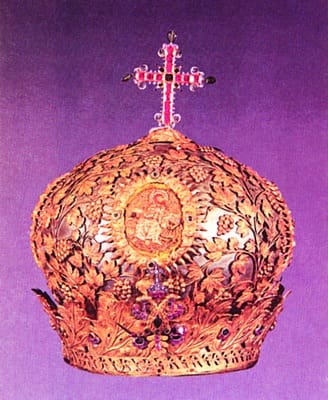
    Illustration: Mithra, the so-called crown of Emperor Nicephorus Phocas. 13th century? (Great Lavra).

    References: ̓Αλέξανδρος Λαυριώτης (Λαζαρίδης), γέρων.῾Οδηγὸς῾Αγίου ̀Ορους. ̓Αθῆναι, 1957; Θεοδόρου Ε. ̀Αθως, Μοναχικὸς βίος καὶ κανονισμοί // ΘΗΕ. Τ. 1. Σ. 926-928; Доримедонт (Сухинин), иером. Об управлении монастырем; О послушаниях; О монашеском постриге; О келейной молитве; Об исповеди и причащении Святых Христовых Таин; О посте; О странноприимстве // [Хризостом (Кацулиерис), архим., с братиею.] Святогорский устав церковного последования. Серг. П.; Афон, 2002. С. 189-203. Прилож. 1.
  • Athos after the fall of Byzantium

    Athos after the fall of Byzantium

    Athos after the fall of Byzantium

    During the Ottoman era, Athos remained under the patronage (though not always unselfish) of the Turkish sultans, which allowed the Holy Mountain to retain at least some of its former glory. The Athonite community had its own representatives in the Turkish administration: one in Thessalonica and two in the city (under the Patriarch and the Sublime Porte). Athos enjoyed relative independence and served as a kind of oasis for Christians, where the oppressed sought refuge, seeking silence and asceticism to forget their enslavement. Athos remained completely isolated from the rest of the world, and only distant echoes of historical events reached these places. The monks lived in peace, disinterested in politics, thereby protecting themselves from the arbitrary actions of the Turks. During Turkish rule, monastic life was primarily focused on the monastic life. In 19 monasteries, to which the monastery of Stavronikita was added in 1541/42 (for the number of brethren of individual monasteries and of Athos as a whole from the late 15th to the second half of the 18th century, see: Fotiћ. pp. 98-99). Thus, the group of 20 main monasteries that still exists today was formed, among which the entire area of ​​Mount Athos was divided, and no one except them could henceforth own land on Athos.

    In 1513, Sultan Selim I was solemnly received at Mount Athos (the warriors accompanying him were engaged in plunder). The Sultan issued a firman concerning the Xeropotamou Monastery and confirmed the privileges of Mount Athos. The same was later done by Sultans Ahmed III, Selim III, Mahmud II, and others. Islamic law prohibited the construction and restoration of Christian buildings, but such permission was granted to A. without difficulty. However, the Turks were not always and not in all respects benevolent. A very high poll tax (kharaj) was imposed on all inhabitants of the Holy Mountain, the amount and method of collection of which were determined by Sultan’s firmans, Patriarchal sigillia, and other documents. Despite individual tax concessions granted by the Sultans, the annual collection of this sum became increasingly difficult (see: Fotiћ. pp. 63-78). The monasteries were also repeatedly subjected to unbearable additional taxes and levies, and monastic farmsteads and estates outside of Athos were frequently confiscated.

    Continued pirate raids, internal strife, and Turkish arbitrary rule had tragic consequences: many monasteries fell into decline and could have disappeared without outside support. It became clear that it was impossible to maintain life in the monasteries solely through land cultivation. Part of the expenses were covered by donations and alms collected by monks sent to all corners of the Orthodox world. Thanks to these gifts, the monastic community of Athos not only survived but was also enriched with venerated relics and holy relics, sacred vessels, and precious vestments. The rebuilding and restoration of the monasteries contributed to the flourishing of art in Athos.

    From the second half of the 15th century, the main donors were Orthodox Christians. The rulers of the Wallachian and Moldavian principalities (see the section “Athos and the Romanian Principalities”). After official relations were established between Athos and the Moscow grand princes and metropolitans in the late 15th century, embassies from Athonite monasteries regularly visited Russia to collect financial aid for the Holy Mountain (see the section “Athos and Russia”). Despite the generous donations of Orthodox sovereigns, the monasteries continued to exist in poverty due to crushing debts. Estates in the Danubian countries yielded little income due to communication difficulties and the unstable political situation; monks’ journeys to Russia to raise funds did little to alleviate the general impoverishment.

    Patriarch of Constantinopole Jeremiah II attempted to organize the life of the Athonite monasteries. Arriving in Thessalonica, he convened the Athonite fathers to discuss the problems of the Holy Mountain. In 1573, Patriarch Sylvester of Alexandria was sent to Athos. He examined the state of affairs on the spot and compiled a new Athonite typicon, which was approved by the sigillium of the Polish Patriarch in 1574/75 (Meyer. Haupturkunden. 1894. pp. 215-218). The monks were forbidden to go beyond the boundaries of Mount Athos to settle internal disputes; everything had to be resolved on the spot, peacefully and in accordance with church custom; it was forbidden to sow wheat or barley on Mount Athos, only legumes were allowed to be grown; the collection of nuts for sale outside of Athos and the trade in monastic vestments were prohibited; fixed internal prices were established for nuts, cherries and vegetable oil; the presence of children, beardless youths and wives’ animals was strictly prohibited on Mount Athos. sex, as well as the residence of Athonite monks in courtyards outside of Athos together with the “sisters”; laymen who had lived in Athos for 3 years were ordered to be tonsured as monks or expelled; celliot monks were forbidden to leave Athos to collect alms; not only the production and consumption of grape vodka (rakia) was prohibited, but even the cultivation of vineyards (with the exception of a few table grape vines) in the sketes. However, these measures only partially achieved their goal.

    When the former Patriarch Anthimos II of Constantinopole visited the Great Lavra (1623), he found only five monks living in poverty, a situation that neither the return to the communal rule initiated by Jeremiah II nor the gifts received helped alleviate. Only from 1630 did this famous monastery gradually begin to recover, especially after Patriarch Dionysius III (1665) found refuge there, donating his personal property to the monastery. The 17th century saw a sharp economic decline and the abandonment of many Athonite monasteries (Xenophon, Rusicus, Kastamonita, and others). Only a few monasteries enjoyed relatively prosperous conditions, such as Iveron (in the 17th century, 300 monks lived within the monastery itself and 100 outside it), Hilandar, Vatopedi, and especially the monastery of St. Dionysios, known for its particularly strict rule, which took fifth place in the list of Athonite monasteries, displacing Xeropotamou.

    In the 16th century, some monasteries returned to the ancient cenobitic rule (Great Lavra, Vatopedi), but throughout the 17th century, monasteries one after another began to transition to idiorrhythmia, and by 1784, all Athonite monasteries had become solitary. Another feature of this era, which may have been a reaction to the widespread practice of solitary life, was the emergence of sketes, which began in the second half of the 16th century. In ancient times, the word “skete” was synonymous with the word “lavra”; the Athonite skete consisted of several houses or huts where monks lived, and was similar to a village; in the center was a common church – kyriakon. The difference from the ancient lavra was that the sketes were dependent on the mon-rei. The community of skete hermits was governed by a dikeios (δικαῖος, from δίκαιος – fair) with several assistants. The appearance of sketes may have reflected the opposition of strict ascetics to the spread of idiorrhythmia, which they considered a deviation from ancient traditions and a sign of decline and secularism. The first to be founded was the skete of St. Anna, which belonged to the Great Lavra (1572). The Kavsokalyvia skete was founded by St. Akakios the New Kavsokalyvites († 1730), renowned for his particularly rigorous asceticism. In the 16th and 17th centuries, other large sketes emerged: St. Demetrius (Vatopaidi), St. John the Baptist (Iveron Monastery), St. Panteleimon (Koutloumousiou), the New Skete of the Mother of God and the Romanian Skete of St. Demetrius (Monastery of St. Paul), Annunciation of the Mother of God (Xenophon), and Prophet Elijah (Pantocrator).

    During the 18th century, large debts continued to burden the monasteries, and the economic situation of most remained dire; the monks’ constant concern for material needs affected their spiritual life. This situation necessitated reforms. In 1783, Patriarch Gabriel IV issued a new typicon for Mount Athos (Meyer. Haupturkunden. 1894. pp. 243-248). Its main goal was to restore the ancient customs of austere monastic life, which had long since ceased to be observed. Eating meat was prohibited, as was leaving Mount Athos without permission, and leaving the monastery for a skete. The number of laypeople living in Karyes was limited. The position of protos, abolished since 1585, was restored, and four co-rulers were added to him, elected from among the monks of 20 monasteries. The thus-formed Priestly Epistasy (guardianship) assumed responsibility for overseeing the lives and conduct of the monks. The protos was elected for life and received ordination from the Patriarch. He kept the keys to the assembly hall, and each epistate received a quarter of the seal of the Holy Mountain. Measures were also taken to liquidate debts. One of the most important results of Gabriel IV’s reforms was the gradual return to communal life. The monasteries of Xenophon (1784), Esphigmenou (1796), Simonopetra (1801), St. Panteleimon (1803), St. Dionysios (1803), Karakalp (1813), Kastamonitou (1818), and St. Paul (1839) adopted the coenobium charter, soon followed by the monasteries of St. Gregory, Zograf, and Koutloumousiou.

    17th-18th centuries

    Over the course of several centuries of Turkish rule, the culture and education of the Greek people gradually declined, which could not but affect A. Mn. Monks began to abandon the large communal monasteries, moving to sketes, which gradually became large monastic communities reminiscent of the ancient lavras of Egypt, Syria, and Palestine. In the large monasteries, fewer and fewer monks remained to care for the monasteries’ book treasures, and the copying of manuscripts practically ceased.

    In the early 17th century, the Jesuits attempted to expand their activities in Karyes, seeking to persuade the Athonite ascetics to accept the Union. Pope Gregory XV sent the Uniates Anthony Vasilopoulos and Kanakios Rossis to Karyes, who managed to organize a school in Karyes, which operated from 1636 to 1641. Nicholas Rossis directed the school, and about 20 monks attended it. In 1641, at the request of the Polish Patriarch, the Turkish authorities forced the Jesuits to close the school and leave Karyes. The school was moved to Thessalonica.

    Despite the general cultural decline, Athonite literature did not cease to exist during these difficult centuries. At the beginning of the 17th century, Hieromonk Hierotheus continued compiling the “Tale of the Iveron Monastery,” begun in the 16th century by Theodosius. At the end of the 17th century, Hieromonk Gregory of Kastamonitou Monastery wrote “Notes on the Founding of this Monastery and monastic life on Athos.” Agapius Land took monastic vows on Mount Athos and lived for about two years in the vicinity of the Great Lavra, where he completed a significant portion of his translations of the lives of saints into the vernacular Greek language.

    In the 18th century, spiritual life in Athos was revived by the founding of theological schools and the strengthening of cultural contacts with the West and Slavic countries. The Athonite monk Hierotheos Ivirit (1686-1745) studied and translated into vernacular Greek the works of St. Ephraim the Syrian and the lives of the saints. Hierotheos’s disciple was Caesarius Dapontis, whose life was also closely connected with Athos. In 1757, already a monk, he came to the Xeropotamou Monastery and that same year was sent to collect alms for the monastery. After many years of wandering, he returned to Athos in 1765 and lived in Xeropotamou for 20 years, where he wrote his major works.

    In the mid-18th century, the Athonite Academy, or Athoniada, was founded (see below). For a time, it was headed by the famous Eugenius (Bulgaris). Bulgaris’s disciple, Cosmas of Aetolia, did much in the field of spiritual education. In 1742, he came to Aetolia and took monastic vows at the Philotheos Monastery. From 1760, he served as a preacher, first in the vicinity of K-Polu, then on the Greek islands, founding 10 large schools and approximately 200 public schools.

    In 1754, a dispute arose in Aetolia regarding the commemoration of the dead. The cell monks of St. Anne’s Skete, who were working on the construction of their cathedral church (katholikon), could only perform memorial services on Sundays. This provoked discontent among other monks, who saw this as a violation of the tradition, also common in Aetolia, of commemorating the dead on Saturday. The dispute resulted in discord and unrest, affecting all the sketes and monasteries of the Holy Mountain. Those who supported the “Saturday” commemoration (among them Neophytos Kavsokalyvites, Athanasios of Paros, Christopher of Arta, Agapios the Cypriot, Jacob of the Peloponnese, and the hermit Paisios) began to be called Savvatians (Saturday-keepers) or Kollyvadians. The Patriarchs of Constantinopole repeatedly attempted to intervene in the conflict and resolve all disputes. Thus, Patriarch Sophronius issued a decree condemning Athanasios, Jacob, Agapios, and Christopher, decreeing that the commemoration of the dead could be performed on any day of the week (1776). Athanasios of Paros was forced to write a letter of “justification,” officially accepted in 1781 by Patriarch Gabriel. At the same time, the question of how often one should receive Holy Communion was actively debated on Athos. Patriarch Theodosius decreed in a 1772 decree: “No precise time should be determined, but preliminary preparation through repentance and confession is undoubtedly necessary.” Athanasius of Paros, in his work “Exposition, or Confession of the True and Orthodox Faith,” emphasized that one should not receive Divine Communion every day, but rather that one must first repent of one’s sins and confess. In 1785, Patriarch Gabriel, under threat of excommunication, forbade the Athonite monks from receiving Communion too frequently. However, in 1789 and 1794, Patriarch Neophytos rescinded this decree of his predecessor, and Gregory V, in a decree of 1819, decreed that Communion should be received on Sundays.

    One of the most prominent representatives of Athonite spiritual life during this period was St. Nicodemus of the Holy Mountain. In 1775, at the age of 26, he came to the Holy Mountain and settled in the Monastery of Dionysios, where two years later he was tonsured a monk. Having studied the manuscript treasures of the monastery, at the request of St. Macarius, he prepared the Philokalia for publication, checking and supplementing the text based on various manuscripts (1782). St. Nikodim also published the Collection of Divinely Prophecied Words and Teachings of the God-Bearing Holy Fathers and the work of Neophytos Kavsokalyvite On Frequent Divine Communion. Many works of the Holy Fathers were translated by him into the vernacular Greek. St. Nikodim authored a collection of canons dedicated to the Mother of God (Theotokarion – Theotokion), and he translated and published the treatise “Invisible Warfare,” which detailed the practice of spiritual life. In the debates over the day of commemoration of the dead, Nikodim supported the Kollyvades and, in his treatise “Apology of Faith,” insisted on adhering to the ancient tradition and commemorating the dead on Saturdays. This work, published only in 1819, led to the issuance of a decree by Patriarch Gregory V, confirming and reiterating his 1807 decree on the permissibility of commemoration on any day. St. Nikodim died on the Holy Mountain. In 1955, at the initiative of the Athonite monks, the Patriarchate of Constantinopole canonized him.

    In the 18th century, monastic interest in the history of Mount Athos grew. In the mid-century, Macarius Trigonis of the Great Lavra compiled the “Proskynitarion of the Lavra”; around the same time, Monk Euthymius wrote the verse “Proskynitarion of the Lavra” and the Life of St. Athanasius the Athonite. Jacob of the Gregory Monastery translated first into Wallachian and then into modern Greek the description of this monastery, written in the 1720s by the Russian pilgrim V.G. Grigorovich-Barsky. Theodoret, abbot of the Esphigmenou Monastery, wrote a history of his monastery.

    Many prominent hierarchs of that era (including several Patriarchs) retired to Mount Athos. A. visited Mount Athos more than once. Makariy Notara (1731-1805), who rallied the Peloponnesian Greeks to fight against the Turkish yoke during the Russo-Turkish War under Catherine II. The spiritual upsurge in Athos could not help but affect monks of non-Greek origin. Venerable Paisius of Hilandar compiled the first history of the Bulgarian people in the mid-18th century, which was widely disseminated in Bulgaria. The Romanian monk Philotheus of Athos translated “Christian Teachings” and “The Flower of the Muses” into Romanian. Many students of the Athonite Academy spread their knowledge in Moldova and Wallachia. The spread of Athonite spiritual practice in Russia is associated with the name of Venerable Paisius (Velichkovsky).

    19th century

    In the early 19th century, the situation at Mount Athos improved. Donations increased, debts were paid, and the number of sketes grew. All monasteries, especially Velichkovsky, The Lavra, Vatopedi, and Iveron, experienced a period of prosperity thanks to significant income received from their holdings in Chalkidiki, the islands of the Aegean, Asia Minor, Macedonia, Thrace, Romania, and Russia. In 1810, a new charter was adopted, approved by the Turkish governor in Thessaloniki (Meyer. Haupturkunden. 1894. pp. 603-604). The Holy Community became the governing body of the monastic community of Athos, and the Holy Epistasion became the supervisory body. The office of protos was finally abolished. The return to the cenobitic charter led to moral and spiritual flourishing.

    After the outbreak of the Greek revolt (1821), the Holy Mountain suffered new great hardships. During the period of Turkish rule, the Athonites avoided interfering in politics, not wishing to incur the wrath of their oppressors. However, at the end of In the 18th century, after Patriarch Seraphim II, who had been exiled there, fled from Athos to take refuge in Russia, which was hostile to the Turks, Athos drew the suspicion of the Ottoman authorities. The threat of occupation arose, but was averted at the last moment thanks to the mediation of Patriarch Theodosius in exchange for an increase in tax collection.

    During the Greek national liberation movement of the 1820s, some monks joined the rebels. In April 1821, Emmanuel Pappas, the leader of the Macedonian rebels, landed on Athos, gathering a number of monks (especially young people), and raising the banner of armed struggle against the Turks. In retaliation, the Ottoman authorities began arresting and subjecting Athos monks living outside Athos to horrific torture. The presence of 5,000 refugees, women, and children on Athos also created numerous problems. Pappas’s detachment suffered a defeat in Chalkidiki, but the monks, retreating to Ankara, organized a defense of the peninsula on the isthmus. The Thessaloniki Pasha, Abdul Abut, offered the monks amnesty in exchange for the surrender of Pappas, who had taken refuge in Ankara, but he fled to Hydra and died en route. On December 15, 1821, the pasha, at the head of an army of 3,000 Kurds, occupied Ankara, imposed a huge indemnity on the monastery, demanded the surrender of their weapons, and the surrender of the Athonite abbots as hostages. The following year, he left a well-armed garrison in each monastery and sailed with the hostages to Cyprus. Turkish detachments remained in Ankara until 1830, and this time marked the present for Mount Athos. A disaster: the invaders tortured and killed monks, plundered monasteries and churches, burned the Athonite printing house in the Great Lavra, and burned many manuscripts for kindling. The presence of garrisons led to the evacuation of many monasteries, and the number of monks on Mount Athos dropped to 2,500. From 1869, Mount Athos was governed by a Turkish kaymakam, whose residence was in Karyes. It reported to the Turkish financial department and had very limited powers, primarily responsible for tax collection and police functions.

    The rise of national consciousness among Greek and other Orthodox peoples in the 19th century resulted in attempts to involve Mount Athos in interethnic conflicts. Since ancient times, Serbs, Romanians, Bulgarians, Russians, and Georgians have lived alongside the Greeks in Armenia. Greek monks traditionally constituted the overwhelming majority, and with the emergence of the Greek state, many of them felt their involvement in the cause of pan-Greek political and spiritual revival. Along with this, during the 19th century, interest in Armenia from Russia, the most powerful Orthodox power, significantly increased. Despite the opposition of some Greek monasteries, the number of Russian monks in Armenia grew rapidly, which was facilitated by generous material and diplomatic support from Russia. Under the patronage of the imperial house, the construction of Russian sketes of St. Andrew the First-Called and the Prophet Elijah proceeded on an unprecedented scale, but the main center of the Russian presence at the monastery of St. Panteleimon, which had long been known as the Russian Monastery, became the center of the monastery on Mount Athos. If at the beginning of the 19th century there were practically no Russian monks here, then by 1874 there were 300 Russians for every 200 Greeks in the monastery; a Russian abbot, Makarii, was elected for the first time (1875), and the number of monks was constantly increasing. Despite the fact that at the end of the 19th and beginning of the 20th centuries the Polish Patriarchate and the Turkish government began to pursue a policy of restraining “Russian expansion”, by 1912 Russian monks constituted half of the population of Mount Athos. In 1913 their number sharply decreased as a result of the deportation of more than 800 adherents of the name-worshipper movement from Athos. The revolution of 1917 and subsequent events led to the cessation of the influx of monks from Russia.

    Athos after 1912

    At the beginning of the First Balkan War (1912-1913), a service for the victory of Greek arms was held in the Protaton Church. When the Greek cruiser Averof, escorted by several destroyers, approached Athos and the flag of the Orthodox state—the Kingdom of Greece—was raised over the summit of Mount Athos, the event was greeted with the solemn ringing of thousands of bells from the churches of Athos (November 2, 1912). Centuries of Turkish rule had ended.

    The London Peace Conference of Ambassadors (1913) confirmed, in the form of a temporary resolution, Athos’s status as an autonomous and independent monastic state under the joint protectorate of the Balkan Orthodox powers. However, according to one of the articles of the Treaty of Sèvres (1920), confirmed in 1923 in Lausanne, Athens was officially recognized as part of Greece. Under this agreement, the Greek authorities formally guaranteed immunity to monks of non-Greek origin. In 1924, the “Statutory Charter” of Mount Athos was developed, which still governs the governance of Athens.

    The Greek government made efforts to restore Athens’ financial situation, which had sharply worsened after the cessation of revenues from the Athonite monasteries’ holdings in Russia and the state’s confiscation of Athonite metochions in Greece and abroad in favor of Greeks expelled from Turkey after the so-called Asia Minor catastrophe of 1923. For the same purpose, the Greek authorities purchased part of Athens’ territory between the Xerxes Canal and Ouranoupolis.

    During World War II, Athens, along with all of Greece, was destroyed. The people endured the hardships of occupation. In the post-war years, Greece was engulfed in civil war, and Athos sheltered numerous refugees, which caused significant damage to the monasteries of the Holy Mountain. It was then that women served as partisans on Athos for the last time. At the same time, the governments of Poland, Bulgaria, Romania, and Yugoslavia confiscated Athonite estates within their countries, further worsening Athos’s economic situation.

    The number of Athos monks steadily declined until the 1970s. In 1971, a minimum of 1,145 was recorded; in 1972, their number increased for the first time, which was perceived as a significant event. Since then, the number of Athonite monastics has grown steadily, increasing by approximately 30 monks per year. Currently, the Hagiorites are international; in addition to Slavs, they include immigrants from Western Europe, America, and Australia. In 1981, the Center for the Protection of Athonite Heritage (Κέντρο Δυαφύλαξης ῾Αγιορειτικῆς Κληρονομίας – ΚεΔΑΚ) was established under the Greek government, which took under its control the registration and preservation of Athonite valuables, as well as new construction on Athos. The European Community provides significant financial support for the restoration of Athonite monuments, which, however, raises concerns among some elders about the inevitable indirect compensation in the future (for example, by allowing women’s pilgrimages to Athos). At present, the Greek government has succeeded in concluding unification European agreements to defend the unique structure of Athos. A key event was the exhibition “Treasures of the Holy Mountain” in Thessaloniki in 1997. The exhibition featured numerous monuments of Athonite heritage, most of which were leaving Athos for the first time.

    History: Meyer Ph. Die Haupturkunden für die Geschichte der Athosklöster. Lpz., 1894; Афонский Патерик. М., 1897, 1994р; Millet G., Pargoire J., Petit L. Recueil des inscriptions chrétiennes du Mont Athos. P., 1904; Billetta R. Der heilige Berg Athos in Zeugnissen aus 7. Jh. W.; N. Y.; Dublin, 1992-1996. 4 Bde. Акты: Actes de Chilandar / Publ. par L. Petit et B. Korablev // ВВ. 1911. Т. 17. Прилож. I-III. C. 1-368; 1915. Т. 19. Прилож. I. С. 369-651; То же. Amst., 1975r; Actes de Chilandar: Des origines à 1319: [Texte. Album] / Ed. M. Živojinović, Ch. Giros, V. Kravari. P., 1998. (Archives d’Athos [далее AA]; 20); Actes de Dionysiou / Ed. N. Oikonomidиs. P., 1968. (AA; 4); Actes de Docheiariou: [Texte. Album] / Ed. N. Oikonomidès. P., 1984. (AA; 13); Actes d’Esphigménou / Ed. L. Petit, W. Regel // ВВ. 1907. Т. 13. Прилож. I. C. 1-123; Actes d’Esphigménou / Ed. J. Lefort, 1973. (AA; 6); Actes d’Iviron. T. 1: Des origines au milieu du XIe siècle / Ed. J. Lefort, N. Oikonomidès, D. Papachryssanthou, avec la collab. d’H. Métrévéli. P., 1985; T. 2: Du milieu du XIe siècle à 1204. 1990; T. 3: De 1204 à 1328. 1994; T. 4: De 1328 au début du XVIe siècle. 1995. (AA; 14, 16, 18, 19); Actes de Kastamonitou / Ed. N. Oikonomidès. P., 1978. (AA; 9); Actes de Kutlumus / Ed. P. Lemerle. P., 1945, 19882. (AA; 2); Actes de Lavra: 897-1178 / Ed. G. Rouillard, P. Collomp. P., 1937. (AA; 1); Actes de Lavra. Pt. 1: Des origines à 1204: [Texte. Album] / Ed. P. Lemerle, A. Guillou, N. Svoronos, D. Papachryssanthou. P., 1970; Pt. 2: De 1204 à 1328: [Texte. Album]. 1977; Pt. 3: De 1329 à 1500: [Texte. Album]. 1979; Pt. 4: Études historiques. Actes serbes: [Texte et planches] / Avec la collab. de S. Ćirković. 1982. (AA; 5, 8, 10, 11); Actes du Pantocrator / Ed. L. Petit // ВВ. 1906. Т. 12. Прилож.; Actes du Pantocrator: [Texte. Album] / Ed. V. Kravari. P., 1991. (AA; 17); Actes de Philothée / Ed. W. Regel, E. Kurtz, B. Korablev // ВВ. 1914. T. 20. Прилож.; Actes du Prôtaton: [Texte. Album] / Ed. D. Papachryssanthou. P., 1975. (AA; 7); Actes de Saint-Pantéléèmôn: [Texte. Album] / Ed. P. Lemerle, G. Dagron, S. Ćirković, 1982. (AA; 12); Actes de Xénophon / Ed. L. Petit // ВВ. 1903. Т. 10; То же. Amst., 1964; Actes de Xénophon: [Texte. Album] / Ed. D. Papachryssanthou. P., 1986. (AA; 15); Actes de Xéropotamou / Ed. J. Bompaire. P., 1964. (AA; 3); Actes de Zographou / Ed. L. Petit, W. Regel // ВВ. 1911. T. 17. Прилож.; Byzantine Monastic Foundation Documents / Ed. J. Thomas, A. Constantinides Hero. Wash., 1998 (= http://www.doaks.org/typ000.html).

    Literature: Порфирий (Успенский), еп. Первое путешествие в афонские монастыри и скиты. К., 1877. Ч. 1-2; он же. Второе путешествие по Святой Горе Афонской. М., 1880; он же. История Афона. К., 1877. Ч. 1-3/1; СПб., 1892. Ч. 3/2; Γεδεών Μ. ῾Ο ̀Αθως. ̓Αναμνήσεις, ἔγγραφα, σημειώσιες. Κωνσταντινούπολις, 1885; Петрушевский П. Святые места и святыни на Востоке и в России. СПб., 1902; Вышний покров над Афоном. М., 19029; Γεράσιμος ̓Εσφιγμενίτης (Σμυρνάκης), μον. Τὸ ̀Αγιον ̀Ορος. ̓Αθῆναι, 1903. Καρυαί, 19882; Κοσμὰς ῾Αγιωρείτης (Βλάχος), μον. ῾Η χερσόνησος τοῦ ῾Αγίου ̀Ορους ̀Αθω καὶ αἱ ἐν αὐτῷ Μοναὶ καὶ οἱ Μοναχοὶ πάλαι τε καὶ νῦν. Βόλος, 1903; Lake K. The Early Days of Monasticism on Mount Athos. Oxf., 1909; Χριστόφορος (Κτενᾶς), ἀρχιμ. ̀λδβλθυοτεΑπαντα τὰ ἐν ῾Αγίῳ ̀Ορει ἱερὰ καθιδρύματα εἰς 726 ἐν ὅλῳ ἀνερχόμενα, καὶ αἱ πρὸς τὸ δοῦλον ἔθνος ὑπηρεσίαι αὐτῶν. ̓Αθῆναι, 1935; Dölger F. Aus den Schatzkammern des Heiligen Berges. Münch., 1943; idem. Mönchsland Athos. Münch., 1943; Dölger F., Weigand E., Deindl A. Mönchsland Athos. Münch., 1943; Hofmann G. Rom und der Athos. R., 1954; Amand de Mendieta E. La presqu’île des caloyers: Le Mont-Athos. Bruges; P., 1955; idem. Mount Athos. B.; Amst., 1972; Darrouzès J. Une république de moines. P., 1956; Dahm Chr., Bernhard L. Athos: Berg der Verklärung. Offenburg, 1959; Sherrard Ph. Athos: der Berg des Schweigens. Olten, 1959; idem. Athos: the Mountain of Silence. L., 1960; ̓Αλέξανδρος Λαυριώτης (Λαζαρίδης), μον. ῾Ο ̀Αθος̇ ̓Αγῶνες καὶ θυσίαι (1850-1855)̇  ̓Εγγραφα Μακεδονικῆς ̓Επαναστάσεως. ̓Αθῆναι, 1962; Millénaire du Mont Athos. Chevetogne, 1963-1964. 2 vol.; Huber R. Athos. Zürich, 1969; Μαμαλάκης Ι. Π. Τὸ ̀λδβλθυοτεΑγιον ̀ρδβλθυοτεΟρος διὰ μέσου τῶν αἰώνων. Θεσσαλονίκη, 1972; Карпов С. П. Трапезундская империя и Афон // BB. 1984. T. 45. C. 95-101; Nastase D. Les débuts de la communauté œcumenique du Mont Athos // Σύμμεικτα. 1985. T. 6. Σ. 251-317; Wittig A. M. Der Heilige Berg von Byzanz. Würzburg, 1985; Δωρόθεος, μον. Τό ̀λδβλθυοτεΑγιο ̀ρδβλθυοτεΟρος. Κατερίνη, [1986]; Χρήστου Π. Τὸ ̀Αγιον ̀Ορος̇ ̓Αθωνικὴ πολιτεία – ἱστορία, τέχνη, ζωή. ̓Αθήνα, 1987; Παπαχρυσάνθου Δ. ̓Ο ἀθωνικὸς μοναχισμός̇ ̓Αρχὲς καὶ ὀργάνωση. ̓Αθῆνα, 1992; Τὸ ̀Αγιον ̀Ορος χθές – σήμερα – αὔριο. Θεσσαλονίκη, 1996; Василий (Кривошеин), архиеп. Афон в духовной жизни православной Церкви // он же. Богословские труды. Н. Новг., 1996. С. 40-68; Mount Athos and Byzantine Monasticism / Ed. A. Bryer, M. L. Cunningham. Aldershot, 1996; Τὸ καθεστὼς τοῦ ̓Αγίου ̀Ορους ̀Αθω. ̀Αγιον ̀Ορος, 1996; ̓Ο ̀Αθως στοὺς 14o-16o αἰῶνες. ̓Αθήνα, 1997; Καβαρνός Κ. Τό ̀Αγιον ̀Ορος. ̓Αθήνα, 2000; Pavlikianov C. The Medieval Aristocracy on Mount Athos. Sofia, 2001; http://www.macedonian-heritage.gr/Athos; http://www.mathra.gr/kedak.

    Bibliography in Russian: Prosvirnin A., priest. Mount Athos and the Russian Church: Bibliography. // BT. 1976. T. 15. P. 185-256 [full abstract. decree. rus. publications about A., more than 900 items].

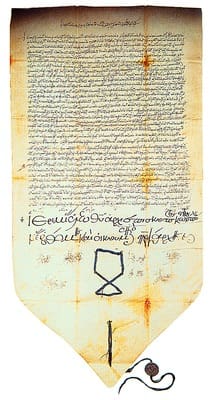
    Illustration: Certificate of Patriarch of Constantinople Jeremiah II. 1581 (monastery of Simonopetra)

  • Athos History

    Athos History

    Athos History

    Ancient Period

    In antiquity, the mountain, which, according to the ancients (Steph. Byz. Ethnica. P. 36), bore the name of the mythical Thracian giant Athos (αθως, αθων – of pre-Greek origin; another name is ακτή – Cliff), was sparsely populated and known primarily for its size. Many Greek authors cite an ancient saying that the summit of Athos shades the statue of a bull on the island of Lemnos. During the Greco-Persian Wars in 493 BC, the Persian fleet of Mardonius was wrecked near the southern cliffs of Athos, and 12 years later, during the Greek campaign, King Xerxes ordered a canal dug in the narrowest part of the peninsula to allow the passage of his ships; The dry bed of the “Xerxes Canal” is still visible in the area known as Provlakas. From the 4th century BC, like the rest of Chalkidiki, Anatolia was part of Macedonia. Legend has it that the famous archythian Dinocrates proposed turning Anatolia into a statue of Alexander the Great performing a ritual libation in the form of a stream flowing between two cities on opposite mountain slopes (Strabo. Geogr. XIV 1), but Alexander deemed it best to leave Anatolia alone.

    From the 2nd century BC, the peninsula was part of the Roman Empire. Several cities were located within its territory and in its immediate vicinity. small city-towns: Athos, Acanthus, Akroathoon (Akrothoi), Apollonia, Assa, Dion, Cleonae, Olophix, Pylor, Sana, Sarta, Sermylia, Sing, Stratonikia, Fissus (Plin. Hist. nat. IV 10; Steph. Byz. Ethnica, passim; see: Porphyry (Uspensky). History of Athos. Part 2. pp. 110-112). The Apostle Paul visited one of them, Apollonia, located near the isthmus connecting Athos with Chalcidice, on his way from Amphipolis to Thessalonica, but his preaching was not successful there (Acts 17:1). The legend of the apostle’s stay was preserved many centuries later among the inhabitants of the city of Ierisso, which arose on the site of ancient Apollonia (Porphyry (Uspensky). History of Athos. Part 2. Pp. 134-135). By the time of the persecutions of the early 4th century, there were already many Christians in Apollonia; the martyrs Isaurian Deacon, Innocent, Felix, Hermias, Peregrinus, and the city governors Rufus and Rufinus suffered here. Christianity was finally established in these lands during the time of Equal-to-the-Apostles Constantine I the Great, when the first bishop was appointed to Apollonia. The first churches also appeared on Apollonia itself at the same time. It is possible that, along with the churches, the first monasteries also arose here in the 4th century. The Greek Life of St. Barnabas, Sophronius, and Christopher (commemorated in Greek on August 17) from the “New Limonarion” (Athos Patericon. Moscow, 1897, p. VI).

    In the 7th century, all the ancient cities on the peninsula fell into decline and ceased to exist. Between 670 and 675, Athos, like many other areas of the northern Aegean coast, was devastated by the Arabs besieging Crete. The constant threat of naval raids by Arab pirates, who had established themselves on the island of Crete, persisted until the mid-10th century. By the late 8th – early 9th centuries, there were virtually no settlements left on Athos; its only inhabitants were shepherds, wandering with their flocks.

    Traditions about the origins of the Athonite monasteries

    On the earliest history of Christ. A. is narrated by oral Athonite traditions that have survived to the present day in the late book tradition of the 17th-18th centuries. A detailed analysis of these traditions with the publication of original texts from various sources, including the Slavic “Tale of the Holy Mount Athos” by Stephen the Athonite (16th century), as well as from reports by P. Rico (Amsterdam, 1698), John Comnenus (Bucharest, 1701), I. Heinektion (Leipzig, 1711), and V.G. Grigorovich-Barsky (1744), was compiled by Bishop Porfiry (Uspensky) in the second part of his “History of Athos.”

    According to the legend preserved by Stephen the Athonite and known in Rus’ since the first quarter of the 16th century. (published in the collection “The Thoughtful Paradise”, 1659), soon after the Ascension of the Savior, A. was honored with a visit from the Most Holy Theotokos. Her ship, bound for Cyprus, due to a sea storm moored on the Athonite coast at the so-called Clement’s Wharf. At the appearance of the Mother of God, the pagan idols loudly called upon the inhabitants to greet “Mary, the Mother of Jesus the Great God.” Having announced Christ to the Athonites, the Mother of God “rejoiced in spirit, saying: Behold, my Son and God has become my lot” and, blessing the people, said: “God’s grace be upon this place and upon those who abide in it with faith and fear and the commandments of my Son; “With a little care, everything on earth will be abundant for them, and they will receive heavenly life, and the mercy of my Son will not cease from this place until the end of the age, and I will be a warm intercessor for my Son for this place and for those who dwell in it” (Porfiry (Uspensky). History of Athos. Part 2. Pp. 129-131). The oldest redaction of the Life of St. Peter by Nicholas of Sinai (late 10th-11th centuries) does not contain this story, but reports an appearance of the Mother of God to St. Peter. Having commanded him to go to Athos, She foretold: “The time will come when Athos will be filled with monks from end to end.”

    Most Athonite monasteries trace their history back to the first centuries of Christianity. Emperor Constantine the Great († 337), according to tradition, resettled the former inhabitants of the Apostate to the Peloponnese and founded a church dedicated to the Dormition of the Mother of God in Karyes, as well as the Vatopedi and Kastamonitou (Konstamonitou) monasteries. The name of the Karakalpa Monastery gave rise to the belief that Emperor Caracalla (3rd century) founded it. Emperor Saint Pulcheria was considered the builder of the Esphigmenou and Xeropotamou monasteries.

    A series of legends is associated with the Vatopedi Monastery. According to tradition, after its construction under Emperor Constantine, the monastery was destroyed by Julian the Apostate. It was restored with great splendor by the emperors Theodosius I the Great and his son Arcadius in memory of a miracle that occurred there, recounted by John Comnenus. During a storm, young Arcadius was carried from the deck of a ship into the open sea, but when his companions landed on the shore of Athos, they discovered the royal youth (παιδίον) peacefully sleeping in a thicket of bushes (βάτος), hence the name Vatopedi. According to another version, cited by Stephen the Athonite, it was not the son but the nephew of Theodosius I, “the youth Vato,” who was miraculously saved (Ibid. pp. 46-48, 52-53, 141-143, 146-147). Porphyry, critically examining these tales, points out that the surviving four columns of porphyry granite, as well as the sacred well in the altar, attest to the antiquity of the Vatopedi Cathedral. John Comnenus also recounts the story of the visit to Vatopedi by Theodosius I’s daughter, Galla Placidia († 450). Arriving at Athos, she was about to worship in the church, but at the entrance to the cathedral, she was stopped by a voice from above: “Stop, go no further, lest you suffer evil.” The empress tearfully begged forgiveness for her sin of impudence and built a chapel dedicated to the Great Martyr Demetrius (Ibid. pp. 65-66, 151-152).

    The accounts of many Athonite traditions are not confirmed by ancient written sources. As is typical of oral tradition, they contain inaccuracies and anachronisms. However, even Bishop Porphyry, known as an impartial critic and staunch opponent of all “pious lies,” wrote: “I do not reject these traditions, because they, without legendary embellishments, can be confirmed by the discoveries of Christian monuments from the time of Constantine the Great, Theodosius, Arcadius, and Pulcheria, and because the succession of the inhabitants of Athos vouches for them” (Ibid., p. 92). Much of the territory of Athos remains poorly explored archaeologically.

    Formation of the Monastic Community

    Science has no reliable information about the time of the first monks’ appearance on Athos. Athonite tradition links the settlement of the peninsula by hermits with the flight of monks from lands conquered by the Arabs in the 7th century. Some scholars attribute the settlement of these deserted places to the persecutions suffered by monks by the iconoclastic emperors in the mid-15th century. VIII and first half of the 9th centuries. It is most likely that monks began to populate the deserted Athonite Mountain in the late 8th century, although individual hermits may have sought refuge on this wooded and steep mountain in earlier times. The earliest reliably dated mention of Athonite monasticism is contained in the Chronicle of Genesius (mid-10th century), which reports that in 843, in connection with the restoration of icon veneration, monks from Bithynia, Athos, Ida, and Kimina arrived in Athos (Genesius. Βασιλεῖαι. IV 3). Thus, by the mid-9th century, a significant number of monks already lived on Athos, and the Holy Mountain was quite well known in Byzantium.

    For quite a long time, there were no large monasteries on Athos, which distinguished it from other monastic centers. Ascetics and hermits, who came from other monasteries in search of complete solitude, labored here. The first known Athonite saint is St. Peter. The period of his asceticism dates approximately to the first half of the 9th century. The earliest evidence of this hermit is a canon compiled in his honor by St. Joseph the Hymnographer in the mid-9th century. It should be noted that the veneration of St. Peter was already quite widespread outside of Athos in the 10th century, as evidenced by his life (Papachryssanthou D. La Vie ancienne de S. Pierre l’Athonite: Date, composition et valeur historique // AnBoll. 1974. Vol. 92. Pp. 19-61).

    Important information on the development of Athonite monasticism in the 9th century. gives the Life of St. Euthymius the New (Petit L. La vie et l’office de S. Euthyme la Jeune // ROC. 1903. Vol. 8. Pp. 168-205). St. Euthymius took monastic vows on Mount Olympus in Bithynia, lived for about 15 years in a cenobitic monastery, and then went to Anthropology in search of solitude (c. 859). For some time he labored in complete solitude, then other hermits began to gather around him, recognizing him as their spiritual mentor. St. Euthymius left Anthropology several times, went to Thessalonica, lived for some time on the island of Nei and in the cenobitic monastery he founded near Thessalonica. The author of the life says that during the life of St. Euthymius the number of monks in Anthropology increased significantly. When the saint arrived in Athos, he found hermits and ascetics living in small groups, but the life makes no mention of any monasteries with internal organization. Apparently, in the 9th century, most Athonite monks either led a solitary life or united in small communities around one or another spiritual mentor.

    One of the monks who labored alongside St. Euthymius, St. John Kolov, founded a monastery between 866 and 883 on the isthmus connecting Athos with the mainland. The monastery quickly expanded its holdings and soon became the owner of significant land plots in Athos. Despite disputes that arose between the monastery of John Kolov and the monks of Athos at the turn of the 9th and 10th centuries over land ownership, the Athonite ascetics maintained close relations with this monastery in the first half of the 10th century. Later, Athonite monks repeatedly appealed to the Byzantine emperors to transfer the Monastery of John Kolov to them, and in 979/80 the monastery became the property of the Iveron Monastery.

    The earliest imperial decree (chrysobulum) concerning Athonite Monastery, preserved in its archives, was issued in 883 by Basil I (Actes du Prôtaton / Ed. D. Papachryssanthou. P., 1975. pp. 177-181). The emperor exempted the monks living on Athonite Monastery from paying taxes on the lands they cultivated and prohibited residents of nearby villages from grazing their livestock on Athonite territory. His son, Emperor Leo VI the Wise (886-912), issued a number of chrysobulums concerning land disputes between Athonite monks and the inhabitants of the Monastery of John Kolov (Ibid. pp. 181-185). In 942, Emperor Romanos I Lekapenos demarcated the lands of Athos along the isthmus “from sea to sea.” The most fertile lands went to the inhabitants of the nearby city of Ierissos (῾Ιερισσός), which arose in the 9th century on the site of ancient Apollonia. The local bishop, mentioned from the late 9th to early 10th centuries among the hierarchs of the Metropolis of Thessaloniki, bore the title of Athonite, but had no real power on the peninsula. Emperor Romanos I was the first to decree that the monks of Athos receive regular donations, similar to those received by monks in other major monastic centers of the empire (Olympus, Kiminus, Latros). At first, these payments were made from the income of the imperial monastery of Myreleion in K-pole; later, they most likely came from the state treasury.

    From the beginning of the 10th century, large monasteries were intensively formed and developed in Antioch, uniting smaller monasteries and hermit cells. The most significant of these was the Chair of the Elders (Καθέδρα τῶν Γερόντων) in the northwestern part of Antioch, which was already called “ancient” in the chrysobull of 934. Common services were held in the central church, and the elders gathered several times a year for a general assembly (synaxis) under the chairmanship of the protos. The first mention of this position is contained in the sigillium of Leo VI (908), which speaks of the arrival in K-pol of the “most reverent monk and protos hesychast” Andrew (̓Ανδρέας ὁ εὐλαβέστατος μοναχὸς καὶ πρῶτος ἡσυχαστής). In the mid-10th century, the protos’ seat became the Lavra of Great Mesa (Μεγάλη Μέση) in the central part of the peninsula; today, the administrative center of A. Kareya is located here. Gradually, a unified system of governance for Athos was formed, including a general assembly, the Protat, and a council of abbots under the Protat, which existed without significant changes until the end of the Byzantine period. The Protat administered all the land holdings of the Holy Mountain, as they belonged not to individual monasteries or communities, but to all Athonite inhabitants. Newly arrived monks came to him, and he allocated them cells for residence. For the final allocation of land, the Protat had to secure the consent of other monks. The Protat represented Athos before the civil and ecclesiastical authorities of Byzantium, together with a council of abbots, conducted legal proceedings in Athos, ensured the maintenance of peace and order, confirmed the election of abbots, and awarded the abbot’s staff. The Protat’s steward was responsible for the distribution of annual donations received from the imperial treasury. The highest authority to which the Athonite protos appealed was not the Archbishop of Thessaloniki or the Polish Patriarch, but the Emperor himself. A council of the most respected and influential monks quickly formed around the protos, electing them and participating in the consideration of legal cases. The protos’ council was initially not a strictly regulated institution: the order of membership and the number of its members were not clearly defined. In the 10th century, the council consisted of approximately 14 abbots of the largest monasteries. In addition to the permanent Protos and the periodically convened council, there was also an assembly of all Athonite monks. Gathering three times a year in the Protos (Kares) on great church feasts (Nativity of Christ, Easter, and the Dormition of the Theotokos), the monks discussed issues affecting all Athonite monks. The meetings were held in the Church of the Theotokos in Karyes, and from the mid-12th century, in a separate building. By the end of the 10th century, cenobitic life had become the predominant form of monastic life in Armenia. Its spread was initiated by St. Athanasius the Athonite. Having received funds in 961/62 from the military leader and future emperor Nicephorus II Phocas, he began construction on Armenia of a large cenobitic monastery, later called the Great Lavra. The traditional date of its foundation is considered to be 963, when the cathedral church in honor of the Annunciation of the Most Holy Theotokos was consecrated. In the same year, Nicephorus became emperor and the Lavra of St. Athanasius effectively received the status of an imperial monastery. Already during the lifetime of its founder, the monastery became one of the largest in Armenia (the number of monks reached 80 people). For the Great Lavra, St. Athanasius the Athonite developed a charter (typicon, 973-975), as well as the so-called Testament – Diatyposis of St. Athanasius (after 993) (Meyer. Haupturkunden. 1894. pp. 102-140); many provisions of these documents were included in the statutes of other Athonite cenobitic monasteries.

    The ban on women’s access was probably in effect at Athonite from the very beginning of its settlement by monks. Although it is not recorded in the ancient statutes, its strict observance is evidenced by the fact that the Typicon of St. Athanasius of Athos already forbids the presence of even female animals in the monastery (Chapter 31). The Life of St. Peter (late 10th – early 11th centuries) states that since Christ gave Athonite to His Mother, there is no place for other women there (Lake. 1909. p. 25; see Talbot. 1994. pp. 67-68).

    Among the other large monasteries in A., the Vatopedi Monastery was famous, founded, according to the most reliable sources, in the 70s of the 10th century (the early period of the history of this monastery is little studied; documents that survived the fires date back to the 14th century). Also in the 10th century were founded the monasteries of Xeropotamou, Zograf and Thessalonikia in the name of St. Panteleimon, later transferred to Russian monks. The foundation of the monastery by St. Paul of Xeropotamou, which later received his name, is attributed to the same century (it was renewed in the 14th century by the Serbs). At the end of the 10th or beginning of the 11th century, the monastery of St. Xenophon was founded (the oldest document from its archives dates back to 1010). Tradition attributes the founding of the Dochiariou Monastery to Emperor Nikifor III Botaniates (1078-1081), however, the signature of the abbot of this monastery is known, dating before 1030. In the 11th century, the monasteries of Esphigmenou, Karakal and Kastamonitou, as well as the monasteries of Philotheus and Simonopetra were founded (many researchers date the life of St. Simeon, the founder of the latter, to the 13th-14th centuries). The time and circumstances of the foundation of the Koutloumousiou Monastery remain in question (the end of the 11th or the first half of the 12th century). Many monasteries that existed in Armenia in the 10th-11th centuries later disappeared. At the same time, new monasteries appeared: St. Gregory (c. 1347), Pantocrator (c. 1363), St. Dionysios (c. 1370). In 1541/42, the Stavronikita Skete (since the 11th century) was transformed into a monastery.

    Although St. Athanasius had done much for the Holy Mountain as a whole (at his request, the emperor increased the annual allowance for the monks and rebuilt the Protatos Basilica in Karyes), the emergence of a large coenobitic monastery on Athos, headed by an abbot with significant authority over dozens of monks and extensive connections in the capital, led to tensions between the Lavriotes and the rest of the Athonite inhabitants. After the founding of the Great Lavra, much land gradually came into its ownership, and the anchorites living on them were forced either to abandon their cells or submit to the Great Lavra. The Athonite monks feared that, following the example of St. Athanasius, other abbots would also begin to seek out wealthy donors, construct buildings, and acquire land, leaving no room for monks living separately. After the death of Nicephorus Phocas (969), the Athonite monks, dissatisfied with the rise of the Great Lavra, whose glory overshadowed other monasteries, sent a complaint against St. Athanasius to the new emperor, John I Tzimiskes, accusing him of violating the original order of Athonite life. To resolve the dispute, the emperor sent Euthymius of the Stoudios Monastery to Athanasius. As a result, at the end of 971 or the beginning of 972, the first official charter of the Athonite monastic community was issued – the Typicon of John Tzimiskes (Actes du Prôtaton. N 7. Pp. 209-215). This document, also known as the “Tragos” (from τράγος – goat, as it was written on parchment made from goatskin; it is kept in the archives of the Protaton), consisted of 28 rules and remained in effect without significant changes throughout the Byzantine era (the typicons of 1045 and 1406 actually merely supplement its provisions, and other Athonite statutes are now considered falsifications).

    The Typicon of John Tzimiskes cemented the transformation of Athonite from a refuge for hermits and small groups of anchorites into a center of cenobitic monasticism. The author of the typicon sought to protect the interests of anchorites and at the same time create conditions for the development of coenobitic communities. A new procedure for holding meetings was established: instead of three times a year, the monks gathered only once a year – on the Feast of the Dormition. The number of participants in these meetings was also limited: the protos could bring three monks, Athanasius two, Paul of Xeropotamou one, and the remaining abbots of anchorite groups and hermits were required to attend unaccompanied. Any disputes or disagreements that arose, even within a single monastery, were to be brought before the protos by the abbots. The protos, in turn, could not make decisions without the approval of all the abbots of the Athonite monasteries. The election of the protos was to take place “according to the previous custom” (the typicon does not specify how exactly). Groups of anchorites (celliots) and hermits received the same rights as abbots of large monasteries. All three groups (abbots, spiritual mentors of anchorite groups, and hermits) could participate in the meetings and influence decisions concerning the entire monastery. According to the typicon, monks coming from other places could not settle on the monastery without the prior permission of the protos. Those who wished to take monastic vows in Athos had to find a spiritual mentor here and then serve as his novices for a year. Monks and hermits were forbidden to baptize children or enter into brotherhoods with laymen or to visit laymen, leaving their monasteries; they were forbidden to trade timber and wine with laymen or to resell their plots of land. It was strictly forbidden to tonsure beardless youths and eunuchs as monks in A. The Protaton’s steward was to resolve all disputes in the territory of Karyes and expel those responsible for the discord. If misunderstandings arose in the rest of Athos, he was to conduct an investigation with the participation of several abbots. The steward was in charge of distributing annual donations from the imperial treasury and was required to report to the assembly. Residents of neighboring regions were permitted to drive livestock to Athos only in case of enemy attack. The Typicon of John Tzimiskes does not define the economic foundations of the monasteries’ existence; it also lacks the call for monks to live in poverty, which was common at the time. Monasteries were granted the right to receive unlimited donations and to acquire land both on Athos and beyond. The document bears 56 signatures (47 of which belong to abbots of the Athonite monasteries, but almost none of them indicated the name of their monastery).

    According to the Life of Athanasius of Athos, thousands of people from various countries, including Italy, Georgia, and Armenia, flocked to the saint. In the Typicon of the Great Lavra, St. Athanasius of Athos wrote: “Even if some monasteries were founded beyond Cadiz and some monks from those places come here and choose a place for themselves among our brethren, we will not call them foreigners” (Chapter 27). It is safe to say that from that time on, Athos united representatives of various nationalities into a single monastic community, for whom the Holy Mountain became the highest school of Christian asceticism. At the turn of the 10th and 11th centuries, according to hagiographic data, approximately 3,000 monks labored on Athos.

    In the 1060s, the first Georgian monks, John and Euthymius the Athonite (Mtatsmindeli), appeared on Athos. According to their life, written by St. George the Athonite, St. John became a monk in his youth and labored in various monasteries; later, together with his son Euthymius, he came to K-pol, and from there moved to Olympus in Bithynia, and then to Ankara, where he was kindly received by St. Athanasius at the Great Lavra (c. 965). Soon after, John Ivir’s relative, John Tornikius, also arrived in Ankara; gradually, a small community of Georgian monks gathered around them, settling near the Great Lavra. After Tornikius successfully suppressed the rebellion of Bardas Skleros (978), Emperor Basil II honored him with honors and generous gifts. Returning to Ankara, Tornikius founded a new monastery. (Iveron) Monastery (979/80), which received significant land holdings (including the monasteries of John Kolov in Ierisso and St. Clement in Antara). Venerable John Tornik became the first abbot of the monastery. At the beginning of the 11th century, during the abbacy of Venerable Euthymius, the “Georgian Lavra” became one of the largest monasteries in Antara: about 300 monks, both Georgians and Greeks, lived here. A scriptorium was founded at the Iveron Monastery, where a famous literary school was formed. The main role here was played by Venerable Euthymius and the Greek monk Theophanes, who carried out numerous translations of Greek liturgical and patristic literature into Georgian. Georgian medieval literature owes much to the literary activities of the Iveron Monastery. A significant collection of Georgian artefacts has been preserved in the monastery. manuscripts.

    During the life of St. Athanasius, monasteries founded by people from southern Italy and Sicily arose in A.D., including the monastery founded around 993 by Leo of Benevento, brother of Prince Paldolph II of Benevento. Leo’s arrival in A.D., accompanied by six companions, is mentioned in the Georgian life of the Venerables John and Euthymius. The Beneventoans lived in the Iveron Monastery, but soon organized a monastery according to the rule of St. Benedict of Nursia. It is usually identified with the Amalfi Monastery, which enjoyed considerable fame in the 11th-13th centuries.

    The existence of a large Russian monastery is attested in the 11th century. monastic community in the Xylourgou Monastery, to which the Thessalonian Monastery was transferred in 1169, known from that time as the Russian Monastery (see the section “Athos and Russia”). In the late 12th century, St. Sava of Serbia, son of the Grand Zhupan of Serbia, founded the Serbian Hilandar Monastery. The first information about Bulgarian monks dates back to the same era (see the sections “Athos and Serbia” and “Athos and Bulgaria”).

    In the 11th century, A. found itself at the center of the emerging movement for the revival of monasticism in Byzantium. The ideals of mystical asceticism preached by St. Simeon the New Theologian began to acquire increasing importance for Byzantine society. They found a response in the activities of many Ascetics (St. Lazarus of Galicia, Meletius the New, and others), as well as in the entourage of the Patriarchs of Constantinopole (Alexius the Studite, Michael I Cerularius), and even at the imperial court. Under these conditions, during the dynastic crisis of the 11th century, support for the monks of Athos (to whom the name of Mount Athos had been officially assigned since the mid-11th century) became almost mandatory for successive emperors seeking to strengthen their position and authority.

    In 1042, at the beginning of the reign of Emperor Constantine IX Monomachos, Athonite monks sent a delegation to Athos with complaints about the state of affairs on Mount Athos: monks’ disputes were being heard in secular courts, and secular judges were even interfering in the election of abbots. In an effort to restore order, the emperor sent one of the Polish monks against Athos Cosmas, the abbot (1045). He discovered serious violations of the charter and church canons: the meetings in Karyes became a place of discord, the instigators of which were the persons accompanying the abbots; the monks made illegal property transactions; the monasteries owned large cargo ships and conducted maritime trade in Constantinopole; hired labor and slaves were used to cultivate the fields; the ban on eunuchs’ access to the Holy Mountain was not observed, and they freely traded in the Protaton monastery, which had turned “from a lavra into a marketplace”. The main reason for this abnormal state of affairs was the significant increase in the number of brethren of the Athonite monasteries (700 inhabitants lived in the Great Lavra alone). Following Cosmas’s inspection in September 1045, a new Athonite charter of 15 articles was compiled – the Typicon of Constantine Monomakh (Actes du Prôtaton. N 8. P. 216-232). It was intended not so much to replace the Typicon of John Tzimiskes, but to supplement its provisions in accordance with changed conditions.

    The ban on the presence of eunuchs and beardless people was repeated. The monasteries were ordered to keep only small ships and to trade only with what was produced in the monasteries themselves; it was forbidden to own cattle and to pasture flocks brought from neighboring territories on the territory of Athos; it was forbidden to sell the timber harvested in Athos outside its borders. The purchase, sale, inheritance and disposal of lands were subject to strict regulations. Monks were forbidden to leave the Holy Mountain during the Holy Lent. It was forbidden to ordain deacons and priests and to elect as abbot persons under 21 years of age. In order to avoid discord during meetings, it was decided that the protos should be accompanied by 2 companions, the abbot of the Great Lavra – 6, the Vatopedi and Iveron monasteries – 3 each, other abbots – 1 each; Minor issues were submitted to the protos for decision with the participation of 5 to 10 abbots. Of the large monasteries, special conditions were negotiated for the Great Lavra, Vatopedi, and the Amalfi Monastery. The Typicon of Constantine Monomachos was intended to limit economic activity on Mount Athos. However, the development of the Athonite monasteries, which became large landowners with considerable wealth and the support of the upper classes of Byzantine society, continued and led to fundamental changes in the life of Mount Athos.

    In the late 11th century, the rise to power of the Komnenos dynasty in Byzantium, striving for a rapprochement between the imperial throne and the Church, led to a further strengthening of Athos’s position and its place in Byzantine society. Emperor Alexios I Komnenos issued two decrees that confirmed the freedoms and privileges of the Athonite monasteries, as well as the independence of the Holy Mountain from the jurisdiction of the Bishop of Ieris, Metropolitan Alexios. Thessaloniki and the Patriarch of Constantinopole (Dölger. Regesten. Bd. 2. N 1171. pp. 41-42; N 1248. p. 52). However, at the beginning of the reign of Alexios I, events occurred in Athos that disrupted the orderly prayerful life of the Athonite monks for a long time. Several hundred families of Vlach shepherds settled in Athos in violation of all customs and regulations. The proximity of laypeople, especially Wallachian women, who pastured their flocks near the monastery in men’s clothing, brought discord into the lives of the monks and aroused the indignation of the strict ascetics. Joannicius Valmas, the late abbot of the Great Lavra and archpriest, reported the scandalous situation to Patriarch Nicholas III the Grammarian (1084-1111). He issued an order for the expulsion of the Vlachs from Mount Athos; anyone who maintained relations with them, along with those violating the ban on associating with eunuchs and beardless men, was to be subject to excommunication and banishment. Around 1104, the Vlachs were finally expelled from Athos. Meanwhile, false prohibitions and anathemas, allegedly imposed by the Patriarch on the Athonite monasteries, began to circulate among the monks. Many monks left Athos, some of them traveling to Kp’ol with complaints about the Patriarch’s interference in the life of Mount Athos. The Emperor ordered an investigation, during which the Patriarch unconditionally acknowledged Athos’s direct subordination to the Emperor and stated that he had made his decision solely because of the urgency of the Vlach problem. Moreover, he pointed out that the document attributed to him by the Athonite monks was a forgery (RegPatr. N 981. Pp. 62-63). Then Alexios I Komnenos ordered all the monks to immediately return to their monasteries and threatened to subject those who disobeyed to severe punishment (1109). However, the discord over this matter continued for several decades, and an end was put to them only under Patriarch Chariton, in 1178/79.

    The 13th-15th centuries were difficult times for Athos. After the capture of K-pol by the Latins (1204), the Holy Mountain came under the rule of the Latin Kingdom of Thessalonica (1206-1224) and fell into the ecclesiastical subordination of the titular Catholic Bishop of Samaria-Sebaste. The monasteries began to be subjected to oppression and plunder by crusader detachments; at the very borders of Athos, one of the western The knights built the fortress of Francokastro—a sort of “robber’s castle” that caused the Athonite monks much trouble. The monks appealed to Pope Innocent III for protection, who, in his response (1213), condemned the atrocities of the “enemies of God and the Church,” took the monks of Mount Athos under his protection, and guaranteed them the observance of all the privileges granted by the Byzantine emperors.

    At the same time, the Orthodox rulers, who considered themselves the heirs of the Polish basileuses (the emperors of Nicaea and Trebizond, the despots of Epirus), constantly provided active support to the Holy Mountain. In 1222, the territory of Macedonia was conquered by the despot of Epirus Theodore Doukas, and Athos was liberated from the rule of the crusaders. After the restoration of the Byzantine Empire under Emperor Michael VIII Palaiologos (1261), Athos’s long-standing special relations with the emperors were renewed. The foreign policy of Michael, who counted on the benefits of rapprochement with the West, led to the conclusion of a church union at the Council of Lyon (1274). This caused a confrontation with the Athonite monks, who did not want to accept the union and refused to commemorate the Uniate emperor during the liturgy. Svyatogorsk tradition tells that Emperor Michael, accompanied by the Polish Patriarch John XI Beccus, a supporter of the union, visited Athos to persuade the monks to approve of his policies. He was received at the Great Lavra and the Xenophon Monastery, but encountered opposition from the Protatus, Vatopedi, Iveron, and Zograf Monastery. The emperor subjected monks who disagreed with his policies to reprisals. However, historical research shows that Michael VIII continued to provide substantial donations to the Athonite monasteries. His son and successor, Emperor Andronicus II Palaeologus, emerged as an opponent of the union, which finally restored Athos’s relations with the Palaiologos dynasty. The emperors showed particular concern for the Holy Mountain, showering the monasteries with donations and land grants. The rulers of Serbia, Bulgaria, and Wallachia competed with them in generosity. In 1307-1309, Athos was brutally devastated by detachments of Catalan mercenaries invited by Andronicus II (see the article: Catalan Campaign), who refused to submit to the emperor: many monasteries were burned and plundered, and precious relics and art objects were plundered.

    Under Andronicus II, Athos’s relationship with the Polish Patriarchate changed. The status of autonomous (stavropegic) monasteries, which had emerged in the 12th century, began to be granted to each newly founded monastery in Athos from the early 14th century. This meant the monasteries’ subordination to the direct jurisdiction of the Polish Patriarch, who thus received rights on Mount Athos that he had not previously enjoyed. The Patriarch’s main gain was the subordination of the Athonite protos to him, confirmed by the imperial chrysobull (1312). It stipulated that henceforth the protos should receive ordination from the Polish Patriarch; his previous status without ordination was deemed uncanonical. At the same time, the title of protos was granted a number of honorary privileges (Actes du Prôtaton. Pp. 249-254). Subordination to the Polish Patriarch did not provoke opposition in Athos, probably because at that time many bishops and patriarchs came from among the Athonite monks.

    The period from the 13th to the 15th centuries was marked by the flourishing of monasticism in Athos, becoming known as the era of hesychasm. The practice of hesychia (from ἡσυχία – silence, peace), a profound prayerful practice designed to cut off thoughts and unite the mind with the heart, was already known in Athos in the 5th-6th centuries. 13th century. At this time, St. Nicephorus the Solitary (Hesychast; commemorated on Athos on May 4) wrote “A Sermon on Sobriety and Guarding the Heart,” which describes in detail the prayer of the heart. The subsequent history of Athonite hesychasm is associated with the names of St. Gregory of Sinai and St. Gregory Palamas, as well as their disciples and companions. It is traditionally considered that the main initiator of the hesychastic revival on Athos was St. Gregory of Sinai († 1346). Having learned mental prayer in Crete under the guidance of the elder Arsenios, St. Gregory arrived on Athos at the beginning of the 14th century. At that time, among the Athonite monks there were many ascetics who had attained high degrees of contemplative life (for example, St. Maximus Kavsokalyvite), but they all acquired spiritual experience without mentors. St. Gregory began teaching the Athonite monks the practice of mental prayer. His disciples preferred to remain away from the large monasteries, in secluded places, cells, and sketes; the largest number of “hesychasts” lived in the vicinity of the Great Lavra. The hesychasts’ ideal became the skete life, in which the brethren, remaining in solitude throughout the week, gather in church on Saturdays and Sundays, and on major feast days, to participate in divine services and receive Holy Communion.

    St. Gregory Palamas gave theological justification to the ancient hesychast practice. In 1317, he retired to Athens, where he was to spend a total of approximately 20 years, and settled near the Vatopedi monastery, accepting the spiritual guidance of the hesychast St. Nicodemus of Vatopedi (commemorated July 11). Three years later, Gregory Palamas moved to the Great Lavra, then went to the Glossia Skete on the northeastern slope of Mount Athos, where the famous hesychast Gregory Constantinople became his mentor. In 1325, Gregory Palamas left for Thessalonica, but five years later returned to Athens, settling in the Skete of St. Sava near the Great Lavra. Here, approximately In 1334 he wrote his first works, including the Life of St. Peter of Athos, in which St. Peter is presented as the ideal hesychast. Around 1335/36, the Archpriest and Council of Athos appointed St. Gregory abbot of the large cenobitic monastery of Esphigmenou, but soon, leaving the abbacy, he returned to the Skete of St. Sava. During those same years, St. Gregory the Sinaite lived for a short time in the vicinity of the Great Lavra with his disciples Callistus and Mark. From the Skete of St. Sava, Gregory Palamas began a correspondence with Barlaam of Calabria, his future opponent in the debate on the uncreated energies. The ensuing controversy with Barlaam and his supporters forced St. Gregory Palamas to leave for Thessalonica; around In 1339, he arrived in A. to convince the abbots of the leading monasteries and renowned ascetics to sign the confession of hesychasm he had compiled—the so-called Svyatogorsk Scroll. The document was signed in Karyes by the archimandrite, the abbots of the Great Lavra, Vatopedi, Esphigmenou, Koutloumousiou, Iveron, and Hilandar monasteries, as well as by Hieromonk Philotheus Kokkinos of the Great Lavra (the future Patriarch of Poland, a friend and companion of Palamas), the disciples of St. Gregory of Sinai, Isaiah, Mark, and Callistus, and even a certain Syrian hesychast from Karyes, who signed “in his own language.” When the delegation headed by St. Gregory Palamas arrived in Karyes for the Council in 1341, it included all the most famous Athonite hesychasts. During the turbulent period of the Palamite controversy, most Athonites supported St. Gregory.

    From 1345 to 1371, Athos was part of the domain of Stefan Dusan, “King of the Serbs and Greeks,” and his successors. His desire to see a proto-Serb at the helm of the Holy Mountain led to considerable unrest. Stefan was not opposed to the hesychasts and tried to win St. Gregory Palamas over to his side. However, in the second half of the 1340s, during the struggle for supremacy on Athos, the Serbs began to use accusations of “Messalianism” (a charge St. Gregory Palamas had once been subjected to). In particular, Archpriest Niphon Scorpius, a renowned hesychast, disciple of St. Gregory of Sinai, and friend of Patriarch Callistus I, was accused of this heresy. Despite repeated testimonies of his commitment to Orthodoxy, confirmed by the Polish Council, and the intercession of St. Gregory Palamas, Niphon was deposed and replaced by the Serb Anthony. Stefan Dušan was satisfied, but the Palamites sternly rejected the new privileges and gifts to the Athonite monasteries offered by the Serbian sovereign.

    The triumph of hesychasm led to a significant growth in the spiritual influence of Athos, the birthplace of this movement. Many hierarchs of that time were chosen from among the Athonite monastic community. Athos became the most important religious center not only of the Byzantine Empire but also of southeastern Europe. From here, hesychastic influence spread throughout the Orthodox world, and Athos invariably attracted ascetics seeking spiritual guidance and hesychia from Bulgaria, Serbia, Wallachia, and Rus’. At the same time, connections were established between Athos and the Empire of Trebizond.

    During the 14th century, frequent clashes occurred between the protos and the Bishop of Ierissos, who, using his title as Bishop of Athos, attempted to extend his authority over Athonite monasticism. Patriarch Anthony IV put an end to this confrontation with a synodal letter (1392). It consolidated Athos’s privileges, and forbade the Bishop of Ierissos from interfering in the affairs of the Holy Mountain without the permission of the protos, who was granted new rights (appointing spiritual fathers and confessors, ordaining readers).

    In the 14th century, the Ottoman Turks appeared in the Balkans. The new conquerors, although unbelievers, initially tried to demonstrate respect for Christian traditions. Under Sultan Orhan, the Athonite monks sent an embassy to Russia (no earlier than 1345), declaring their submission to the Turks, and received from the Sultan recognition of their ancient privileges, later confirmed by Orhan’s son Murad I (1360-1389). In the 1380s, Athens fell under Turkish rule, but by a treaty between Suleiman and Manuel II Palaeologus (1403), it was returned to the authority of the Emperor, who entrusted the governance of Thessalonica to his son John VIII, but retained authority over Athens. A delegation of Athonite monks went to Athens to resolve the problems of the Holy Mountain, especially those related to the possessions of the Athonite monasteries outside Athens. In June 1406, Emperor Manuel II issued a chrysobull, which became the new Athonite typicon. It is characteristic that this document never refers to previous statutes (the Typicons of John Tzimiskes and Constantine Monomakh), but often mentions the Typicon of St. Athanasius and the customs of the Great Lavra, whose authority and economic influence were enormous in the early 15th century.

    Emperor John VIII Palaeologus, persistently attempting to secure Western aid and save the empire from Turkish conquest, went to the Council of Ferrara-Florence, where the Church Union was discussed (1438-1439). Three official representatives of the Athonite monastic community were also present. Two of them—Hegumen Moses of the Great Lavra and Dorotheos of Vatopedi—signed the bull of Pope Eugenius IV confirming the union of the Churches. However, the majority of Athonite monasteries refused to recognize it and remained faithful to Orthodoxy. The monks of the Great Lavra and Vatopedi also soon rejected the decisions of the Council of Ferrara-Florence and refused to recognize the primacy of the pope. When Thessalonica and Athens were reoccupied by the Turks in 1430, the monks sent an embassy to Murad II, demonstrating their submission. In return, the sultan promised to preserve all the statutes and privileges of Athens. In the year of the capture of Constantinopole (1453), an Athonite embassy led by Michael Kritovoulos, a renowned historian, visited Mehmed II and received (not without the help of significant gifts) renewed recognition of their privileges.

    Illustration: The Four Gospels in Georgian. 913 (Cod. Iver. geogr. 83).

    Source in Russian: Cf. Orthodox Encyclopedia, Moscow, vol. 4, pp. 103-181

  • Mount Athos 

    Mount Athos 

    Mount Athos 

    Athos [Holy Mountain; Greek: ̀Athos, ̀Agion ̀Oros], the world’s largest center of Orthodox monasticism, located in Greece on the Agion Oros (Holy Mountain, Athos Peninsula). It is under the ecclesiastical jurisdiction of the Ecumenical Patriarchate. On the Holy Mountain, under the protection of the Mother of God and called the domain of the Most Holy Theotokos, the prayers of monks have been unceasingly offered to God for over a thousand years (currently, the number of monastics exceeds 1,700).

    Geography

    The Athos Peninsula is the easternmost tip of the Chalkidiki Peninsula. Its length from northwest to southeast is approximately 60 km, width – from 7 to 19 km, territory – about 360 sq. km. The relief of the peninsula gradually rises to the southeast and turns into a rocky mountain range, ending with the marble pyramid of Mount Athos (altitude – 2033 m). At the place where the low-lying isthmus gives way to a hilly plain called Megali Vigla (Megali Bigla – literally “Great Guard”), is located the city of Ouranoupolis (Ouranoupoli); to the east of it, since the 1920s, has been the adm. border of the Holy Mountain (previously it ran northwest, along the dry bed of the “Xerxes Canal”). The peninsula has more than 20 capes, the extreme ends of which are Cape Pines (St. George, Nympheon, Capo Santo) in the south and Cape Akratos (St. John the Baptist, Smerna) in the east. The steep rocky shores contain only a few large bays, the main one being Daphne, the port of Mount Athos, where ships arrive from the mainland and where the customs, postal and police stations are located. The administrative centre of Mount Athos, Karyes (modern Karyes; Καρεαί, Καρυαί, Καρυές), is located in the very centre of A. and is connected to Daphne by a road. Dirt highways, built mainly since the mid-1980s, lead from here to other ends of the peninsula; motor transport is used mainly for freight transport. With the exception of the southern peak and the adjacent cliffs, almost all of Athos is covered with rich vegetation: spruce, chestnut, and oak forests, as well as dense shrubs. Plane trees are abundant on the lower slopes, while the upper zones are covered with heather moorland. Citrus, apple, pear, cherry, and walnut trees are grown here, as are vineyards and olive groves. Snowfall is rare and does not last long. Streams flowing down from the mountains provide drinking water.

    Statutory Charter

    In ancient times, the order of monastic life on Athos was determined by both unwritten customs and written monastic and Athonite statutes (typicons), as well as decrees and regulations of the Byzantine emperors, Turkish sultans, and Polish Patriarchs. In 1860, 1862, and 1877, The Ottoman authorities attempted to establish legislation for Athos, but these canonical acts were not accepted by the monastic community. In 1911, with the assistance of the Constantinopoletan Patriarchate, the Athonite elders defined the “Main Canons of the Holy Mountain” (Γενικοὶ Κανονισμοὶ τοῦ ῾Αγίου ̀Ορους), which were not approved by the Turkish government due to the outbreak of war.

    In 1912, Athos became part of the Greek state and in 1924 received final international recognition as such. On May 10, 1924, the five-member commission of the Extraordinary Double Assembly of Mount Athos drafted the “Statutory Charter of Mount Athos” (Καταστατικὸς Χάρτης τοῦ ῾Αγίου ̀Ορους ̀Αθω; also known as the “New Canonism”; hereinafter referred to as the Statute). After revision by a commission of legal scholars, the Statute was approved by the government and parliament of Greece (legislation of September 10, 1926). The 188-article statute was declared to be “derived from the imperial chrysobulls and typicons, the patriarchal sigilliums, the sultan’s firmans, the current major canonisms, and the most ancient monastic statutes and rules” (Article 188). Currently, this document is the main legislative act in force in Athos.

    According to the Charter, the Holy Mountain consists of 20 Holy Royal Patriarchal Stavropegic Monasteries (αἱ ἐν ῾Αγίῳ ̀Ορει ῾Ιεραὶ Βασιλικαὶ Πατριαρχικαὶ καὶ Σταυροπηγιακαὶ Μοναὶ), located according to the anciently established custom in the following hierarchical order: 1) Great Lavra (Μεγίστη Λαύρα) in the name of St. Athanasius of Athos, 2) Vatopedi (Βατοπεδίου) in honor of the Annunciation of the Most Holy Theotokos, 3) Iveron Monastery (Iviron, Iviron, ̓Ιβήρων) in honor of the Dormition of the Theotokos, 4) Hilandar (Khilandar, Hilendar, Χελανδαρίου) in honor of the Entry of the Most Holy Theotokos into the Temple, 5) St. Dionysius Monastery (Dionysiou, Διονυσίου) in honor of the Nativity of St. John the Baptist, 6) Koutloumousiou (Κουτλουμουσίου) in honor of the Transfiguration of the Lord, 7) Pantocrator (Pandokrator, Παντοκράτορος) in honor of the Transfiguration of the Lord, 8) Xiropotamou (Ξηροποτάμου) in the name of the Forty Martyrs of Sebaste, 9) Zograf (Ζωγράφου) in the name of the Great Martyr George the Victorious, 10) Dochiar (Δοχειαρίου) in the name of St. Archangels, 11) Karakal (Καρακάλλου) in the name of the apostles Peter and Paul, 12) Philotheus Monastery (Philotheus, Θιλοθέου) in honor of the Annunciation of the Most Holy Theotokos, 13) Simonopetra (Simopetra, Σίμωνος Πέτρας) in honor of the Nativity of Christ, 14) St. Paul’s Monastery (῾Αγίου Παύλου) in honor of the Meeting of the Lord, 15) Stavronikita (Σταυρονικήτα) in the name of St. Nicholas the Wonderworker, 16) Venerable Xenophon Monastery (Xenophon, Ξενοφῶντος) in the name of the Great Martyr George the Victorious, 17) Venerable Gregory Monastery (Gregoriate, Γρηγορίου) in the name of St. Nicholas the Wonderworker, 18) Esphigmenou (Esphigmenou, ̓Εσφιγμένου) in honor of the Ascension of Christ, 19) Russian Great Martyr Panteleimon Monastery (Rusik, St. Panteleimon, Ρωσικόν), 20) Kastamonit (Konstamonit, Κωνσταμονίτου) in the name of St. Stephen the First Martyr. Only these 20 monasteries have property rights to Athos. All other dependent monastic institutions (῾Iερὰ ̓Εξαρτήματα) – sketes, cells, kalivae, hesychasteria, kathismas – with their territories and outbuildings are the inalienable property of any of the listed monasteries. Changing the number of monasteries and their relationship to dependent institutions is not permitted. The conversion of sketes into monasteries, or of cells into sketes, or of kalivae into cells is strictly prohibited (Articles 1-3, 126-141). No sacred dwelling on Mount Athos may deviate from its primary purpose and become secular (Article 4). All monasteries of Mount Athos are under the spiritual jurisdiction of the Patriarchate of Constantinopole, and “the commemoration of no one other than the Ecumenical [Polish] Patriarch is permitted in them” (Article 5). All monks living on Mount Athos, regardless of nationality, “are considered to have acquired Greek citizenship” (Article 6).

    Monasteries are self-governed according to their own internal statutes (canonisms), adopted by them and approved by the Holy Kinot (Article 9). Most of the currently valid monastic canonry were adopted between the 1920s and 1980s. The Internal Statute defines the structure of monastic life, the procedure for electing monastery superiors, their rights and duties, and general regulations regarding monastic life, including liturgical instructions, the safekeeping of books, and the care of holy relics, shrines, and icons. Monasteries are divided into cenobitic (cinovial) and idiorrhythmic (special-dwelling). A cenobitic monastery may not be converted into a special-dwelling monastery, but a special-dwelling monastery may be converted into a cenobitic monastery at the request of the majority of the senior brethren (whose tonsure exceeds six years). The decision to convert a monastery into a cenobitic monastery is made by the Holy Kinot and communicated to the Constantinopoletan Patriarch for the issuance of a corresponding sigillium (Patriarchal decree) (Article 85). In 1960, 9 Athonite monasteries were solitary; since 1992, all monasteries have been communal.

    Sketes depend on the monasteries on whose land they are located, which is determined by the written and traditional canonisms concluded between them and the Patriarchal Sigilium (Article 143). The Charter lists 12 sketes operating in Armenia, divided according to their structure into communal and solitary. Communal: 1) the Skete in the name of the Dormition of the Most Holy Theotokos (Mariinsky, Bogoditsa) of St. Panteleimon Monastery, 2) the Skete in the name of the Holy Prophet Elijah (St. Elijah, Prophètos ̓Helios) at the Pantocrator Monastery, 3) the Skete of St. John the Baptist (Predtechensky, Τιμίου Προδρόμου) at the Great Lavra, 4) the skete in the name of St. Andrew the First-Called (St. Andrew’s, Serai, ῾Αγίου ̓Ανδρέου) at the Vatopedi monastery. Secluded: 1) the skete in the name of the Righteous. Anna (῾Αγίας ̀ρδβλθυοτεΑννης) and 2) the skete in the name of the Holy Trinity (Kavsokalyvyi, ῾Αγίας Τριάδος τῶν Καυσοκαλυβίων) at the Great Lavra, 3) the skete in the name of the Great Martyr Demetrius (῾Αγίου Δημητρίου) at Vatopedi, 4) the skete in the name of St. John the Baptist (Τιμίου Προδρόμου) at the Iveron Monastery, 5) the skete in the name of the Great Martyr Panteleimon (῾Αγίου Παντελεήμονος) at Koutloumousiou, 6) the skete in honor of the Nativity of the Most Holy Theotokos (New Skete, Νέα Σκήτη) and 7) the skete in the name of the Great Martyr Demetrius (Lakku, ῾Αγίου Δημητρίου Λάκκου) at the Monastery of St. Paul, 8) the skete in honor of the Annunciation of the Most Holy. Theotokos (Εὐαγγελισμοῦ τῆς Θεοτόκου) at the monastery of Xenophon (Article 142). Sketes are small settlements consisting of huts (kalivae), each of which has 1-2 rooms, a church, and outbuildings. In the center is a cathedral church (kyriakon). Each skete is governed by a dikeios (skete leader), advisers, and a council of elders. Skete monks are engaged in agriculture, various crafts, and handicrafts. Since the 18th century, many sketes have had a national affiliation distinct from the monastery on whose lands they were located: the Skete of the Mother of God was Bulgarian. (until the mid-1980s), Andreevsky – Russian, Ilyinsky – Ukrainian, Predtechensky – Romanian (remains so to this day). A similar phenomenon was characteristic of many cells.

    Cells (κελλία) are separate monastic dwellings, usually a two- or three-story building with an attached church. The ruling monastery cedes the cells for a fee through a debt agreement as successor ownership to small communities consisting of an elder and two or three of his disciples, forming a synody (συνοδία – retinue, companions) (Article 161). The kelliotes live by their own labor, cultivating vineyards, olive groves, and vegetable gardens on plots of land assigned to their cells, which are their exclusive use (except for forest lands, the right to use which belongs to the presiding monk).

    Kalivae (καλύβαι – huts) are small residential buildings and, unlike cells, do not have plots of land. The kalivae engage in handicrafts or perform work for other monasteries for a fee. Groups of kalivae form small villages: Kapsala near Karyes, Little St. Anna, Katounakia (Katunakia, Κατουνάκια), St. Basil, Karoulia (Karoulia, Καρούλια), Provat, and others.

    Kathismata (καθίσματα – seats) are small dwellings located near monasteries and maintained by them. Ascetics who have attained the heights of the contemplative life typically retreat here, maintaining cells within the monastery.

    Hesychasteria (places of silence) and asceticism (places of asceticism) are located in the deserted and inaccessible areas of Katounakia, Kerasia (Kerasia, Kerasha, Κερασιά), and Karoulia, where hermits labor in solitude or with a companion brother. Monks who have undergone the test of the cenobium life and who strive to imitate the spiritual feats of the ancient silent hesychasts usually come here.

    Administrative Structure

    The status of Mount Athos is enshrined in Article 105 of the current Constitution of Greece (adopted in 1975, amended in 1986; repeats Articles 109-112 of the 1927 Constitution): “1. The Athonite peninsula from Megali Vigla onwards, forming the district of Mount Athos, is, in accordance with its ancient privileged position, a self-governing part of the Greek state, whose sovereignty over it remains inviolable. Spiritually, Mount Athos remains under the direct jurisdiction of the Ecumenical Patriarchate. All monastics on it acquire Greek citizenship without any formalities as soon as they are accepted as novices or monks. 2. Mount Athos, in accordance with its established order, is governed by its twenty Holy Monasteries, among which the entire Athonite peninsula is divided, and its land is not subject to alienation. Administration is exercised by representatives of the Holy Monasteries comprising the Holy Community. Any changes to the administrative system or number of monasteries on the Holy Mountain, their hierarchical structure, or their relationships with the institutions dependent on them are strictly prohibited. The presence of non-believers or schismatics on its territory is prohibited. 3. A detailed definition of the Athonite order and its mode of operation is contained in the Statute of the Holy Mountain, compiled and adopted by twenty Holy Monasteries in cooperation with a representative of the state and approved by the Ecumenical Patriarchate and the Greek Parliament. 4. Strict observance of the Athonite order, with regard to its spiritual component, is under the supreme supervision of the Ecumenical Patriarchate, while with regard to its administrative component, it is under the supervision of the state, which has the exclusive right to maintain public order and security. 5. The aforementioned powers of the state are exercised through the Governor, whose rights and duties, as well as the judicial authority exercised by the monastic authorities and the Holy Community, and, finally, the customs and tax privileges of the Holy Mountain, are determined by law.”

    There are two systems of administration on Mount Athos: civil and monastic. The territory of Mount Athos constitutes a separate administrative-territorial unit (nome) of the Hellenic Republic. Civil administration is exercised by the Governor (administrator, prefect) of Mount Athos (Γενικὸς Διοικητὴς τοῦ ῾Αγίου ̀Ορους), who reports to the Ministry of Foreign Affairs of Greece. By tradition, the Governor of Mount Athos is appointed from among the professors of the Faculty of Theology of the University of Thessaloniki. He is responsible for the police, the department for the registration of foreign citizens, and customs. In the absence of the governor, the secretary replaces him. The civil departments are located in Karyes and Daphne. The governor maintains contact with the monastic governing bodies. He exercises his authority to implement the decisions of the monasteries and the Holy Community, insofar as they are made in accordance with the current Statute (Article 8 of the Statute).

    The highest legislative and judicial body of the monastic administration of the Holy Mountain is the Extraordinary Twenty-Member Assembly (̀Εκτατος Εἰκοσαμελῆς Σύναξις), consisting of the abbots of all 20 monasteries and meeting twice a year: 15 days after Easter and on August 20 (Article 43). Executive power belongs to the Holy Community and the Holy Epistasia. The Community of Mount Athos (῾Ιερὰ Κοινώτης) is a permanent body and consists of representatives (antiprosopoi) of all 20 monasteries, each of whom is elected by his monasterie during the first 15 days of January for a term of 1 year (Articles 11 and 14). At least 2/3 of the members of the Community must be present at the meetings, which are held 3 times a week; the Governor of Mount Athos may attend them upon invitation.

    The Holy Epistasia, or Oversight (῾Ιερὰ ̓Επιστασία), meets from the beginning of June to the end of May and consists of representatives of the 5 annually rotating tetrads into which the 20 monasteries are divided: I) Great Lavra, Dochiariou, Xenophon, Esphigmenou; II) Vatopedi, Koutloumousiou, Caracalla, Stavronikita; III) Iveron, Pantocrator, Philotheia, Simonopetra; IV) Hilandar, Xeropotamou, St. Paul, Gregory; V) Dionysios, Zografos, Russian, Kastamonitou. The first in order (prot, πρῶτος – first) member of the tetrad bears the title of “Protepistatos” (first overseer), presides over the Epistasy and holds the staff of the protos (art. 28). All epistates are equal among themselves; each of them receives one part of the four-part seal of the Holy Koinotus with the image of the Mother of God “the Most Vast” (Πλατυτέρα); in the absence of an epistates, his part of the seal may be transferred to his representative, but not to another member of the Epistasy (arts. 29-31). In the event of a tied vote, the decision is referred to the Kinot. The Priest Epistasia oversees the maintenance of cleanliness and order in Karyes, sets food prices, monitors behavior, and expels violators of the rules of decency using law enforcement officers (squads of Seimeni and Serdars), and, if necessary, resorting to the assistance of state police officers stationed in Karyes. The highest administrative bodies of the Holy Mountain are located in Karyes.

    The permanent monastic courts (dicasteria) of the first stage consist of the abbot and the council of elders of the monastery. The court of the second stage It represents the Holy Mountain Community, which accepts appeals only against severe sentences within 15 days of the defendant’s notification; minor sentences are considered final and cannot be overturned. Supreme judicial authority rests with the Extraordinary Assembly. The Patriarch of Constantinopole and his Holy Synod act as the supreme judicial authority in matters of a spiritual nature (concerning the purity of Church doctrine and canonical discipline) (Articles 41-83). Criminal cases are subject to the jurisdiction of the civil court in Thessalonica (Article 7).

    Illustration: Mother of God – Abbess of the Holy Mountain. Icon. 20th century, Mount Athos.

    Source: Cf. Orthodox Encyclopedia, Moscow, Vol. 4, pp. 103-181.