
Tag: USA

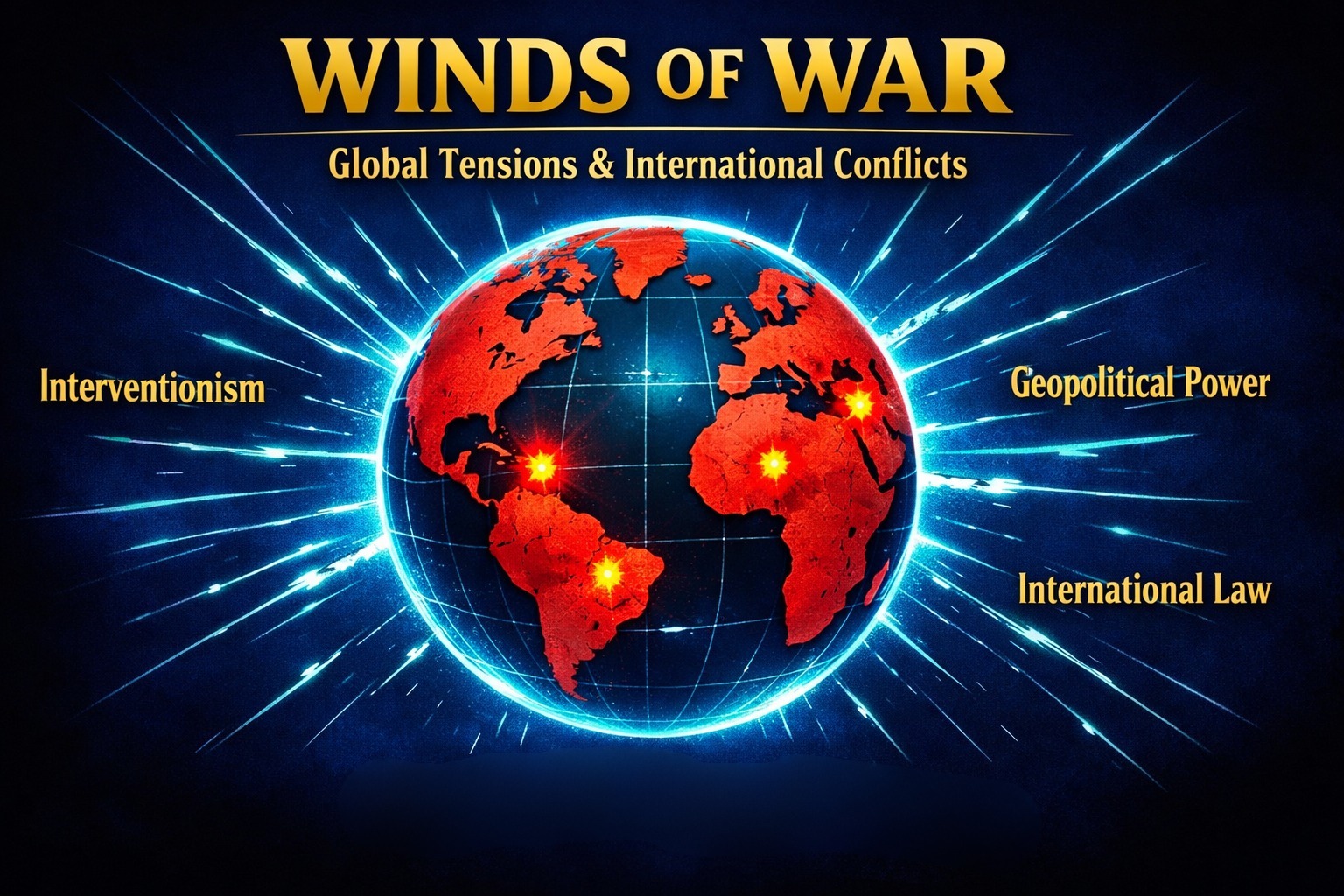
  • Winds of War

    Winds of War

    Winds of War

    By Dr. Stephen Eric Bronner 

    In Charlie Chaplin’s masterpiece “The Great Dictator” (1940), there is a scene in which his character “Adenoid Hynkel,” ruler of the anti-Semitic and fascistic nation named “Tomania,”  dreamily juggles a huge balloon painted as a globe – until it bursts. Should our balloon burst, and the possibility is becoming ever greater, the consequences will dwarf anything that Charlie might have imagined.

    Since the start of Donald Trump’s second term in 2024,  his cult of the personality picked up steam. The Kennedy Memorial Center for the Performing Arts has been renamed the Kennedy-Trump Center. The president’s name also graces the new $300 million ballroom at the White House and various other Washington buildings. In this vein, he has also called for the construction of a new “Arc de Trump,” and —significantly – plastered his moniker on a new class of Navy battleships.

    On the campaign trail, Trump had promised there would be no new wars and that the United States would no longer serve as the “world’s policeman.”  But we should have seen what was coming. Glimpses of the future were already apparent  when the president changed the “Gulf of Mexico” into the “Gulf of America,” demanded that Denmark surrender Greenland to the United States, and called upon Canada to become our 51st state. Nor was that all. Trump renamed the Department of Defense the Department of War and, despite the cost cutting frenzy led by Elon Musk’s DOGE, he successfully pressured Congress into passing the first $1 trillion military budget in American history.

    Trump’s crass public campaign for the Nobel Prize failed. An Israeli Peace Prize and another from soccer’s FIFA governing body, both hastily created for Trump, proved merely embarrassing substitutes. His attempts to coerce peace in the Russia-Ukraine War had been unsuccessful. The Gaza cease-fire was appearing increasingly fragile, and it was clear that the president had stoked international tensions with his strangely miscalculated tariff policy.

    Trump claims that he has ended more than eight wars all over the globe. But the statement is thin on evidence whereas it is abundantly clear that the United States was involved in 622 air and drone strike across seven countries in 2025: Afghanistan,, Iran, Iraq, Nigeria, Somalia, Syria, Venezuela, and Yemen. The president has never been a staunch advocate of international law or human rights. To the contrary: Trump stated quite openly that he recognized no constraint on his international decision-making authority other than his own “morality” should have surprised no one.

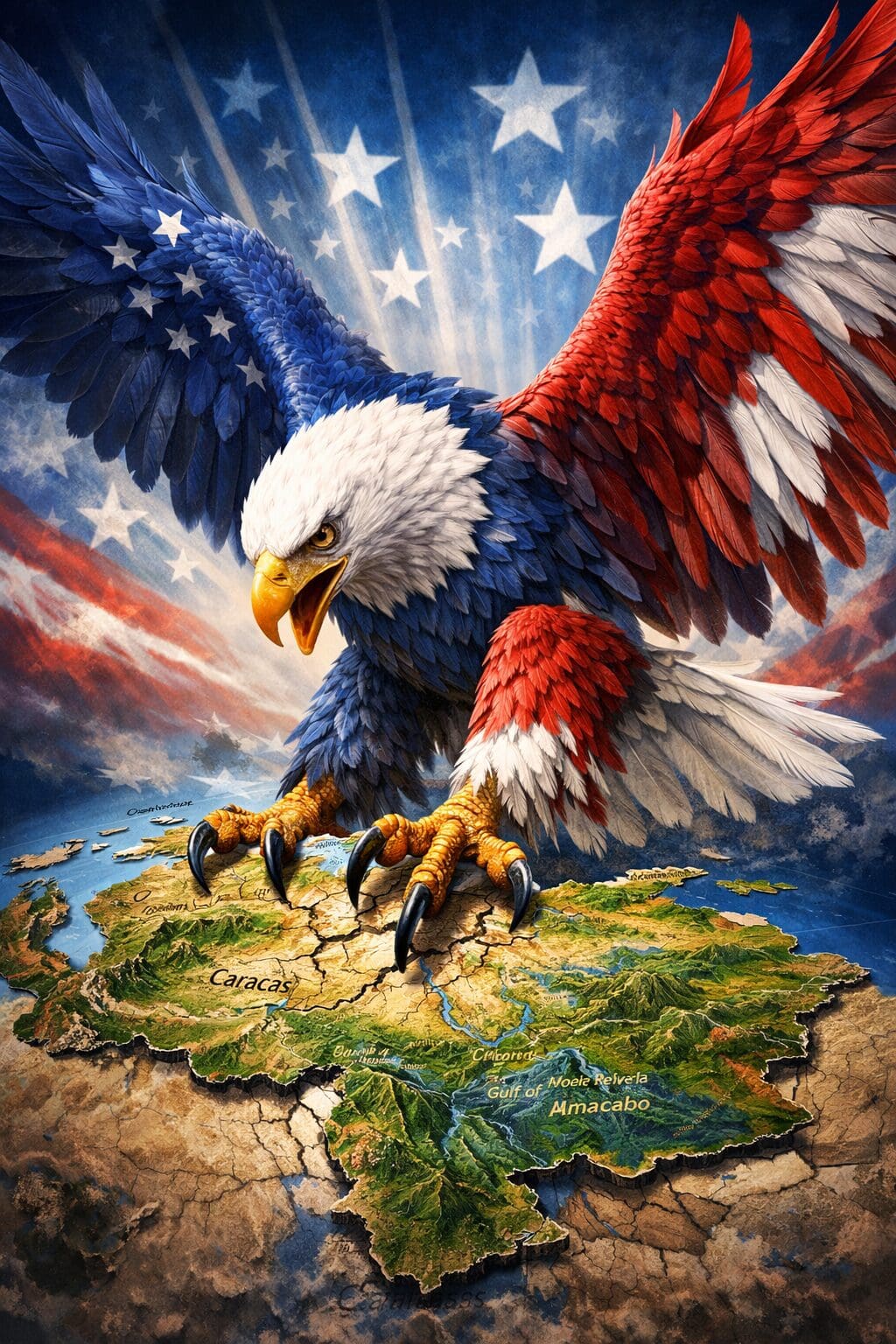
    As 2026 begins, the president has taken over Venezuela, kidnapped its noxious president, Nicolas Maduro and his wife and charged them with “narco-terrorism.”  To achieve these ends, the United States launched 22 strikes that killed 110 people, murdered sailors seeking to surrender, and shelled vessels without first determining whether they were actually carrying drugs. Nor did Congress approve Trump’s act of war; it was not even briefed. The enterprise was instead prepared by Trump and a few close advisors in consultation with oil company executives; indeed, this was a war waiting for an excuse to wage it.

    Why did Trump do it? The president needed something dramatic in the face of slipping poll numbers, mumblings of discontent among a few supporters, the mess surrounding the Epstein files, the anger resulting from an economic “affordability” crisis,  changes in healthcare that put millions at risk, and the growing repulsion against the storm-trooper tactics of ICE against immigrants.  In 2024, moreover, Trump had demanded that oil companies and the energy sector donate $1 billion to his camapign. They gave him $75 million. Coporations always expect something for their money and perhaps providing them with a profitable suruprise would make them more generous the next time around.

    Given Trump’s desire to recreate a past golden age, it made sense for him to justify his Venezuelan policy by invoking the Monroe Doctrine of 1823. This seminal document of American diplomatic history warned foreign powers against interfering in the Western hemisphere, and contributed to the belief that Central and South America constituted the United States’ sphere of influence. However, Trump gave it a radical twist by declaring that the United States would “run” Venezuela until an “acceptable” sovereign is installed and for now, under his stewardship, the United States would “indefinitely” control sales of its oil and minerals on the open market.

    This he calls the “Donroe” Doctrine. Justififications are of secondary importance. Insisting that the Maduro regime was an agent of “narco-terrorism,”  which dominated fentanyl smuggling operations, it turnd out that  Venezuela was responsible for only about 5% of the fentanyl entering the United States. Trump then changed the narrative by claiming that Maduro was the master-mind behind the cocaine plague and when that accusation fell flat, he shifted it again by condemning him as a war criminal for possessing weapons of mass destruction.

    Americans cheer interventions when they begin, but quickly grow weary when the price comes due. And invading Venezuela might prove to be a high price to pay. There are strking similarities with the plans laid bare in Venezuela and the American invasion of Iraq in 2003. In both cases, there was the lure of oil, a murderous dictator to overthrow, an exaggerated “existential” threat, an arrogant conviction the citizenry of another country would welcome American “liberators” with open arms,, and disregard for the chaos that reckless regime-change would generate.

    Maduro’s regime was authoritarian, brutal, corrupt and incompetent. But Trump’s actions normalize contempt for international law, rights of national self-determination, and sovereignty. Indeed, calling his overthrow an international police action agaist narco-terrorism doesn’t change that reality. Arbitrarily snatching world leaders creates widespread fear and distruction and contributes to creating a politics based on the “war of each against all’ that Thomas Hobbes feared above all else, if only because it heightens instability

    As became clear in Afghanistan, Iraq, and Libya, to leave a nation without a sovereign is to condemn it to violent rivalry between paramilitary groups. Vice-President Delcy Rodriquez was installed by the Venezuelan Supreme Court as “interim” president for up to 90 days though that can be extended by legal means, and an election awaits the future. And she is in an impossible situation. Ms. Rodriquez must navigate between independence and submission. She must either stand on her own and risk regime change or serve as a shadow sovereign lacking legitimacy and power.

    Trump is satisfied with what has transpired, and he feels emboldened. He is already saber-rattling while making similar charges of drug-running against Columbia, Mexico, and Cuba. Trump has also grown more bellicose in insisting that Denmark prioritize American “national security” interests, and either sell or prepare to lose its autonomous territory of Greenland. Whether discord among members of NATO will strengthen its enemies is far less important than Trump’s ability to exercise power in an unimpeded manner

    Besides, these policies can change in the blink of an eye should Trump find that alternative approaches better serve his purposes. He has stated openly that his vaunted unpredictability is a tactic to keep his enemies off guard. He neglected to mention, of course, that his erratic behavior gets in the way of planning, heightens distrust, and serves as an incentive for other nations to spend more on defense. He wishes only to be able to do what he wants, when he wants, and wherever he wants. This spirit is infusing his foreign policy and contributing to a spreading existential fear of military conflict.

    Nation-wide protests have rocked Iran in response to the Islamic Republic’s repression of all democratic tendencies, its incompetence in dealing with questions of infrasstructure and water, the corruption of the mullahs, and the complete collapse of the currency. These are brave people risking their lives in the streets, but Trump feels it his duty to take center stage. He has warned that he will intervene should the government wind up killing protestors. It sounds heroic, but such warnings only put protestors at greater risk because the leadership can now claim that they are traitors and agents of “The Great Satan” –and that is precisely what the Supreme Leader has done.

    Trump was not thinking about the negative consequences his words might have for those Iranians fighting for freedom. But that is the point: he never thinks about others, only about himself. More likely Trump is thinking about sabotaging further negotiations on a nuclear deal, undermining a regional rival, and making himself appear once again, as with the Maduro affair, as the champion of democracy and peace. Even if the rest of the world disagrees, indeed, that is how he can view himself—and that is what counts.

    *Stephen Eric Bronner is Board of Governors Distinguished Professor Emeritus of Political Science at Rutgers University and Executive Director of the “Independent Experts’ Peace Initiatives.”

    Source : https://www.rsn.org/001/winds-of-war-.html

    Dr. Stephen Eric Bronner is Director of the International Council for Diplomacy and Dialogue,  Executive Director of the Independent Experts Peace Initiatives, and Board of Governors Distinguished Professor Emeritus of Political Science at Rutgers University.
  • From a peace-making president to dictatorial ruler of USA

    From a peace-making president to dictatorial ruler of USA

    From a peace-making president to dictatorial ruler of USA

    By :

    Bashy Quraishy :Secretary General – EMISCO -European Muslim Initiative for Social Cohesion – Strasbourg

    Thierry Valle :Coordination des Associations et des Particuliers pour la Liberté de Conscience 

    Trump’s intervention in Venezuela and his provocative statements of invasions of Greenland, Iran Cuba and Colombia deserve to be highlighted and condemned strongly by European leaders and decision makers

    On 3 January 2026, the United States military carried out strikes on Venezuela, including in Caracas, against military and other infrastructure. During the operation, U.S. forces captured Venezuelan President Nicolás Maduro and his wife Cilia Flores. The couple was flown to the United States and taken into federal custody; Maduro was arraigned and pleaded not guilty to U.S. criminal charges. U.S. President Trump publicly stated that the U.S. would “run Venezuela” temporarily and oversee a transition, including tapping its oil infrastructure.

    The Trump administration has offered multiple reasons for the action, For example, he has labeled Maduro and his network as a narco-terrorist organization responsible for drugs entering the United States. Trump also framed Maduro’s rule as authoritarian and claimed intervention was in the interest of Venezuelan people. Trump suggested Venezuela’s instability was contributing to illegal immigration to the U.S. border.

    But it is widely believed that the whole scheme was to have control over oil resources.  Though officials downplay this, analysts and critics point that an underlying factor is that Venezuela has world’s largest oil reserves.

    Was this a compulsive action or planned for a while?

    Starting in late 2025, the U.S. dramatically increased military and covert operations, including warships and marine units near Venezuelan waters. USA conducted airstrikes on boats alleged to be drug traffickers, killing dozens. Prior to the invasion USA navy seized Venezuelan oil tankers and put in place the blockade of the Venezuelan oil exports.

    Add to that the fact that Trump authorized CIA covert operations inside Venezuela months before the invasion. These moves indicate a rising pressure campaign leading up to the January action.

    All these signs tell us that it was a planned invasion. The sequence of events suggests long-term preparation, not a sudden, reactive decision.

    But Why Now?

    Few concrete public explanations exist for why the invasion happened at precisely this moment, but the biggest factor appears to be Venezuela’s oil and minerals, and its orientation toward Russia/China, may have been catalysts for timing.

    Historically, U.S. interventions in Latin America have invoked, The Monroe Doctrin, counter-communism / pro-democracy rhetoric and counter-narcotics enforcement, limited mostly to law enforcement cooperation. But direct invasion and capture of a sovereign leader goes far beyond recent U.S. interventions. Experts say this is unprecedented since Panama in 1989, when the U.S. removed Manuel Noriega, another leader accused of drug crimes.

    This raises the main question; Is it legal under U.S./International doctrine?

    Most analysts and international law experts view the invasion as illegal. Under the UN Charter, military force is only lawful with Security Council approval or in response to an imminent military attack — neither condition clearly applies in Venezuela’s case. Even the U.S. use of force against alleged drug traffickers prior to the invasion lacks established legal justification under international law.

    This means the action breaks from both international norms and recent U.S. practice, not fitting neatly into accepted doctrines like humanitarian intervention, self-defense, or multilateral peacekeeping. Some observers say that Trump’s actions reflect a new, more assertive ideology of “America First” intervention. Trump reportedly referenced a modified Monroe Doctrine asserting U.S. geopolitical control in the hemisphere. The framing mixes security, resource access, and hegemony in ways older doctrines did not openly articulate.

    The immediate and future consequences of the invasion

    Inside Venezuela, Maduro’s removal has left a power vacuum. Vice President Delcy Rodríguez was sworn in as acting president, though the legal and constitutional situation is highly contested. Strikes caused casualties, including military personnel and civilians, which human rights groups have criticized. Venezuelan military and state infrastructure were damaged or disabled. Violence and uncertainty will likely drive additional migration and displacemen and Venezuelan oil production and state services likely disrupted, deepening already severe humanitarian issues.

    In U.S some political actors praised decisive action; others warned it risks broader conflict. Retaliation or escalation from aligned states and non-state actors is a heightened possibility.UN Secretary-General António Guterres warned the operation sets a dangerous precedent and called for diplomacy. Russia and China strongly condemned the move as a violation of sovereignty. Russia’s UN ambassador accused the U.S. of acting as “a supreme judge” above international norms. China’s envoy argued the U.S. “trampled upon Venezuela’s sovereignty and Beijing may increase diplomatic support for Caracas or use this to criticize U.S. unilateralism.

    Some EU member states condemned the use of force and stressed respect for international law; others focused on concerns about Venezuela’s governance while still not endorsing military action. Figures like Brazil’s president denounced the strikes as violating international law and several African and Asian governments and movements condemned the invasion and kidnapping of a sovereign leader.

    Under international law, the U.S. operation raises serious questions. Article 2(4) of the UN Charter prohibits military force against another state’s sovereignty except in limited exceptions (self-defence or Security Council authorization). There is no UN Security Council authorization for the strikes or capture. Forcible removal of a head of state and unilateral interference in another government’s political process are generally prohibited without Security Council mandate. Chatham House and other legal experts describe the operation as a significant violation of Venezuelan sovereignty and international legal norms.

    U.S. officials have argued this was a law enforcement mission and referenced self-defense claims regarding narcotics threats, but such reasoning is not recognized under international law as a lawful basis for military intervention.

    The reaction of American public, politicians, and Trump’s further threats to other nations

    According to an Associated Press analysis of recent polling, most Americans wanted the U.S. government to focus in 2026 on domestic issues, such as health care and high costs, rather than foreign policy issues. Meanwhile, polling conducted in the immediate aftermath of the military operation that captured Venezuelan President Nicolás Maduro suggested that many Americans are unconvinced that the U.S. should step in to take control of the country.

    Since taking over presidency,Trump boasted to be a peace-making president and claimed to have stopped many international conflicts, like India-Pakistan clash of 2025. It could be a tricky position for a president who ran on a promise of putting “America first” and ending the country’s involvement in “forever wars.” About 7 in 10 voters who backed Trump in the 2024 presidential election said that they wanted the U.S. to take a “less active” role in solving the world’s problem.

    Trump’s public statements about taking over Greenland and Mexico, invading  Colombia, Cuba and Iran have sent shock waves throughout the world.

    Europeans, especially Denmark, where, one of us lives are very angry on Trump’s threats to take over Greenland. He has said that repeatedly that Greenland is strategically important to USA. He is not wrong that Greenland is strategically important, but his method and language are the problem, not the underlying fact. USA already enjoys extensive military access under agreements with Denmark and faces no military exclusion from Greenland today. So the strategic need already exists and is already met.

    Then why the threats?

    Trump does not think in terms of alliances, shared sovereignty and mutual trust.

    He thinks in terms of ownership, control, leverage and transactions. In his worldview: “If something is important, you should own it,  not share it.” This is 19th-century thinking. But an attempt to seize Greenland would be an act of war against Denmark, trigger a NATO existential crisis, testroy USA – European relations, collapse the Western alliance structure and isolate the U.S. globally.

    It seems that Trump’s threats are meant to pressure Denmark into concessions, signal dominance to domestic audiences, normalize the idea that sovereignty is negotiable and test how far Europe will push back verbally and politically. Trump is a master in coercive intimidation.

    But Denmark’s reaction is completely understandable and justified. Trump’s repeated statements about Greenland are not just abstract rhetoric, they touch sovereignty, dignity, and security of a partner country. We believe that Denmark is doing right by firmly rejecting any transfer of sovereignty, emphasizing Greenlandic self-determination, strengthening Arctic defence cooperation, increasing presence and investment in Greenland and keeping the issue international, not bilateral.

    What Europe should do collectively?

    It should make sovereignty non-negotiable and state clearly and repeatedly that allied territory is not subject to coercion, purchase, or threat. Europe should tell USA this, without ambiguity, jokes or misunderstandings. Europe should also engage American institutions, not Trump personally, anchor its responses in NATO, EU, and international institutions and avoid escalation via insults. Trump thrives on that.

    What Europe realistically can do?

    Since Europe cannot stand up to the USA militarily, and say enough is enough, it can do that structurally and economically. For that Europe must reduce defence dependency, build independent command capacity, and coordinate intelligence outside U.S. control. On top of that the EU still has real power when it comes to trade regulation, sanctions frameworks, market access and tech and finance rules. It means that Europe can impose conditionality, use lawfare, not force and coordinate with non-aligned BRICS states.

    Europe also needs alliance diversification by improving its ties with China, Russia, Africa, ASEAN and Latin America. This will reduce vulnerability to U.S. unilateralism.

    In short, Europe’s strength is not tanks but in its market size, norm-setting, regulatory power, and coalition-building. All the decision makers in Europe need is to stand on its two feet and let USA know, what its people are thinking and demanding. 

    The danger is not confrontation. The danger is passive alignment with actions Europe privately rejects.